The Inner Product Space
A Hilbert space H is a vector space equipped with an inner product ⟨·,·⟩ that defines geometry, together with a completeness condition (every Cauchy sequence converges in H).
For quantum mechanics, H can be finite-dimensional (qubits, spin systems) or infinite-dimensional (position, momentum). The inner product of two states |ψ⟩ and |φ⟩ is ⟨ψ|φ⟩, a complex number.
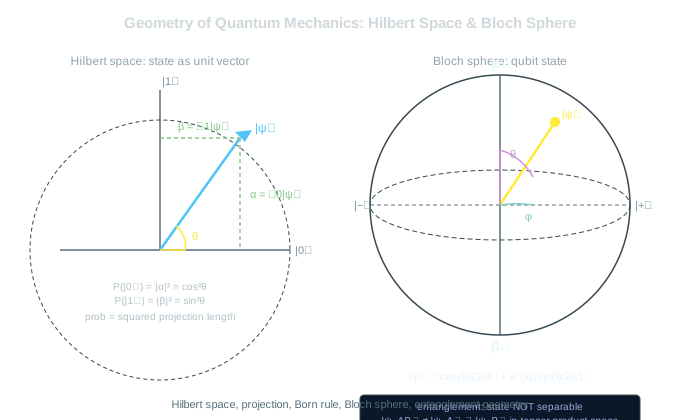
Normalization: a quantum state |ψ⟩ is a unit vector: ⟨ψ|ψ⟩ = 1. The state space is therefore the unit sphere in H.
Orthogonality: two states |ψ⟩ and |φ⟩ are orthogonal when ⟨ψ|φ⟩ = 0. Orthogonal states are maximally distinguishable: a measurement designed to detect |ψ⟩ has zero probability of finding the system in |φ⟩.
Basis: any complete orthonormal set {|eᵢ⟩} with ⟨eᵢ|eⱼ⟩ = δᵢⱼ spans H. The computational basis {|0⟩, |1⟩} for a qubit consists of two orthogonal unit vectors.
Measurement as Projection
An observable creates a set of eigenstates {|aᵢ⟩} that form an orthonormal basis. The state |ψ⟩ expands as:
|ψ⟩ = Σᵢ cᵢ|aᵢ⟩, cᵢ = ⟨aᵢ|ψ⟩
The coefficient cᵢ = ⟨aᵢ|ψ⟩ is the projection of |ψ⟩ onto the eigenstate |aᵢ⟩ — it measures how much of |ψ⟩ points in the |aᵢ⟩ direction.
The Born rule: P(aᵢ) = |cᵢ|² = |⟨aᵢ|ψ⟩|² = (projection length)².
Geometrically: probability equals the square of the projection length of the state vector onto the eigenspace. The longer the projection, the more probable that outcome.
This is exactly the classical rule for decomposing a vector into components — except that in QM, only one component 'survives' each measurement, and the probability of which one survives equals its squared length.
Parameterizing Qubit States
A qubit state |ψ⟩ = α|0⟩ + β|1⟩ with |α|² + |β|² = 1 has infinitely many choices — but many are physically equivalent. An overall global phase e^(iφ)|ψ⟩ is physically indistinguishable from |ψ⟩ (probabilities are unchanged because |e^(iφ)α|² = |α|²).
After removing the global phase, a qubit state depends on exactly two real parameters:
|ψ(θ,φ)⟩ = cos(θ/2)|0⟩ + e^(iφ) sin(θ/2)|1⟩
where θ ∈ [0°, 180°] is the polar angle and φ ∈ [0°, 360°) is the azimuthal angle. These are exactly the spherical coordinates of a point on a unit sphere in ℝ³ — the Bloch sphere.
Poles:
- θ = 0: |ψ⟩ = |0⟩ (north pole)
- θ = 180°: |ψ⟩ = |1⟩ (south pole)
- θ = 90°: |ψ⟩ = (1/√2)|0⟩ + e^(iφ)|1⟩ (equatorial states, including |+⟩ = (|0⟩+|1⟩)/√2)
Orthogonal states sit at antipodal points on the Bloch sphere. |0⟩ and |1⟩ are at opposite poles; |+⟩ and |−⟩ are at antipodal equatorial points.
Reading the Bloch Sphere
A qubit gate is a unitary transformation U that maps the Bloch sphere to itself — a rotation. The Pauli X gate (analogous to a classical NOT) maps |0⟩ → |1⟩ and |1⟩ → |0⟩. On the Bloch sphere, X performs a 180° rotation around the x-axis: north pole maps to south pole.
Two-Qubit Hilbert Space
The Hilbert space of two qubits A and B is the tensor product H_A ⊗ H_B. Basis states: |00⟩, |01⟩, |10⟩, |11⟩ (four-dimensional space).
A product state (or separable state) has the form:
|ψ_AB⟩ = |ψ_A⟩ ⊗ |ψ_B⟩
For example: |ψ_A⟩ = α|0⟩ + β|1⟩ and |ψ_B⟩ = γ|0⟩ + δ|1⟩. The joint state:
|ψ_AB⟩ = αγ|00⟩ + αδ|01⟩ + βγ|10⟩ + βδ|11⟩
Note that the four amplitudes (αγ, αδ, βγ, βδ) satisfy a constraint: the matrix [[αγ, αδ], [βγ, βδ]] has rank 1 — it factors as an outer product.
An entangled state is any state that CANNOT be written as a product state. The most famous: the Bell state
|Φ⁺⟩ = (1/√2)(|00⟩ + |11⟩)
The amplitude matrix [[1/√2, 0], [0, 1/√2]] has rank 2 — it cannot factor as an outer product. No individual qubit state describes the system.
Testing Separability
The Schmidt decomposition provides a geometric criterion for entanglement: a two-part state is separable if and only if its Schmidt rank is 1. The Schmidt rank equals the number of non-zero singular values of the amplitude coefficient matrix.
For a two-qubit state |ψ⟩ = Σᵢⱼ cᵢⱼ|ij⟩, form the 2×2 coefficient matrix C = [[c₀₀, c₀₁], [c₁₀, c₁₁]]. Compute the singular values (square roots of eigenvalues of C†C). Separable ↔ exactly one non-zero singular value.