The Interface as a Geometric Transform
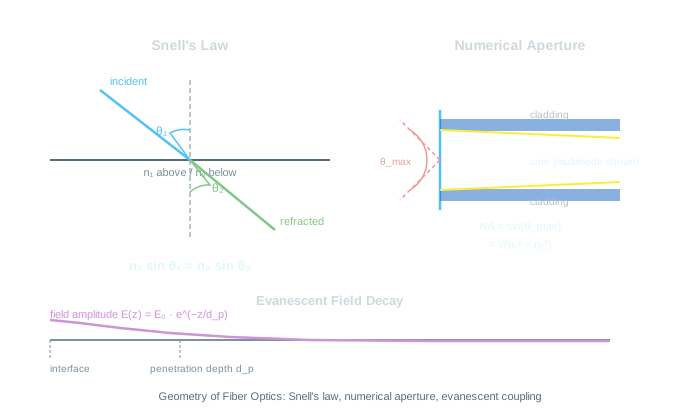
Snell's law n₁ sin θ₁ = n₂ sin θ₂ describes how a ray changes direction at a boundary. Geometrically, it maps an incident angle θ₁ to a transmitted angle θ₂ via a monotone function.
Define f: [0°, 90°] → [0°, 90°] by f(θ₁) = arcsin((n₁/n₂) sin θ₁). When n₁ > n₂ (light going from dense to sparse medium), f amplifies angles: small input angles become larger output angles.
The critical angle emerges as the input value where f(θ_c) = 90°:
sin θ_c = n₂/n₁
For input angles beyond θ_c, the function has no real output: the transmitted ray disappears. The entire incident intensity reflects. This is total internal reflection.
Numerical Aperture: the Acceptance Cone
Light enters a fiber from air (n₀ = 1.0). Not every ray that enters the fiber face will undergo total internal reflection at the core-cladding boundary. Only rays within a certain cone of angles at the fiber entrance will be guided.
The numerical aperture (NA) measures the half-angle of this acceptance cone:
NA = n₀ sin(θ_max) = √(n₁² − n₂²)
where n₁ is the core index and n₂ is the cladding index. This follows from applying Snell's law at the entrance face and then requiring that the refracted ray hits the core-cladding boundary at exactly the critical angle.
A larger NA means a wider acceptance cone: easier to couple light in, but more modes allowed, increasing dispersion.
The Exponential Decay Outside the Core
Total internal reflection does not mean the electromagnetic field vanishes instantly at the core-cladding boundary. The field penetrates into the cladding as an evanescent wave that decays exponentially with distance z from the interface:
E(z) = E₀ · e^(−z/d_p)
where the penetration depth d_p depends on wavelength λ, the angle of incidence θ, and the refractive indices:
d_p = λ / (4π √(n₁² sin²θ − n₂²))
As θ approaches θ_c from above, the denominator approaches zero and d_p → ∞: the evanescent field extends further as the angle barely exceeds the critical angle. Deep into total internal reflection (θ >> θ_c), d_p shrinks to roughly λ/4.
Practical consequence: two fibers placed close enough together can exchange light through their evanescent fields — a directional coupler. This enables power splitting, wavelength multiplexing, & optical switching without mechanical connections.
Evanescent Coupling
An evanescent coupler places two fiber cores parallel within a few wavelengths of each other. Light tunnels from one core to the other through the overlapping evanescent fields.
The V-Number and Mode Count
How many modes does a fiber support? A single dimensionless number, the V-number (or normalized frequency), determines this:
V = (π · d · NA) / λ
where d is the core diameter, NA is the numerical aperture, and λ is the wavelength.
A fiber supports only one mode (single-mode) when V < 2.405 (the first zero of the Bessel function J₀). Multiple modes appear when V > 2.405. The mode count scales roughly as V²/2 for large V.
To guarantee single-mode operation at λ = 1550 nm with NA = 0.12:
V < 2.405 → d < (2.405 · λ) / (π · NA) = (2.405 × 1550 nm) / (π × 0.12) ≈ 9.9 µm
This is why telecom single-mode fiber uses a core diameter of ≈8–10 µm: a geometric constraint set by the requirement V < 2.405.