A Tube of Air, Vibrating
The Pitch Lives in the Length
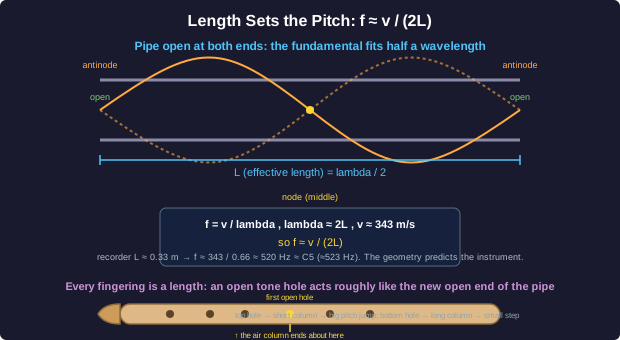
A recorder is a tube of air. Blow across the fipple's edge and you set the whole air column vibrating at the frequency that fits the tube. For a pipe open at both ends (the recorder, the flute behave this way), the lowest mode is a standing wave with an antinode at each end and a node in the middle: that takes half a wavelength to span the tube, so the wavelength of the fundamental is about twice the tube's effective length: lambda is approximately 2L.
Pitch follows from the wave equation: f = v / lambda, where v is the speed of sound in air, about 343 m/s at room temperature. So f is approximately v / (2L): a longer tube means a longer wavelength means a lower pitch. Halve the length and you double the frequency: that is exactly an octave, which is why an alto recorder, built longer, sits a fourth or so below the soprano.
A sanity check. A soprano recorder's sounding tube is roughly 0.32 to 0.33 m. Then f is approximately 343 / (2 x 0.33) which is approximately 520 Hz, and C5 (the recorder's nominal lowest note, written C) sits at about 523 Hz. The geometry predicts the instrument.
End correction. The air does not stop exactly at the physical opening: it bulges out a little, so the effective length is slightly longer than the tube you can measure (by roughly 0.6 times the bore radius at each open end). Instrument makers account for this; for our purposes, 'effective length' is the length that matters, and it is a hair more than the ruler says.
Covering and uncovering holes is changing the length. Cover every hole and the air column runs the full length of the tube: lowest note. Lift a finger off a hole near the bottom and the air column effectively ends near that hole: shorter tube, higher note. Lift a finger off a hole near the top and the column ends way up there: much shorter, much higher. Every fingering is a length.
Predicting the Length
Take the speed of sound as 343 m/s and ignore end correction for an estimate.
Where the Holes Go, and Why They Bunch Up Top
The First Open Hole Is the New End
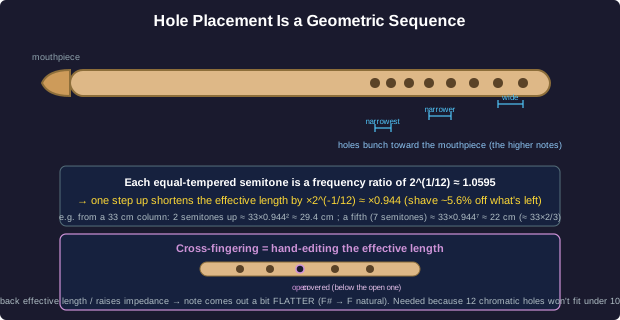
From Section 1: a recorder's sounding pitch is set by the distance from the mouthpiece to the first open hole (going down from the top). So the whole problem of where to drill the holes is the problem of placing a sequence of 'new ends' so that uncovering them one at a time walks the pitch up a scale.
The spacing is a geometric sequence, not an even one. In a roughly equal-tempered scale, each semitone is a frequency ratio of 2^(1/12), which is about 1.0595. Since f is approximately v / (2L), raising the pitch by one ratio step means shortening the effective length by the inverse ratio: L_new is approximately L_old x 2^(-1/12), which is about 0.944 x L_old. Each step up shaves off about 5.6 percent of what is left. So the holes get closer and closer together as you move toward the mouthpiece: the top holes bunch up. That bunching is not sloppy drilling; it is the geometry of a multiplicative scale forcing a multiplicative spacing.
Real holes are not the whole bore. A finger hole is smaller than the tube's diameter, so it is not a perfect 'new end': some of the air still feels the tube below it. The effect is that an open hole acts as if the pipe ended a little past the hole, by an amount that depends on the hole's size and the wall thickness (there is a 'cutoff frequency' for the open-hole lattice in the keyed instruments). Makers compensate by enlarging holes, undercutting their edges, and fine-tuning the bore profile: the published hole positions are the geometry after these corrections.
Cross-fingering is deliberate length-fudging. The basic fingerings give you a diatonic scale: seven notes. To get the chromatic notes (F sharp versus F natural, B flat, and so on) you cross-finger: you uncover one hole but cover a hole below it. That covered downstream hole adds back some effective length and raises the impedance, so the note comes out a little flatter than the bare fingering would give: just enough to drop F sharp to F natural, or wherever you need. Cross-fingering is the player reaching in and editing the effective length by hand, because twelve evenly spaced holes will not fit under ten fingers.
Placing the Holes
Suppose a simple recorder has an effective air-column length of 33 cm with all holes covered (its lowest note). Use 2^(1/12) is approximately 1.0595, so going up one semitone multiplies the effective length by about 0.944.
Open Tube, Closed Cylinder, Closed Cone
The Second Register Is the Harmonic Series, and the Bore Picks Which Harmonics Exist
Blow a recorder a little harder, or (better) pinch the back thumb hole open a sliver, and the air column jumps to a higher mode: a higher member of the harmonic series of the tube. Which higher modes are available, and therefore how the upper register relates to the lower, is decided entirely by the shape of the bore: whether the tube is open or closed at the reed end, and whether it is cylindrical or conical.
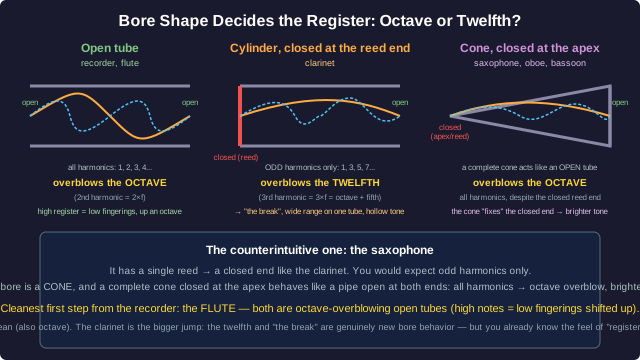
Open at both ends (recorder, flute). A tube open at both ends supports all harmonics: 1, 2, 3, 4, and so on. The second harmonic is twice the fundamental frequency, which is the octave. So a recorder or flute overblows to the octave: the upper register repeats the lower register's fingerings, shifted up an octave. That is why the recorder's high notes are mostly the low-note fingerings with the thumb vent open. Simple, regular.
Cylindrical, closed at the reed end (clarinet). A clarinet's mouthpiece end is effectively a closed end (the reed seals it), and its bore is a cylinder. A cylinder closed at one end and open at the other supports only the odd harmonics: 1, 3, 5, 7. The lowest available jump is to the third harmonic, three times the fundamental frequency, which is an octave plus a fifth: a twelfth. So a clarinet overblows a twelfth, not an octave. Consequences: the clarinet's upper register fingerings differ a lot from its lower register (the famous 'break' you have to cross), it has an unusually wide range for a single tube (it has to fill in the missing octave-to-twelfth gap with the basic fingerings), and its tone is the distinctive 'hollow' clarinet sound because the even harmonics are weak: odd harmonics only.
Conical, closed at the apex (oboe, bassoon, saxophone). Here is the counterintuitive part. A saxophone has a single reed, so its mouthpiece end is 'closed' like a clarinet's: you would expect odd harmonics only. But the saxophone's bore is a cone, not a cylinder, and a complete cone closed at the apex behaves, for its standing waves, like a pipe open at both ends: it supports all harmonics. So a saxophone (and an oboe, and a bassoon) overblows to the octave, like a flute, despite the closed reed end: the conical bore 'fixes' the closed end. That is also why the cone-bored woodwinds have a brighter, fuller tone than the clarinet: the even harmonics are present. Bore shape, a piece of pure geometry, decides the register relationship and a big part of the timbre.
Why this matters for the on-ramp. A recorder player moving to the flute finds the cleanest match, because both are open tubes that overblow the octave: the upper register fingerings echo the lower, just like on the recorder. Moving to the saxophone, also octave-overblowing, is nearly as clean. Moving to the clarinet means meeting the twelfth and the break for the first time: still very learnable, because the player already knows what 'a register change means a new set of fingerings' feels like, but the bore geometry is genuinely different there, and now you know why.
Octave or Twelfth?
A clarinet, a flute, and a saxophone walk into a band room.
Ratios, Beats, the Comma, and the Twelfth Root of Two
Intervals Are Ratios
Two notes sound consonant when their frequencies are in a simple ratio, because then their overtone series overlap heavily and there are few 'beats' (the slow throbbing you hear when two close frequencies interfere). The classic ratios: the octave is 2:1, the perfect fifth is 3:2, the perfect fourth is 4:3, the major third is 5:4. The simpler the ratio, the more the harmonics line up, the smoother the sound. Beat frequency = the absolute difference of the two frequencies: two strings at 440 Hz and 442 Hz beat twice a second, and a tuner kills the beat by closing that gap. Tuning by ear is minimizing beats.
The Pythagorean Comma: Pure Fifths Do Not Close the Circle
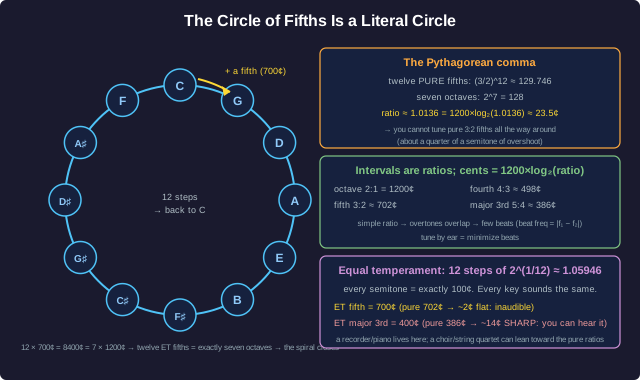
Stack twelve perfect fifths and you should, in principle, land back on the note you started, twelve fifths and seven octaves later. But (3/2)^12 is approximately 129.746, while 2^7 = 128. They do not match: twelve pure fifths overshoot seven octaves by a ratio of about 1.0136, which is roughly 23.5 cents (about a quarter of a semitone). This gap is the Pythagorean comma. It means you cannot tune an instrument in pure 3:2 fifths all the way around the keyboard: somewhere a fifth has to be sour, or you have to compromise everywhere.
Equal Temperament: Twelve Geometrically Equal Steps
The modern compromise: divide the octave into twelve geometrically equal steps, each a frequency ratio of 2^(1/12) is approximately 1.05946. Now every semitone is the same ratio, every key sounds the same, and you can modulate anywhere. The price: every fifth is 700 cents instead of the pure 702 cents (a fifth flat, barely audible), and every major third is 400 cents instead of the pure 386 cents: that is 14 cents sharp, which a good ear can hear, and which is why equal-tempered thirds have a faint restless shimmer. Cents measure intervals logarithmically: cents = 1200 x log2(f2/f1), so an octave is 1200 cents and each equal-tempered semitone is exactly 100 cents.
Why the Circle of Fifths Is a Circle
In equal temperament, a fifth is exactly 700 cents, and 12 x 700 = 8400 = 7 x 1200: twelve equal-tempered fifths equal exactly seven octaves. So if you go up by fifths, C, G, D, A, E, B, F sharp, C sharp, G sharp, D sharp, A sharp, F, and back to C, you return exactly to where you started after twelve steps. The Pythagorean comma has been absorbed: the spiral of pure fifths has been bent into a closed loop. That is why the diagram is drawn as a circle with twelve points, one per fifth, wrapping around. (You can also picture pitch as a helix: the twelve pitch classes on a circle, octave height on a vertical axis, so the same letter name stacks straight up.)
What a Recorder Lives With
A recorder is essentially fixed: you can pull the head joint to tune the whole instrument, and cross-fingerings and gentle air-speed changes shade individual notes a little, but you cannot retune a chord mid-phrase the way a string quartet or an a cappella choir can. So a recorder, like a piano, lives inside equal temperament's compromises: its thirds are a bit sharp, its fifths a hair flat, and that is fine because it is consistent. A consort of recorders can nudge toward pure intervals by careful fingering choices and listening, but the instrument is built around the twelfth root of two: it trades a little purity in every key for the freedom to play in every key.
Closing the Circle
Use 1200 cents per octave and cents = 1200 x log2(ratio).
Woodwind Geometry: Summary
What You Have Learned
Almost everything about a wind instrument is geometry:
- Length sets the pitch. For a pipe open at both ends, f is approximately v / (2L). A 33 cm air column sounds about C5; halve the length and you double the frequency, an octave. Every fingering is a length, and a tone hole acts roughly as the new open end, so the sounding pitch is the distance from the mouthpiece to the first open hole, which is why a top hole changes pitch far more than a bottom hole.
- Hole placement is a geometric sequence. Each equal-tempered semitone is a frequency ratio of 2^(1/12), so each step shaves a fixed fraction (about 5.6 percent) off the effective length: the holes bunch toward the top. Real holes are not full-bore, so makers correct with hole size and undercutting, and players reach the chromatic notes with cross-fingerings, hand-editing the effective length because twelve holes will not fit under ten fingers.
- Bore shape decides the register. An open tube (recorder, flute) supports all harmonics and overblows the octave. A cylinder closed at the reed end (clarinet) supports only odd harmonics and overblows a twelfth, which gives it the 'break', a wide range on one tube, and a hollow tone. A cone closed at the apex (saxophone, oboe, bassoon) acts like an open tube, supports all harmonics, and overblows the octave despite the closed reed end, with a brighter tone. The flute is the cleanest first step from the recorder because both are octave-overblowing open tubes.
- Pitch itself is a lattice of ratios. Octave 2:1, fifth 3:2, fourth 4:3, major third 5:4: simple ratios overlap overtones and minimize beats (beat frequency is the difference of the two frequencies). Twelve pure fifths overshoot seven octaves by the Pythagorean comma, about 23.5 cents, so equal temperament divides the octave into twelve geometrically equal steps of 2^(1/12): every fifth 700 cents (2 flat), every third 400 cents (14 sharp), and now twelve fifths equal exactly seven octaves, which bends the endless spiral of pure fifths into the closed circle of fifths. A recorder, like a piano, lives in that compromise; a choir or a string quartet, with continuous pitch, can lean toward the pure ratios.
A recorder is a ruler, a row of holes spaced by a geometric series, a tube whose shape picks which harmonics it owns, and a participant in a 700-cent lattice that closes into a circle. Hand a child that instrument and you have handed them an acoustics laboratory that happens to play 'Hot Cross Buns', and a key that opens the flute, the clarinet, the saxophone, and the whole geometry of music.