Platonic Mathematics
Hamming surveyed five main schools of thought about what mathematics is. None has proved fully satisfactory.
The oldest school: Platonism. Plato argued that the world of ideas — including mathematical objects — is more real than the physical world. Physical objects are imperfect, temporary instantiations of perfect, immutable forms.
Applied to mathematics: the number 7 is not the numeral written on a page, not seven horses, not seven chairs. The abstract number 7 exists in a realm of pure ideas. It has no physical instantiation. You have never seen, heard, touched, or smelled the number 7 itself — only its shadows in the physical world.
Hamming's key observation: regardless of notation, 7 is prime. In Roman numerals (VII), in binary (111), in hexadecimal (7) — the primeness does not depend on the representation. This notation-independence is what Platonists point to as evidence for the independent existence of mathematical objects.
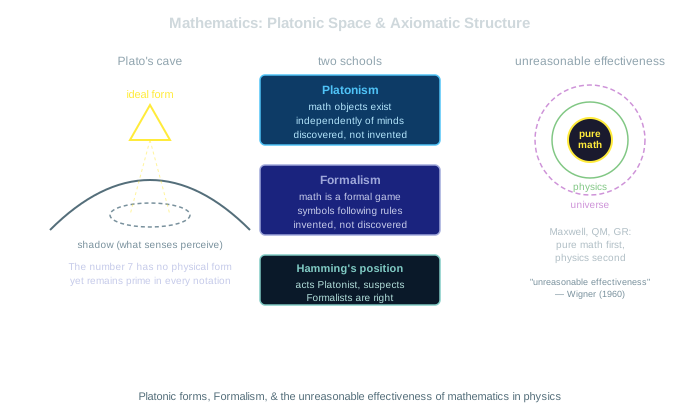
Formalism: Mathematics as Symbol Manipulation
The Formalist school, associated with David Hilbert, takes the opposite position. Mathematics is a formal game: choose a set of axioms and inference rules, then derive theorems by mechanically applying the rules. The symbols have no meaning outside the formal system.
On this view, mathematics is invented, not discovered. Different axiom systems produce different mathematics. Euclidean geometry and non-Euclidean geometry are both valid — they start from different axioms.
Hamming's position: he acts like a Platonist when doing mathematics (he feels he is discovering pre-existing truths) but suspects the Formalists are right about the foundations (there is no eternal realm, only the formal game we choose to play).
Hamming's practical test for a mathematical result: regardless of which school is correct, a theorem proven within a consistent formal system is reliable. The philosophical debate does not affect the engineering value of the result.
Mathematics and the Physical World
In 1960, physicist Eugene Wigner published an essay titled 'The Unreasonable Effectiveness of Mathematics in the Natural Sciences.' The thesis: mathematics developed by pure mathematicians for purely abstract reasons keeps turning out to describe physical reality with uncanny precision.
Examples Hamming cited:
- Maxwell's equations: derived from pure mathematical elegance & symmetry, they predicted electromagnetic waves — and specifically, the speed of light — before any experimental verification.
- Riemannian geometry: developed by Bernhard Riemann in the 1850s as pure mathematics, with no physical application in mind. Einstein used it 60 years later as the mathematical framework for general relativity.
- Quantum mechanics: built on Hilbert spaces, operator algebras, and group theory — all developed independently by mathematicians for abstract reasons.
Why should mathematics developed in the mind, for purely aesthetic reasons, describe physical reality so precisely? Neither Platonists nor Formalists have a fully satisfying answer.
Evaluating Wigner's Puzzle
Wigner's observation is striking, but it can be questioned. Not all mathematics that gets developed turns out to be useful — only the mathematics that ends up describing something survives in the history of physics. Perhaps the selection effect is doing the work.
More Abstract = More Broadly Applicable
Hamming made a counterintuitive claim: the more abstract a mathematical tool, the more broadly it applies.
Concrete mathematics: the formula for the area of a specific rectangle. Applies to one shape.
Abstract mathematics: linear algebra over a field. Applies to quantum mechanics, computer graphics, economics, data compression, circuit analysis, statistics — any domain where vectors and linear transformations arise.
Why? Abstraction strips away domain-specific content, leaving only structure. Two systems with the same structure obey the same theorems, even if one involves electric fields and the other involves probability distributions.
Universal mathematics: Hamming noted that any civilization capable of interstellar communication must have developed the same mathematics. The reason: mathematics derives its theorems from axioms via logic, and logic appears universal. The number 7 is prime in any notation because primeness is a structural property, not a notational one.
The Value of Abstraction
The history of mathematics contains many examples of abstract structures developed with no application in mind that later became essential tools in physics or engineering.