Orders of Magnitude
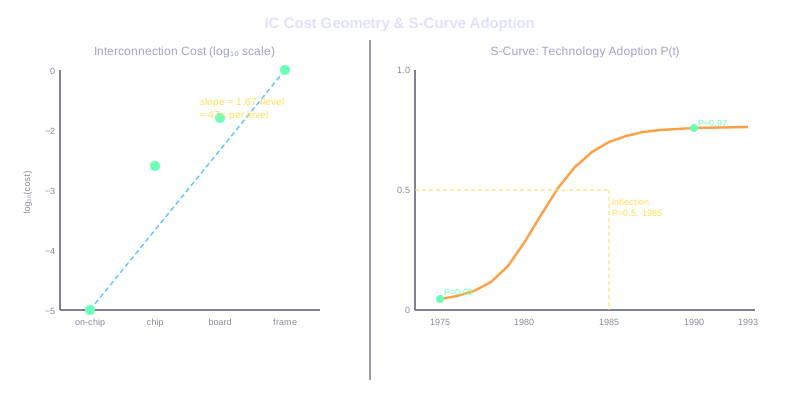
Hamming's interconnection cost table spans four levels: on-chip ($0.00001), chip-to-chip ($0.01), board-to-board ($0.10), frame-to-frame ($1.00).
On a linear scale, these values are nearly impossible to compare visually — the on-chip cost is invisible next to the frame cost. On a logarithmic scale, equal steps represent equal ratios.
Logarithmic Scale
If cost C at level k satisfies log₁₀(C) = a + bk, then C = 10^(a+bk) — an exponential in k, which plots as a straight line on a log scale.
From the data: log₁₀(0.00001) = −5, log₁₀(0.01) = −2, log₁₀(0.10) = −1, log₁₀(1.00) = 0. Each level up adds roughly 1-1.5 orders of magnitude.
Computing the Slope
Treat interconnection level as a variable L: L=0 (on-chip), L=1 (chip), L=2 (board), L=3 (frame). Map costs to log₁₀ values: −5, −2, −1, 0.
A least-squares fit of log₁₀(cost) on L gives the slope: how many orders of magnitude per level.
SNR & the Threshold Decision
Signal-to-noise ratio (SNR) measures the quality of a communication channel:
SNR = signal power / noise power
In decibels: SNR_dB = 10 · log₁₀(SNR)
For an analog channel, SNR degrades additively through n relay stages. If each stage contributes noise power N₀, total noise after n stages: N_total = n · N₀. SNR after n stages: S / (n · N₀).
For a digital channel, each relay regenerates the signal to full power S₀ and resets noise to N₀. SNR after n stages: S₀ / N₀ — independent of n.
The geometric interpretation: analog SNR falls as 1/n (hyperbolic decay in n). Digital SNR stays constant — a horizontal line in the SNR vs n plot.
Threshold: at each digital relay, the decision rule is: if received voltage > V_threshold, output 1; else output 0. The probability of error at one relay:
P_error ≈ Q(V_threshold / σ_noise)
where Q is the tail probability of a standard normal. For SNR >> 1, P_error approaches zero exponentially.
Calculating SNR Degradation
A fiber optic link spans 1000 km. Analog design: one amplifier every 10 km, each contributing equal noise N₀. Digital design: one regenerator every 10 km, each resetting SNR to S₀/N₀ = 30 dB.
From Exponential to Logistic
New technologies follow a pattern: slow early adoption, rapid acceleration, then saturation. This S-shaped trajectory appears in semiconductors, internet adoption, mobile phones, & every major platform technology.
Logistic Equation
Let P(t) = fraction of potential adopters who have adopted by time t. The logistic model:
dP/dt = r · P(t) · (1 − P(t))
Solution: P(t) = 1 / (1 + e^(−r(t − t₀)))
where r = growth rate, t₀ = inflection point (P = 0.5). At t = t₀: growth rate is maximum.
Geometric features: the curve passes through (t₀, 0.5); symmetric about that point; approaches 0 as t → −∞ and 1 as t → +∞; maximum slope = r/4 at the inflection.
The S-curve explains why early digital adoption looked slow: at P = 0.1 (10% adoption), dP/dt = r · 0.1 · 0.9 = 0.09r. At P = 0.5 (inflection), dP/dt = 0.25r. Growth accelerates until it hits the saturation constraint (1 − P) pulls it back.
Inflection & Half-Life
Digital IC adoption in consumer electronics followed a logistic curve from roughly 1975 to 1995, with the inflection point around 1985.
Suppose P(1975) = 0.05 and P(1985) = 0.50. Using P(t) = 1 / (1 + e^(−r(t − t₀))) with t₀ = 1985.