e^{i2πf} Traces the Unit Circle
A complex exponential e^{iθ} lives on the unit circle in the complex plane. As θ increases, the point rotates counterclockwise.
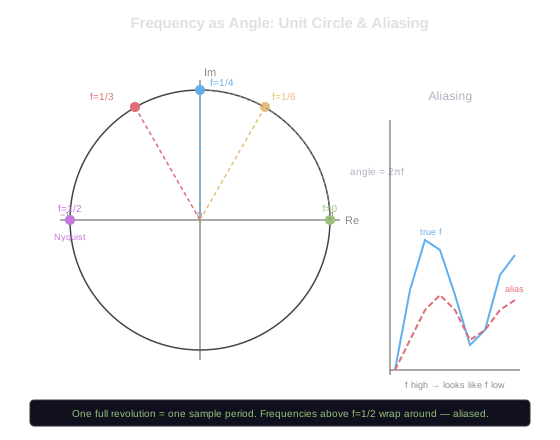
For a digital filter sampled at integer times n = 0, 1, 2, …, the eigenfunction e^{i2πfn} takes a step of angle 2πf around the circle at each sample.
Frequency as rotation rate: f measures how much of a full revolution occurs per sample.
- f = 0: no rotation; point stays at (1, 0)
- f = 1/4: quarter rotation each step
- f = 1/2: half rotation each step (Nyquist frequency)
- f = 1: full rotation each step — indistinguishable from f = 0
This last point contains the entire aliasing story geometrically.
Why the Unit Circle
The unit circle is the set {z : |z| = 1}. Evaluating the Z-transform H(z) on the unit circle — setting z = e^{i2πf} — gives the frequency response H(f). The unit circle is the boundary where discrete-time stability & frequency analysis meet.
Angles & Frequencies
Each frequency f corresponds to an angle θ = 2πf radians per sample. The full range of distinct frequencies spans one full revolution: f ∈ [0, 1) or equivalently θ ∈ [0, 2π).
At the Nyquist frequency f = 1/2, each sample advances exactly π radians — half a revolution.
The Geometric Picture of Aliasing
The unit circle has circumference 2π. A full revolution corresponds to frequency f = 1 (one full cycle per sample). The distinct frequencies in a sampled signal occupy exactly one revolution.
What happens at f = 1/2 + δ? The rotation per sample = 2π(1/2 + δ) = π + 2πδ. After k samples, the angle = k(π + 2πδ). But angle π + 2πδ is geometrically identical to −π + 2πδ, which corresponds to the rotation of frequency f = 1/2 − δ.
Aliasing is modular arithmetic on the circle. Frequencies above the Nyquist frequency wrap around. The circle has no memory of which way they came from.
The sampling theorem says: stay in the half-circle [0, π). Sample fast enough that your signal never reaches the other half. Anti-aliasing filters enforce this boundary before the signal reaches the sampler.
Computing Aliases Geometrically
The alias of frequency f under sampling rate f_s appears at |f − round(f / f_s) · f_s| — the distance to the nearest multiple of f_s, expressed as a fraction.
For f_s = 1 (normalized): alias of f = 1 − f for f ∈ (1/2, 1). This is the reflection of f about the Nyquist point f = 1/2.
Geometrically: f & 1 − f sit at mirror-image positions on the unit circle, equally distant from the π-axis.
Magnitude Response as Distance Product
For a transfer function H(z) with zeros z_1, z_2, … and poles p_1, p_2, …:
|H(f)| = (∏ |e^{i2πf} − z_k|) / (∏ |e^{i2πf} − p_k|)
This is the graphical method for reading frequency response directly from the pole-zero plot.
Rules:
- A zero ON the unit circle creates a perfect null at that frequency.
- A pole NEAR the unit circle creates a peak in the response.
- A zero near the unit circle (but not on it) creates a dip, not a null.
- Poles INSIDE the unit circle keep the filter stable.
The Z-plane geometry encodes the entire filter behavior visually. Engineers sketch pole-zero plots before computing coefficients.