The Isosceles Triangle Proof
One of the most striking results from early machine reasoning research: a geometry theorem-proving program produced a proof of the isosceles triangle theorem that its designers had not anticipated, & that most mathematicians did not know.
The classical proof requires constructing an auxiliary line: draw the angle bisector from the apex, use SAS congruence on the two sub-triangles. The proof works but requires an external construction the original problem does not mention.
The program's proof used no auxiliary construction. It compared triangle ABC with triangle CBA — the same triangle, read backward. The correspondence A↔A, B↔C, C↔B turns the original triangle into itself with its base vertices swapped. Both sides are equal by hypothesis. By SSS congruence, triangle ABC is congruent to triangle CBA, meaning angle B equals angle C.
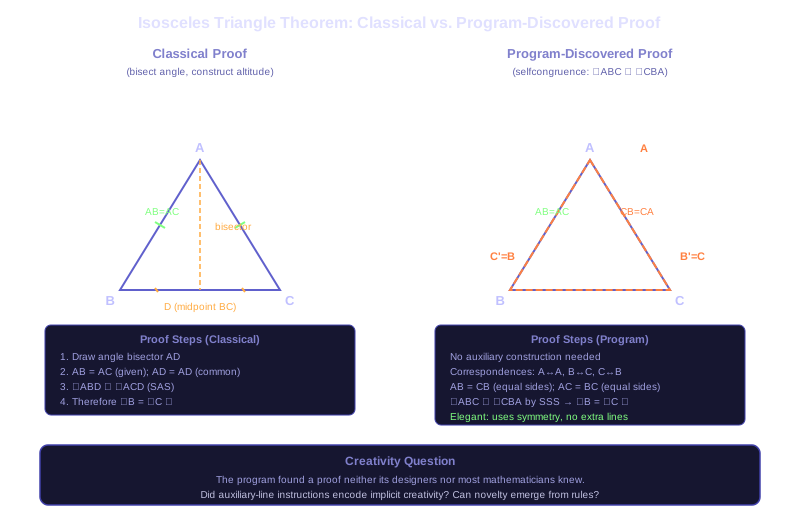
The proof appears as a footnote in some editions of Euclid, but it was not widely known. The programmers who built the system did not know it. The program found it by following a programmed strategy: try direct proof first; if stuck, try drawing auxiliary lines.
Did the Program Show Creativity?
Hamming asks the direct question: does this constitute machine creativity? His answer: partly, & the qualification matters.
The programmers wrote instructions to try proving theorems directly, & when stuck to try auxiliary constructions. The program followed those instructions. The novel proof emerged from applying those instructions to a problem where direct proof happened to work elegantly.
Hamming's observation: that is precisely how creativity works in humans. Your geometry training loaded a program into you. The instructions said: try direct proof; if stuck, draw auxiliary lines. You learned those instructions less cleanly than a machine does — you forget, misapply, & need endless repetition. But the structure is the same.
The paradox Hamming names: once a program exists to do something, observers automatically reclassify the behavior as routine. The existence of the program destroys the impression of intelligence. A machine can never demonstrate, to a skeptical audience, that it is more than a machine — because any demonstration gets reclassified as 'just programming.'
Max Mathews & Computer Music
Hamming shifts from geometry to music, and the transition is deliberate: he wants to show that machine reasoning extends beyond obviously analytical domains.
Max Mathews & John Pierce at Bell Labs computed music by synthesizing waveforms digitally. The system required choosing a sampling rate: per the Nyquist theorem, to reproduce sound up to frequency f, you need a sampling rate of at least 2f. Human hearing extends to roughly 18,000 Hz; telephone-quality voice needs 8,000 Hz, requiring a sample rate of at least 16,000 Hz.
With the sampling rate fixed, the system could compute any sequence of amplitudes representing any possible waveform, pass the values through a digital-to-analog converter & smoothing filter, & play the result. Pure tones are simple sine waves. Instruments combine multiple frequencies with characteristic attack & decay envelopes. Composition became a matter of specifying note sequences & instrument models.
They then asked: why supply the notes manually? Rules of composition exist. They used those rules plus random number generation to produce computer-composed music.
Result: computer-composed, computer-played music was already appearing in radio & TV commercials by the mid-1970s. The 'highest quality recording' by 1994 was digital. Hamming's observation: it is now a matter of what sounds are worth producing, not what sounds are technically possible. The technical frontier has closed; the aesthetic frontier remains open.
The Closed Technical Frontier
Hamming makes a sharp claim: with digital audio, there can be no future significant technical improvements to sound reproduction. The medium has achieved theoretical completeness. Remaining improvements are in aesthetics, not engineering.
He observes that computer music systems also changed the role of the composer: real-time playback replaced years-long waits for live performance. A composer can now develop style faster because the feedback cycle is orders of magnitude shorter.
Routine Jobs & the Capability Question
Hamming does not flinch from the displacement question. Computers displace workers from routine jobs. He states this plainly: 'robots will displace many humans doing routine jobs. In a very real sense, machines can best do routine jobs, thus freeing humans for more humane jobs.'
The uncomfortable qualifier: 'unfortunately, many humans at present are not equipped to compete with machines — they are unable to do much more than routine jobs.'
He expresses doubt that most people can be retrained from routine to non-routine work. This is not a popular position. He acknowledges the widespread belief (hope, he says) that proper training will let displaced workers compete. He publicly doubts it, then continues.
The Distinguishing Property
What separates non-routine from routine work, in Hamming's framing: the ability to analyze a situation carefully & specify in detail what should be done next. This is exactly what a program does — & what machines can increasingly do. The question is whether the set of situations requiring human specification is shrinking or growing.
The Capability Question
Hamming's career at Bell Labs gave him direct observation: over decades, the work displaced from human attention by computers consistently skewed toward the routine, & the new work that appeared skewed toward the non-routine. The remaining human value lay in judgment, synthesis, & the choice of what problems to pursue — not in execution.
He raises but does not resolve: is this pattern permanent, or does automation eventually consume the non-routine too?
Human-Machine Collaboration
Hamming's preferred frame for machine reasoning isn't competition but collaboration. He is interested in what human & machine can do together that neither can do alone.
Examples he saw at Bell Labs: the algebra simplification system that guided human algebraists through long symbol manipulations while leaving judgment calls to the human; the computer music system that extended the composer's creative reach while leaving aesthetic choices to the composer; the medical diagnosis support system that matched machine pattern recognition with human contextual judgment.
His prediction: the most valuable work of the coming decades sits at the interface — not humans replaced by machines, & not machines constrained by humans, but the combination that exceeds both.
The chemistry synthesis program is a clear example: it enumerated possible synthesis routes, computed costs & yields, & presented options. The chemist chose. Neither alone would do as well: the program cannot recognize which synthesis is elegant or which byproduct matters for downstream use; the chemist cannot enumerate 10,000 routes by hand.