Your Research Portfolio as a Point in Problem-Space
Model the set of open problems in a field as a space P. Each problem p ∈ P has two relevant properties: importance I(p) (the downstream value of solving it) and difficulty D(p) (the effort required to make progress).
Your research portfolio is a probability distribution over P: a measure μ on P describing where you allocate your attention. If you work only on one problem, μ = δ(p₀). If you work on many, μ is spread across P.
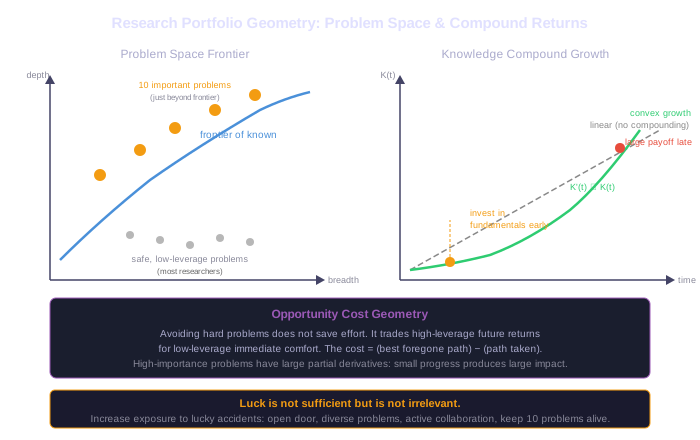
The 10 important problems technique is a coverage strategy: maintain mass on the high-importance region of P, even if you are not actively solving those problems at the moment. The mass enables recognition when a new technique arrives.
The leverage function of a problem: L(p) = I(p)/D(p). High importance per unit difficulty = high leverage. Most researchers cluster at low-leverage problems (low difficulty, moderate importance) even when high-leverage problems exist.
Why people avoid the high-leverage region: problems with high I(p) typically have high D(p). Failure on a hard important problem is visible. Failure on an easy unimportant problem is invisible. The incentive structure pushes researchers toward the low-leverage region even when they know, rationally, that the high-leverage problems matter more.
Computing Leverage
Researcher A spends 100% of their effort on Problem 1: I(p₁) = 10 (importance), D(p₁) = 2 (difficulty). Researcher B spends 100% of their effort on Problem 2: I(p₂) = 100 (importance), D(p₂) = 50 (difficulty).
Both researchers have the same total effort budget. Assume the probability of making progress on a problem in one year is proportional to effort/difficulty.
Knowledge That Enables More Knowledge
Hamming's argument for fundamentals: knowledge that enables further learning compounds. A researcher who invests in fundamentals early can acquire specialized knowledge faster, recognize connections across domains more readily, and solve new problems more efficiently — because the fundamentals provide a dense subgraph in the knowledge graph.
Model: let K(t) = your total knowledge stock at time t. If the rate of acquiring new knowledge is proportional to what you already know: dK/dt = r · K(t), then K(t) = K₀ · eʳᵗ. This is exponential growth.
More realistically: dK/dt = r · K(t)^α, where 0 < α < 1 gives sub-exponential (but still super-linear) growth. The key: K(t) is a convex function of t for any α > 0. A later-time investment produces more future knowledge than an equal early investment at the same time, but an early investment produces more future knowledge than an equal late investment at the same absolute knowledge level.
Fundamentals as high-leverage investments: if a fundamental skill increases your ability to acquire all future knowledge (raises r), then investing in it early maximizes the compound return. Spending the same effort on peripheral knowledge that does not generalize raises K₀ by a fixed amount without affecting r — a linear rather than multiplicative return.
Hamming on Shannon: Shannon primed himself years before information theory was 'in the air' by asking early questions about the relationship between information and uncertainty. When the moment arrived, he was positioned to see what others could not.
Compound vs Linear Knowledge Investment
Researcher A invests 1 year early in their career learning a fundamental mathematical technique (linear algebra at research depth). This doubles their learning rate (r → 2r) for all subsequent work. Researcher B spends that year on a peripheral skill that adds K₀ → K₀ + C for a fixed constant C, without affecting r.
After T more years beyond the investment year, Researcher A has K_A(T) = K₀ · e^(2rT). Researcher B has K_B(T) = (K₀ + C) · e^(rT).
The Cost of Avoiding Hard Problems
Opportunity cost of a decision = (value of best forgone alternative) − (value of chosen option).
In research portfolio terms: if you allocate your effort to Problem B (low leverage) when Problem A (high leverage) was available, the opportunity cost per year = E[output_A] − E[output_B].
Over a T-year career: total opportunity cost = T × (E[output_A] − E[output_B]), assuming constant leverage. In practice, the difference compounds: as K(t) grows, your ability to make progress on A grows too, so the forgone value grows over time.
The geometry of avoidance: in problem-space, the high-leverage problems occupy a region near the frontier. Most researchers stay well inside the frontier, in the low-difficulty, moderate-importance region. The opportunity cost is the difference in expected output between the frontier region and the interior region, summed over the career.
Hamming's observation: the researchers who clustered at the interior region (the physics and chemistry tables he left) were not lazy. They were actively productive. But their productivity compounded at a lower rate than it would have if directed at the frontier. The opportunity cost is invisible — you see only what was produced, not what could have been.
Computing Career Opportunity Cost
A researcher has two options each year: Option A (frontier problem, expected output E_A = 3 per year) and Option B (interior problem, expected output E_B = 1 per year). They choose Option B every year for 30 years.
Assume the outputs from different years do not interact (no compound effect for simplicity). The total output under B: O_B = 30. The total output under A: O_A = 90.