From Time Domain to Complex Plane
The Z-transform maps a sequence x_n to a function X(z) of a complex variable:
X(z) = Σ_{n=−∞}^{∞} x_n · z^{−n}
The variable z parameterizes the complex plane. Different regions of this plane correspond to different qualitative behaviors of the filter.
Geometric Regions
| Region | z | Behavior | ||
|---|---|---|---|---|
| Inside unit circle | < 1 | Stable poles: decaying response | ||
| Unit circle | = 1 | Frequency axis: z = e^{i2πf} | ||
| Outside unit circle | > 1 | Unstable poles: growing response |
The unit circle plays the same role in discrete-time stability that the imaginary axis plays in continuous-time (Laplace) stability.
Relationship to Laplace Transform
For continuous-time systems, the Laplace transform uses variable s. The imaginary axis s = iω is where frequency response lives. Stability: poles must have Re(s) < 0 (left half-plane).
The bilinear transform maps s → z: z = (1 + Ts/2) / (1 − Ts/2). This maps the left half-plane to the inside of the unit circle — the geometric translation of 'left half-plane stable' into 'inside unit circle stable.'
The Bilinear Transform as Conformal Map
The bilinear transform z = (1 + Ts/2) / (1 − Ts/2) is a Möbius transformation — a conformal (angle-preserving) map of the complex plane.
Its key geometric properties:
- Maps s = iω (imaginary axis) to |z| = 1 (unit circle)
- Maps Re(s) < 0 (left half-plane) to |z| < 1 (inside unit circle)
- Maps Re(s) > 0 (right half-plane) to |z| > 1 (outside unit circle)
- Frequency warping: the mapping ω → f is nonlinear — ω_analog = (2/T)·tan(πf_digital)
This warping compresses high frequencies toward the Nyquist point. Designers account for it by pre-warping the analog specification before applying the bilinear transform.
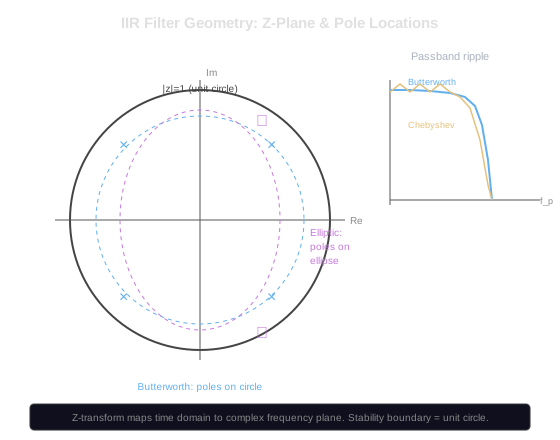
Butterworth Poles: Circle Locus
Butterworth filters achieve maximally flat passband by placing analog poles on a circle of radius ω_c in the s-plane.
For an N-th order Butterworth filter, the poles sit at:
s_k = ω_c · e^{iπ(2k+N−1)/(2N)} for k = 0, 1, …, N−1
This places them equally spaced on the left half of a circle of radius ω_c. (Poles on the right half would be unstable; only the left-half-plane poles are kept.)
Why circular locus → maximally flat passband?
The Butterworth polynomial |B_N(jω)|² = 1 + (ω/ω_c)^{2N} has all its poles at |s| = ω_c. The equal-radius constraint means all poles contribute equally to the magnitude response at ω = ω_c. The maximum flatness theorem: among all N-th order polynomials with poles on this circle, the Butterworth polynomial has the most derivatives equal to zero at ω = 0.
Chebyshev Poles: Ellipse Locus
Chebyshev poles lie on an ellipse in the s-plane (not a circle). The ellipse has semi-major and semi-minor axes determined by the ripple parameter ε. The equal-ripple passband emerges from the equioscillation property of Chebyshev polynomials.
Elliptic Poles: Elliptic Function Locus
Elliptic (Cauer) filter poles also lie on an ellipse — but with BOTH poles AND zeros contributing to frequency response. The zeros sit on the imaginary axis (finite attenuation poles in the stopband). The elliptic function mapping optimally distributes the zeros to achieve equal ripple in both bands simultaneously.
Computing Butterworth Pole Locations
For a 4th-order Butterworth filter with ω_c = 1 (normalized), the poles sit at:
s_k = e^{iπ(2k+3)/8} for k = 0, 1, 2, 3
k=0: s₀ = e^{i3π/8} (in left half-plane)
k=1: s₁ = e^{i5π/8} (in left half-plane)
k=2: s₂ = e^{i7π/8} (in left half-plane)
k=3: s₃ = e^{i9π/8} (in left half-plane)
These four poles sit at equal angular spacing on the unit circle, all with negative real parts (left half-plane).
Distance from Poles to the Unit Circle
Theoretical stability requires |p| < 1. In practice, two additional concerns arise.
Stability Margin
The stability margin of an IIR filter is the minimum distance from any pole to the unit circle: min_k (1 − |p_k|).
A pole at |p| = 0.99 is technically stable but leaves only 1% margin. Finite-precision arithmetic (rounding in coefficient representation & accumulation of roundoff errors) can effectively move poles. If coefficient quantization shifts a pole from 0.99 to 1.001, the filter becomes unstable.
Geometric Consequence
Poles very close to the unit circle produce very sharp frequency response peaks — narrow bandwidth resonators. But narrow resonators require high precision: small coefficient errors move the peak frequency significantly.
The geometric trade-off: peak sharpness ∝ 1 / (1 − |p|). As |p| → 1, sharpness → ∞ but stability margin → 0 and sensitivity to coefficient errors → ∞.
Second-Order Sections
A high-order IIR filter implemented as a single polynomial is numerically sensitive — rounding a single coefficient can move many poles. The standard solution: implement as a cascade of second-order sections (biquads), each with only one conjugate pole pair and one conjugate zero pair. Errors in one section cannot perturb poles in others.