The Definition Problem
Richard Hamming opens Chapter 25 with a confession: he cannot define creativity. He knows it when he sees it, but the word refuses precise definition.
He distinguishes three terms people often conflate:
Creativity: producing something genuinely new that has value — the hardest to define.
Novelty: different from what exists, but not necessarily valuable. A random walk produces novelty.
Originality: tracing to a single source without being copied.
His example from fashion: creative means different, but not too different. A dress ten years ahead of its time is not creative in fashion terms — it will not sell. A dress exactly like last season's is not creative either. The creative act lands in a narrow band.
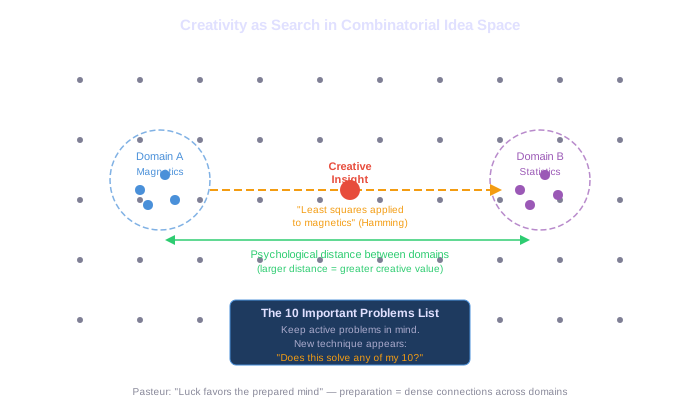
He then gives a sharper technical example: when he applied the well-known method of least squares to a problem in magnetics, a colleague wrote it up. A shrewd physicist friend told Hamming: his own most-requested reprint was a paper that applied standard circuit analysis to solid state physics. Creativity, it seems, is partly about psychological distance — putting together things not previously perceived as related.
His tentative definition: creativity is usefully combining things that were not perceived as related before. The psychological distance between the domains may count more than the difficulty of the act itself.
Creativity vs Novelty
Hamming asks a pointed question about a geometry theorem-proving computer program of his era: was the creativity in the program, or in the people who wrote it?
This question has no clean answer. But it forces a distinction: the program produced novelty (new proofs). Whether that constitutes creativity depends on whether you locate the generative act in the program's execution or in the humans who designed the generative mechanism.
Continental Drift & Mendel: Creativity Ignored
Hamming uses two historical cases to make a sobering point: even in science, creativity goes unrecognized when it occurs.
Continental drift: Thomas Dick mentioned it in 1838. Alfred Wegener published a book devoted to it in the early 1900s. It was not accepted in official circles until after World War II — and then only after oceanographers found magnetized rock striping on the ocean floor that provided the missing mechanism. Wegener, who had the creative insight, did not live to see vindication.
Mendel's genetics: Gregor Mendel completed his pea experiments in the 1860s. His paper sat ignored until 1900, when three researchers independently rediscovered genetics — and then found Mendel's earlier paper. Mendel now gets public credit. But for decades, his creative work was invisible.
Hamming's lesson: science, like art, regularly fails to recognize creativity when it happens. The creative act and the recognition of the creative act are separate events, sometimes separated by decades.
The Recognition Gap
The Wegener and Mendel cases share a pattern: the creative insight existed in one person, but institutional acceptance required either a mechanism (geologists demanded a physical explanation for drift) or rediscovery (Mendel needed independent confirmation).
Serendipity, Gestation, & the Prepared Mind
Hamming describes the typical arc of a creative act:
1. Recognition: a dim sense that a problem exists — often not yet clearly formulated.
2. Refinement: a dangerous stage — move too quickly here and you land the problem in its conventional form, finding only the conventional solution. Emotional involvement matters: without deep commitment to finding a real solution, you will not.
3. Gestation: intense thinking, followed sometimes by temporary abandonment. Hamming: the monomaniacal pursuit often does not work; the temporary dropping of the idea sometimes seems to be essential to let the subconscious find a new approach.
4. Insight: the moment you see it — often during the abandoned period, not during intense focus.
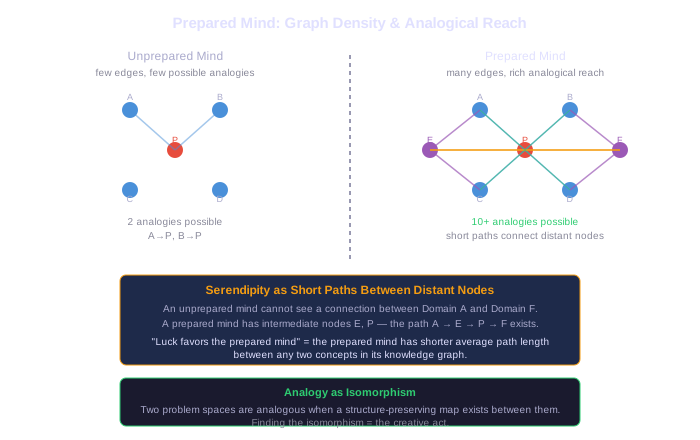
Pasteur's famous statement applies: 'Luck favors the prepared mind.' Hamming treats this seriously. A prepared mind has more connections across domains, shorter paths between distant ideas, more hooks on which a new technique can catch.
His practice: keep 10-12 of the most important open problems actively in mind. When a new technique appears — a paper, a conversation, a tool — immediately ask: Does this solve any of my 10 problems? A mind that does not maintain this list cannot ask that question.
The 10 Problems Technique
Hamming's technique is specific: a list of 10-12 of the hardest, most important problems in your field, kept alive in the back of your mind over years.
Apply the Technique
The creative work itself, for Hamming, follows from preparation. The prepared mind also involves emotional involvement: you must care enough about the problems to commit to finding solutions, not just to know about them.