Umbrella Organization
unturf operates as an umbrella organization for machine-learning-first ventures. It does not manufacture a product or deliver a single service. It provides a shared context, shared infrastructure, shared values, & shared ML tooling across a set of independent child entities.
Each child entity solves a distinct problem in a distinct domain. They share a philosophy: machine learning mediates between humans, not the humans themselves. Humans bring their enterprise. ML tools bridge the gaps.
Current children of unturf include:
- remarkbox: comment & discussion infrastructure for static sites - make_post_sell: lightweight commerce for independent makers - uncloseai: free LLM & TTS access for anyone - unsandbox: secure remote code execution - unfirehose: real-time data distribution - unhomeschool: ML-guided education for all ages
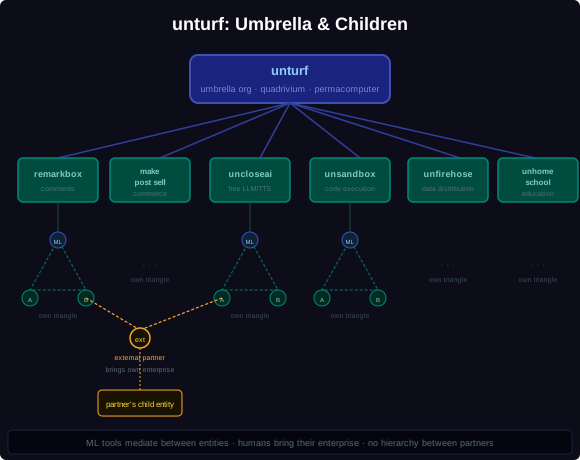
Each child carries its own ML Triangle: one pair of humans, one machine, one problem to close. That triangle structure scales across every domain without requiring centralized headcount or hierarchy.
Structure Check
A Quick Reflection
Look at the diagram above. Each child entity fans out with its own ML Triangle below it. External partners (shown in gold) connect between children, bringing their own enterprise into the network.
Eight Forms of Capital
Most economic systems optimize for a single form of capital: financial. Dollars in, dollars out. Every other form of value either converts to financial or gets ignored.
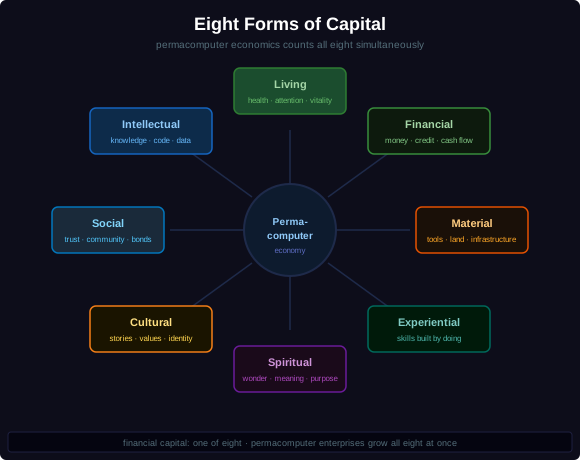
Permacomputer economics counts eight forms of capital simultaneously:
| Capital | What It Measures | |---|---| | Living | Health, attention, wellbeing, biological vitality | | Material | Physical tools, land, durable infrastructure | | Financial | Money, credit, cash flow | | Intellectual | Knowledge, data, code, curriculum, designs | | Experiential | Skills built through doing, not just knowing | | Social | Trust networks, relationships, community bonds | | Cultural | Shared stories, values, traditions, identity | | Spiritual | Wonder, meaning-making, sense of purpose |
A permacomputer enterprise grows all eight at once. Financial capital costs near zero. Intellectual capital flows freely as open seeds. Social capital forms through voluntary collaboration. Living capital stays protected: no harvest of attention for ad revenue, no extraction of human time for growth metrics.
Each child entity in unturf aligns to this accounting. unhomeschool grows intellectual capital (open curriculum), experiential capital (learning by doing), & living capital (healthy learners). remarkbox grows social capital (genuine discourse). unsandbox grows experiential capital (code that runs, problems that resolve).
Capital Mapping
Apply the Framework
Pick any enterprise you are part of right now. It does not have to be technology. A garden, a small business, a community group, a trade practice.
Control vs. Outcome
Traditional organizations optimize for control. Work flows down a hierarchy. Executive suites define strategy; managers enforce execution; workers implement. The org chart exists to ensure that whoever controls the organization controls the output.
Machine learning breaks this alignment.
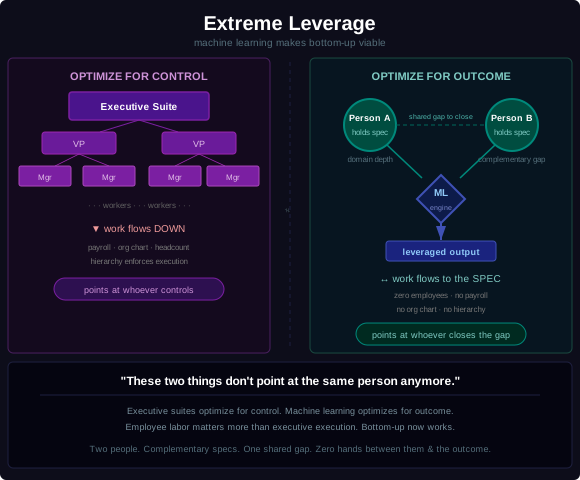
On the left: executive suites, VP layers, manager rows, workers below. Work flows down. Hierarchy enforces execution. The system points at whoever controls.
On the right: two people, complementary specifications, one shared gap, one ML engine. Zero employees between them & the outcome. Work flows toward the specification. No payroll. No org chart.
"These two things don't point at the same person anymore."
Executive suites optimize for control. Machine learning optimizes for outcome. These used to coincide. They no longer do. A pair of people with complementary domain depth & access to ML tools can close gaps that once required departments. Bottom-up is viable now.
Shift
The Structural Change
Before: headcount was leverage. More people meant more output. Hiring was growth.
After: specification quality is leverage. A sharper spec, directed at a capable ML tool, produces more output than a team directed at a vague goal.
One Pair, One Machine, One Problem
The ML Triangle is a structural unit: one pair of humans, one machine learning engine, one problem.
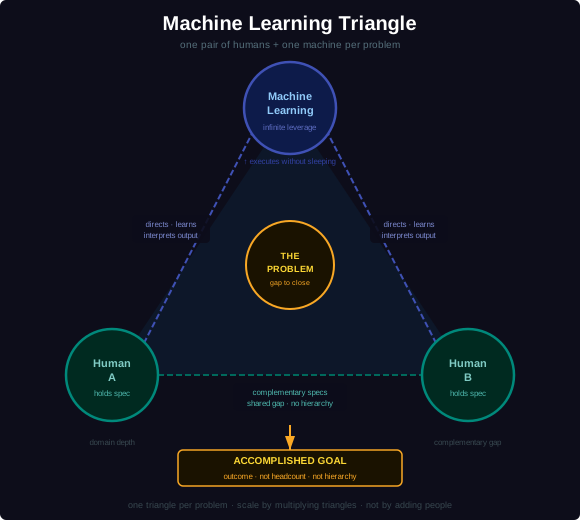
Machine Learning sits at the top: infinite leverage, executes without sleeping. Human A sits at bottom-left: holds a specification, brings domain depth. Human B sits at bottom-right: holds a complementary specification, brings the gap that A cannot see alone.
Center: THE PROBLEM. Not a goal, not a mission statement. A specific gap to close.
Left edge: A directs the ML, learns from its output, interprets results. Right edge: B does the same from a different angle. Bottom edge: A & B hold complementary specs, sharing the gap between them. No hierarchy. Neither reports to the other.
Output: an accomplished goal. Not headcount growth. Not managed process. A closed gap.
Scale by multiplying triangles: not by adding people.
One triangle handles one problem. Ten triangles handle ten problems simultaneously. Each triangle operates independently. unturf scales by fanning out triangles across domains, not by building management layers.
Design a Triangle
Build One
Think about a problem you care about closing. It does not need to be software. Soil health, structural inspection, curriculum design, supply chain routing, medical diagnosis workflow: any domain works.
No Change Required
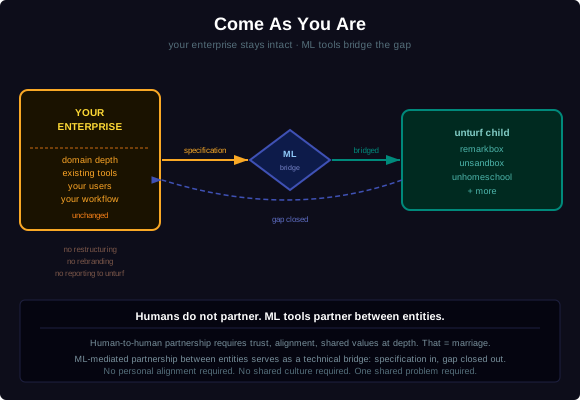
External partners need not restructure their enterprise to join unturf. They do not dissolve into unturf. They do not report to unturf. They do not adopt a new brand or a new mission.
Come as you are. Bring your existing enterprise. ML tools will bridge the gap between your enterprise & unturf's children.
Look at the diagram from the opening of this lesson. Notice the gold nodes: external partners connecting between child entities. An external partner might connect remarkbox (comments) to make_post_sell (commerce): enabling discussion-driven storefronts. Or connect unsandbox (code execution) to unhomeschool (education): enabling students to run code inside a lesson. The partner brings their enterprise; ML tools handle mediation.
Humans are not partnering. ML tools partner between entities.
Human-to-human partnership is marriage. It requires trust, alignment, long-term commitment, shared values at depth. ML-mediated partnership between child entities is a different thing entirely: it is a technical bridge between specifications. No personal alignment required beyond a shared problem to close.
This distinction matters. unturf does not ask partners to believe what unturf believes, adopt unturf's culture, or change how their enterprise runs. It asks: do you have a specification? Do you have domain depth? Is there a gap between your enterprise & one of unturf's children? If yes, a triangle exists.
Your Enterprise
Where Do You Fit?
An external partner in unturf's network brings their enterprise: unchanged: and connects via ML to one or more children.
Paths Forward
How Partnership Works in Practice
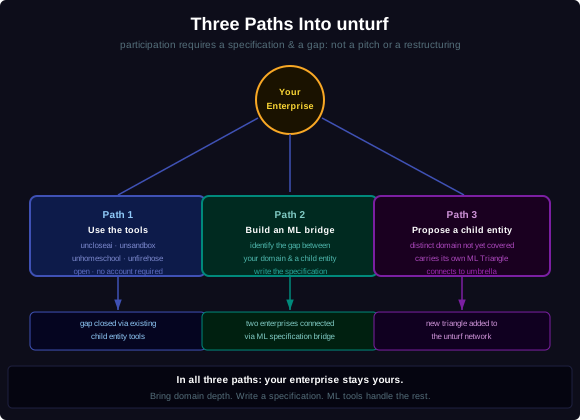
Joining unturf's network does not require a contract, a pitch, or a restructuring. It requires a specification & a gap.
Three paths exist:
1. Use a child entity's ML tools directly. unsandbox runs your code. uncloseai provides LLM access. unhomeschool hosts your curriculum. These are open tools. Use them.
2. Build an ML bridge between your enterprise & a child entity. Identify the gap between what you do & what a child entity does. Write a specification for what ML should bridge. Start there.
3. Propose a new child entity. If your domain represents a distinct problem space not covered by existing children, propose a new entity. It would carry its own ML Triangle & connect to the umbrella.
In all three paths, your enterprise remains yours. You bring your domain depth. ML tools mediate. unturf provides the shared context that makes mediation coherent across domains.
The permacomputer economy grows by multiplying triangles. Every new partnership adds a triangle. Every new child entity adds a fan of triangles. Every domain solved opens adjacent domains to the same leverage.
This is not a company acquiring your work. It is a network growing its capacity to close gaps: one pair, one machine, one problem at a time.
Synthesis
Final Question
You have covered the full structure: umbrella & children, eight forms of capital, extreme leverage, the ML Triangle, & external partnership via ML-mediated bridges.