Creativity as Search
Model idea space as a set of N concepts, each a node in a graph. A creative act joins two previously unjoined nodes.
The number of possible combinations of two concepts from N concepts: C(N, 2) = N(N−1)/2.
For N = 100 concepts: C(100, 2) = 4,950 possible pairings. For N = 1000: C(1000, 2) = 499,500. The search space grows quadratically.
Most pairings produce nothing useful. Creativity requires navigating a vast space to find the rare useful combination. This is why preparation matters: a prepared mind does not search randomly — it has strong priors about which regions of the space are worth exploring.
Hamming's domains (magnetics, statistics) were both well-mapped in his mind. The question 'can I apply X to Y?' has a short answer only if you have both X and Y well-represented as nodes with many internal connections.
Size of the Search Space
Consider a researcher with working knowledge of 50 distinct techniques or concepts. They encounter a problem in a new domain with 20 unknown aspects.
What an Analogy Really Is
Hamming describes creativity as useful combination of previously unrelated things. Geometrically, the deepest form of this combination is structural isomorphism.
Two problem domains P and Q are analogous when there exists a bijective map f: P → Q that preserves the relationships between elements. If element a in P relates to element b in P in the same way that f(a) in Q relates to f(b) in Q, then f is a structure-preserving map — an isomorphism.
Example: electrical circuits and mechanical systems. Voltage ↔ force, current ↔ velocity, resistance ↔ damping, capacitance ↔ compliance, inductance ↔ mass. The differential equations governing both domains have the same form. An engineer who knows this can solve mechanical problems using circuit analysis — exactly what Hamming's physicist friend did.
The creative act, in this model, is finding the isomorphism. Once found, every result in domain P maps to a result in domain Q for free.
Find the Isomorphism
Consider heat conduction and electrical conduction. In heat conduction: heat flux Q flows from high to low temperature T. Thermal resistance R_th = ΔT / Q. In electrical conduction: current I flows from high to low voltage V. Electrical resistance R = V / I.
Graph Distance & Serendipity
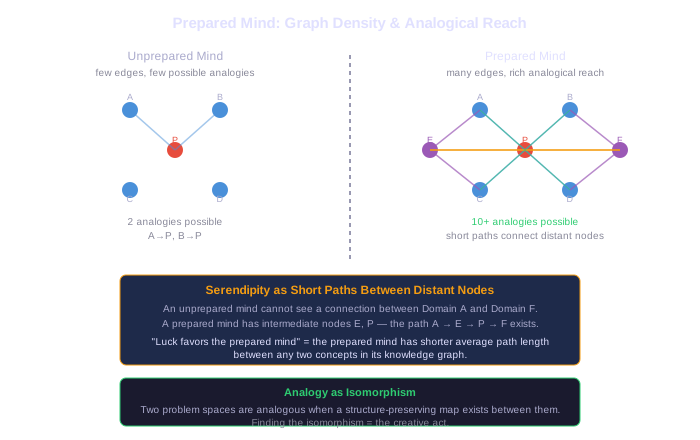
Model the prepared mind as a weighted graph. Nodes represent concepts. Edges represent associations or derivable connections. Edge weight = strength of connection (lower weight = stronger, shorter effective path).
Serendipity: encountering a new idea (node X) and immediately recognizing it connects to an open problem (node Y). This requires a short path from X to Y in your graph.
An unprepared mind may lack intermediate nodes between X and Y entirely — the path does not exist. A prepared mind has intermediate concepts that connect them: X → A → B → Y. The connection fires.
Pasteur's 'luck favors the prepared mind' restated geometrically: the prepared mind has shorter average path length between any two concepts in its knowledge graph. This is not luck — it is graph density.
The 10 important problems technique: these 10 nodes are marked as high-priority targets. When a new node (technique) appears, you immediately compute: is there a short path from this node to any of my 10 targets? If yes, fire. If no, file for later.
Path Length & Recognition
Consider two researchers who both read the same paper describing a new statistical clustering technique.