You Get What You Measure
Richard Hamming's sharpest observation about organizations: measuring something changes how people behave toward it.
IQ tests calibrate against themselves. A test designed to measure intelligence gets optimized for by the institution that uses it. Over time, it measures 'what this institution rewards' more than it measures 'what it originally claimed to measure.' Goodhart's Law before Goodhart named it: when a measure becomes a target, it ceases to be a good measure.
Bell Labs measured patents, publications, & revenue impact. These are financial & intellectual capital metrics. Bell Labs produced extraordinary results on those measures: the transistor, error-correcting codes, UNIX, C, information theory, laser, cellular telephony.
But Bell Labs also produced exclusion. Research happened inside walls. Knowledge required employment at one institution to access. Military-industrial contracts shaped which problems received resources. These are not financial failures. They are failures on other capital queues: social (who gets access), cultural (what knowledge flows freely), intellectual (is the capital actually open?).
Roland & Landua describe eight forms of capital. Hamming measured two of them. His framework was correct for the goals he had. This lesson asks: what happens when we apply his measurement insight to all eight?
Bell Labs: What the Metrics Rewarded & What They Missed
Bell Labs measured patents and publications. These metrics rewarded work that produced intellectual property held by AT&T and work visible in peer-reviewed journals.
Eight Forms of Capital: A Map
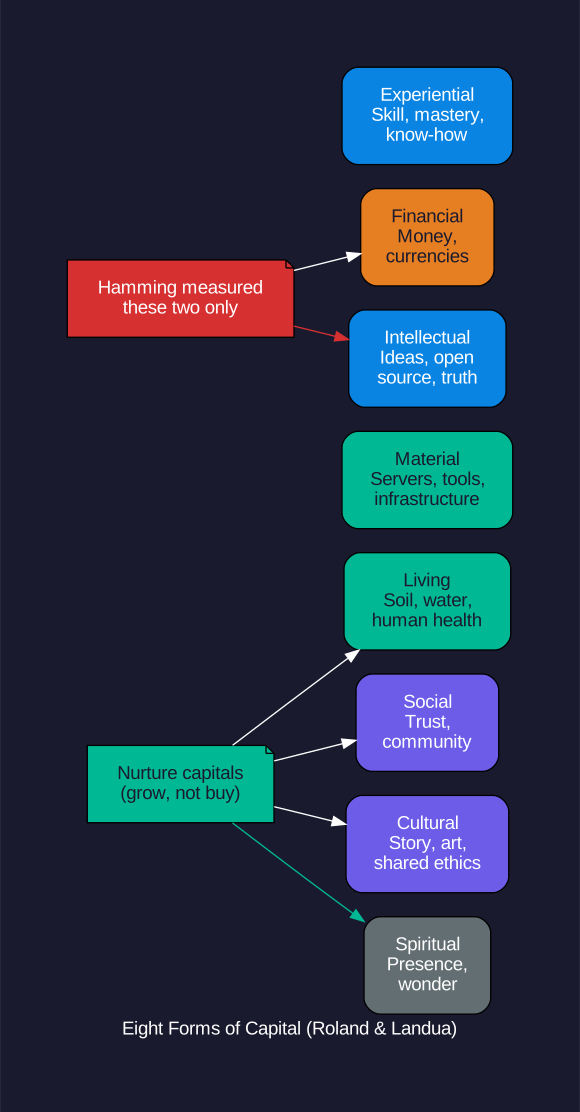
Roland & Landua named eight forms of capital, each representing a different class of value that flows through a system. Reference: unturf.com/eight-forms-of-capital/
Four Nurture Capitals — cannot be bought, only grown:
- Living capital: soil, water, human health, ecosystems, biodiversity. Destroyed by: exhausted workers, food deserts, poisoned supply chains, attention extraction.
- Social capital: trust, relationships, community networks, reciprocity. Destroyed by: algorithmic isolation, surveillance capitalism, manufactured outrage.
- Cultural capital: story, art, ceremony, shared values, language, ethics. Destroyed by: monoculture, platform homogenization, erasure of local tradition.
- Spiritual capital: presence, wonder, connection to a greater whole, meaning-making. Destroyed by: infinite scroll, manufactured urgency, commodification of attention.
Four Transactional Capitals — tools for exchange:
- Financial capital: money, currencies, securities, debt. Extracted by: platform rent, transaction fees, O(N²) friction in exchange layers.
- Material capital: servers, tools, infrastructure, buildings, equipment. Destroyed by: planned obsolescence, deferred maintenance, vendor lock-in.
- Intellectual capital: ideas, knowledge, open source, algorithms, truth. Destroyed by: paywalls, patent moats, closed algorithms, NDAs.
- Experiential capital: embodied skill, mastery, tacit know-how, apprenticeship. Destroyed by: gig economy churn, deskilling, no apprenticeship pathways.
Transactional capitals facilitate exchange. Nurture capitals grow the conditions for exchange to occur. A system that grows financial capital by draining living or social capital consumes its own substrate.
Hamming measured intellectual capital (publications, patents) & financial capital (revenue impact). He ignored the other six. His institution thrived on two queues and left four others to chance.
Platform Economics: Capital Diagnosis
Scenario: a software platform connects independent contractors with clients. It takes a 30% commission on every transaction.
Nurture Capitals vs Transactional Capitals
The four nurture capitals (Living, Social, Cultural, Spiritual) cannot be purchased. A company can buy intellectual capital (acquire a patent portfolio). A company can buy financial capital (issue stock). A company cannot buy social trust. It can only grow it or destroy it.
This asymmetry matters for systems design. Platforms that drain social capital for financial gain operate at a loss they cannot see in their financial statements. The loss shows up years later: declining community engagement, platform flight, reputation collapse.
Hamming saw this in reverse at Bell Labs: the institution grew intellectual capital by concentrating it behind walls. That concentration grew financial capital for AT&T. What eroded slowly: the social capital of the broader research community that could not access the work.
The Stewardship Check
Before shipping any feature, patch, or system decision, a stewardship check asks which of the eight capital queues it touches.
Stop conditions:
- Does it drain a workaholic to feed a glutton? Stop.
- Does it route throughput away from communities with less access? Stop.
- Does it grow financial capital at the expense of living capital? Stop.
Ship conditions:
- Does it regenerate experiential capital (leave people more skilled)? Ship it.
- Does it strengthen social capital (more trust, more connection)? Ship it.
- Does it contribute intellectual capital as open source? Ship it.
Permacomputer infrastructure applies this specifically: free compute, zero platform tax, code as public domain. Designed to grow all eight queues simultaneously. Not extracting rent from workers to feed platform owners.
The stewardship check is not a veto on all commercial activity. It is a scope check: what queues does this touch, in which direction, & at what magnitude? A project can grow financial capital while also growing experiential capital. The question is: which queues does it drain in the process?
Education Platform: Version A vs Version B
Two versions of a programming education platform:
Version A: $50/month subscription, instructors on salary, proprietary curriculum (not released externally).
Version B: Free to use, instructors paid per enrolled student, all curriculum released as open source.
Closing: Extending Hamming's Framework
Hamming measured intellectual and financial capital because those were the queues Bell Labs cared about. He got extraordinary results on those queues.
His insight, 'you get what you measure,' applies to itself. Measuring only two capital forms gives you extraordinary performance on two queues & unexamined behavior on six others.
Extending his framework: before choosing your metrics, ask which queues they represent. The queues you do not measure will still change. You just will not see it happening.
A MOAD pipeline (scan → ticket → patch → test → disclose → PR → upstream merge) measures: patches merged (intellectual capital, fixed defects become public goods), upstream adoption (social capital, maintainers trust the work), & zero financial extraction (no paywall on disclosures). Three queues, all positive direction.
What it does not measure directly: living capital (the time of contributors), cultural capital (how patch culture shapes open-source norms), spiritual capital (whether contributing to open infrastructure produces meaning for the people doing it). Those queues matter. Measure them or watch them by accident.