Pipeline Shape
A kanban system is a pipeline. The geometric properties of that pipeline determine how fast work moves through it.
Imagine the pipeline as a tube with five segments: one for each column: Backlog, Selected, In Progress, Review, Done. Each segment has a width (its WIP limit) and a flow rate (how fast work moves through it).
Cross-sectional area & flow rate
In fluid dynamics, a narrow pipe forces faster flow through the constriction. In a kanban system, a narrow column (low WIP limit) forces work to complete before new work enters. The analogy is not perfect: water is conserved, but work items can be created and destroyed: but the spatial intuition is useful.
A wide column (high WIP limit or no limit) allows work to accumulate. A narrow column forces completion. The geometry of the board encodes the team's theory of where constraints should live.
The queue triangle
At any moment, the state of a kanban column can be described geometrically as a queue with:
- Length: number of cards currently in the column
- Width: the WIP limit (maximum cards allowed)
- Rate: cards completed per unit time (throughput)
If Length > Width, the column is in violation. If the rate of cards entering a column consistently exceeds the rate of cards leaving, the queue grows without bound: a geometric divergence.
Queue Geometry
A Review column has a WIP limit of 3 & completes 2 reviews per day. The In Progress column completes 4 cards per day.
L = λW
Little's Law is a theorem from queuing theory, proven by John D.C. Little in 1961. It applies to any stable queuing system.
L = λW
- L = average number of items in the system (WIP)
- λ (lambda) = average arrival rate (throughput)
- W = average time an item spends in the system (lead time)
Rearranged for kanban: Lead Time = WIP ÷ Throughput
If your team completes 5 cards per week & has 20 cards in flight at any time, your average lead time is 20 ÷ 5 = 4 weeks.
The geometric interpretation
On a time-vs-cards graph, Little's Law describes a rectangle: WIP is the height, throughput is the slope of the input curve, & lead time is the horizontal distance between when a card enters & when it exits the system.
Reduce WIP (height) without changing throughput (slope), and lead time (horizontal distance) shrinks proportionally. This is the geometric proof that WIP limits shorten cycle time: not by working faster, but by reducing the area of work in flight.
Applying Little's Law
Two teams. Same throughput. Different WIP.
Shape of a Result
Little's Law describes the geometry of flow through a system. Brian Tracy's 1986 formula describes the geometry of output from a single node: a solo worker.
R = (W × C) + T
- R: Result
- W: Clarity of goal (0–10)
- C: Concentration (0–10)
- T: Distraction-free hours
The multiplicative term is an area
W × C defines a rectangle. Goal clarity on one axis, concentration on the other. The area of that rectangle is the capacity to produce a result. A 9 × 9 rectangle has area 81. A 3 × 3 rectangle has area 9: the same dimensions summed equal 12 either way, but the areas differ by a factor of 9. This is why goal clarity and concentration compound: they interact geometrically, not arithmetically.
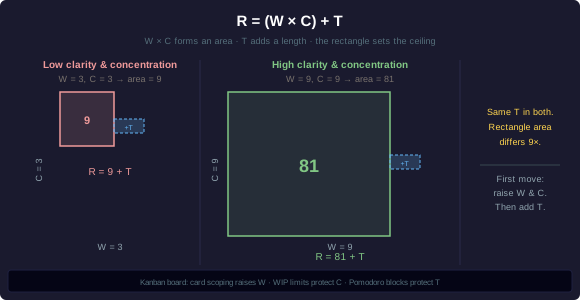
T is a length, not an area
Distraction-free hours add to the result linearly. T extends R along one axis: it cannot expand the rectangle. Every hour of focused time adds the same fixed increment regardless of how high W × C is. This makes T the least leveraged variable: doubling T on a low (W × C) base doubles a small number. Doubling W or C on a moderate base multiplies the area.
The asymmetry
W & C are bounded (0–10 each). T is unbounded in principle but bounded by physiology. The practical ceiling of W × C is 100. The practical T in a day is 4–6 hours of genuine concentration. So R is bounded not by time but by the rectangle.
What the kanban board does geometrically
A vague backlog card lowers W before work begins. Multiple items in Active splits C proportionally. Each context switch resets the concentration ramp: the time required to re-enter a problem after interruption. WIP limits protect the rectangle. Card scoping fills it in.
Comparing Strategies
Two strategies for improving R from a baseline.
Reading the CFD
A Cumulative Flow Diagram (CFD) is a time-series visualization of work state across the whole system. The x-axis is time. The y-axis is total number of cards (cumulative). Each column on the kanban board becomes a band on the CFD.
What to read
Band width: the vertical distance between two boundary lines at any point in time represents the number of cards currently in that stage. Wide band = many cards in that stage. Narrow band = few cards.
Slope: the slope of a band's upper boundary represents the arrival rate into that stage. Steeper slope = faster arrival. Flat slope = work has stopped arriving.
Gap between Done boundary and upper boundary: this is your current WIP. The horizontal distance between when a card entered the system and when it crossed into Done is that card's lead time.
Pathologies on a CFD
A bulging band in one stage: a band that grows wider over time: is a bottleneck. Work arrives faster than it completes. This is the geometric signal of the Review queue problem from earlier.
A flat upper boundary (zero slope) means no new work is completing. The system has stalled in that stage.
A narrowing band means work is completing faster than it arrives: the stage is ahead of the system and about to starve for input.
Diagnosing from a CFD
Reading a CFD is the fastest way to diagnose a kanban system without talking to anyone.
Putting It Together
You now have the geometric toolkit for kanban analysis.