What Is Entrepreneurship?
Entrepreneurship is not about having a brilliant idea. It is about building something people will pay for — and surviving long enough to make it work.
At its core, entrepreneurship means taking a risk to create value. You identify a problem, build a solution, and convince people to exchange their money for it. That last part is harder than it sounds.
Types of Businesses
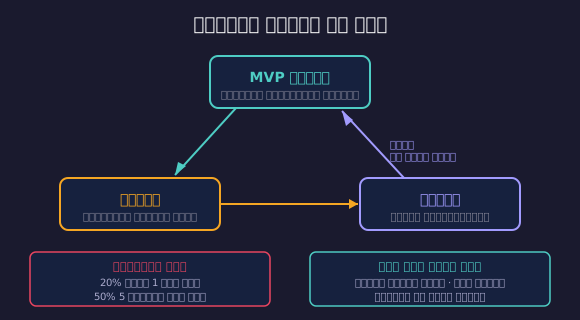
Not every business is a tech startup. Most businesses are not. Here are the main categories:
- Service businesses — you sell your time and expertise. Consulting, freelancing, plumbing, tutoring. Low startup cost, but hard to scale because revenue is tied to your hours.
- Product businesses — you sell physical or digital goods. Inventory, manufacturing, shipping. Higher upfront cost, but you can sell while you sleep.
- SaaS (Software as a Service) — subscription software. High upfront development cost, but once built, each new customer costs almost nothing to serve. This is why investors love it.
- Marketplace businesses — you connect buyers and sellers and take a cut. Airbnb, Etsy, Uber. Extremely hard to start (chicken-and-egg problem) but extremely powerful once they hit critical mass.
- Brick-and-mortar — restaurants, retail stores, gyms. Physical location, local customer base, high overhead. The oldest form of business and still the most common.
Risk vs. Reward
About 20% of new businesses fail in the first year. About 50% fail within five years. These are not reasons to avoid starting — they are reasons to prepare. The entrepreneurs who survive are not the ones with the best ideas. They are the ones who validate before they build, watch their cash, and adapt when reality disagrees with their plan.
Warm-Up
Your Entrepreneurial Lens
You do not need to have started a business to think like an entrepreneur. Every time you notice something inefficient, overpriced, or missing from the market, you are seeing an opportunity.
Identifying Real Problems
Start With the Problem, Not the Solution
The number one reason startups fail is not running out of money — it is building something nobody wants. They fall in love with their solution and never check if anyone actually has the problem.
A real problem has three characteristics:
- Frequency — people encounter it regularly, not once in a lifetime
- Intensity — it causes real pain, not mild annoyance
- Willingness to pay — people would spend money to make it go away
A problem that scores high on all three is a goldmine. A problem that scores low on any one of them is a warning sign.
Value Proposition
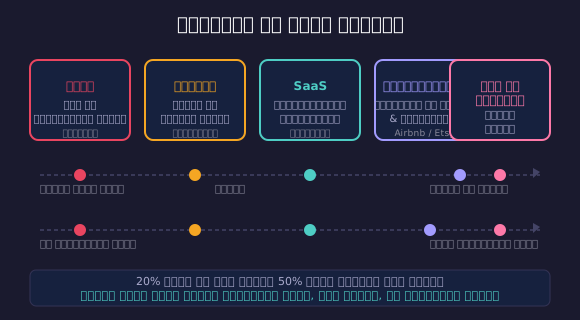
Your value proposition is one sentence that explains why someone should buy from you instead of the alternative. The alternative is not just your competitors — it includes doing nothing, using a spreadsheet, or asking a friend.
A good value proposition has three parts: who you serve, what problem you solve, and why your solution is better than what they use now.
Customer Segments
Not everyone has your problem. And not everyone who has your problem will pay to solve it. Your customer segment is the specific group of people who have the problem, know they have it, and are willing to pay for a solution.
Early-stage entrepreneurs often make the mistake of saying their market is 'everyone.' If your market is everyone, your market is no one. The tighter you define your initial customer, the easier it is to find them, talk to them, and sell to them.
Value Proposition Practice
Building a Value Proposition
Consider these two pitches for the same product — a meal planning app:
- Pitch A: 'We help people eat healthier with our meal planning technology.'
- Pitch B: 'We help busy parents who spend 45 minutes every evening figuring out dinner cut that time to 5 minutes with a weekly meal plan personalized to their family's dietary restrictions and budget.'
Pitch B is specific. You know who it is for, what problem it solves, and how it is better than the current situation.
Revenue Streams and Cost Structure
How Businesses Make Money
A business model answers one question: how do you make more money than you spend? Every business model has two sides — revenue (money in) and costs (money out).
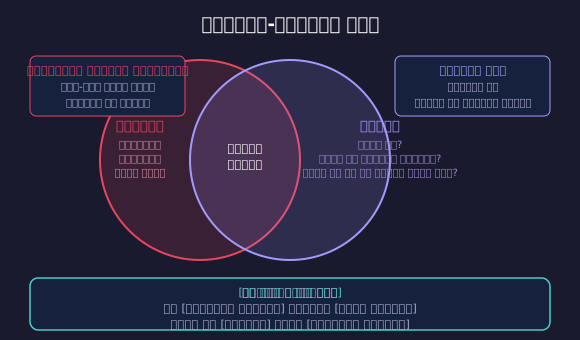
Revenue Models
- Direct sales — customer pays once for a product or service. A bakery sells a cake. Simple, but you need to keep finding new customers.
- Subscription — customer pays recurring fees. Netflix, gym memberships, SaaS. Predictable revenue, but you must deliver ongoing value or they cancel.
- Freemium — basic product is free, premium features cost money. Spotify, Dropbox. Great for growth, but conversion rates are typically 2-5%.
- Advertising — product is free, advertisers pay to reach your users. Google, Instagram. Requires massive scale to generate meaningful revenue.
- Commission/marketplace — you take a percentage of each transaction. Etsy charges sellers, Uber takes a cut of each ride. You need both supply and demand.
- Licensing — you charge others to use your intellectual property. Software licenses, franchise fees, patents.
Cost Structure
- Fixed costs — expenses that stay the same regardless of sales. Rent, salaries, insurance. These are dangerous because they keep coming whether you sell anything or not.
- Variable costs — expenses that scale with sales. Materials, shipping, payment processing fees. These are safer because they only appear when revenue does.
A restaurant has high fixed costs (rent, staff, equipment) and moderate variable costs (ingredients). A freelance consultant has low fixed costs (laptop, internet) and almost no variable costs. The cost structure determines how much revenue you need just to survive.
Unit Economics
The Math That Decides If You Survive
Unit economics answers the question: do you make money on each individual sale?
Key metrics:
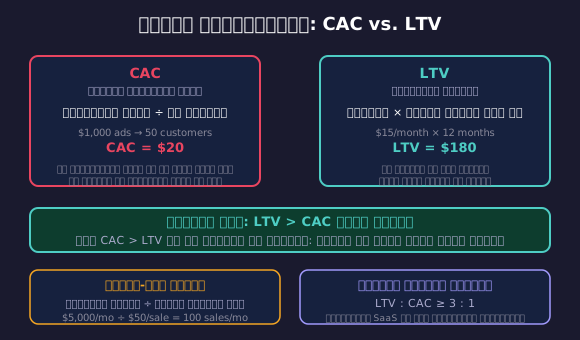
- CAC (Customer Acquisition Cost) — how much you spend to get one new customer. If you spend $1,000 on ads and get 50 customers, your CAC is $20.
- LTV (Lifetime Value) — how much total revenue one customer generates before they leave. If the average customer pays $15/month and stays 12 months, LTV is $180.
- The golden rule: LTV must be greater than CAC. If it costs you $20 to acquire a customer who only spends $10, you lose money on every sale. You cannot make that up with volume.
- Break-even point — the number of units (or customers) you need to cover all your fixed costs. If your fixed costs are $5,000/month and you make $50 profit per sale, you need 100 sales per month to break even.
Why This Matters
Many businesses look successful — growing revenue, adding customers — but are actually losing money on every transaction. They are subsidizing growth with investor money or savings. When the money runs out, they die. Unit economics tells you whether your business can ever be profitable, even at scale.
Talking to Customers
The Mom Test
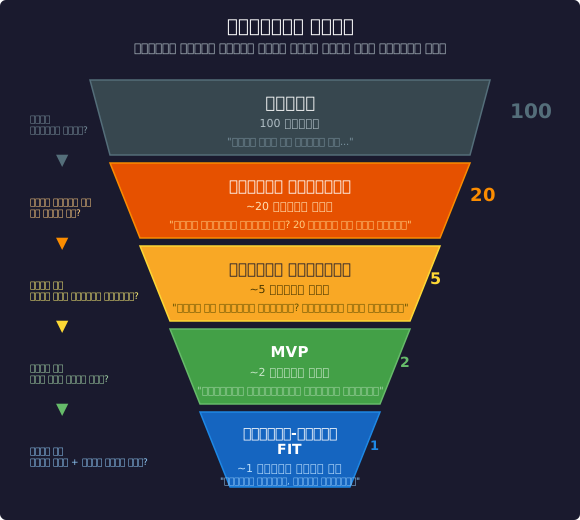
Before you build anything, you need to talk to potential customers. But most people do this wrong. They pitch their idea and ask if people like it. Everyone says yes — your mom, your friends, strangers being polite. This tells you nothing.
The right approach (from Rob Fitzpatrick's book 'The Mom Test') is to ask about their life, not your idea:
- Bad question: 'Would you use an app that tracks your spending?' (Everyone says yes.)
- Good question: 'How do you currently track your spending? What is frustrating about that process?' (Reveals real behavior.)
- Bad question: 'Would you pay $10/month for this?' (Hypothetical money is not real money.)
- Good question: 'What have you tried to solve this problem? How much did you spend on it?' (Past behavior predicts future behavior.)
Talk to at least 20 potential customers before you write a line of code or spend a dollar on inventory.
Minimum Viable Product (MVP)
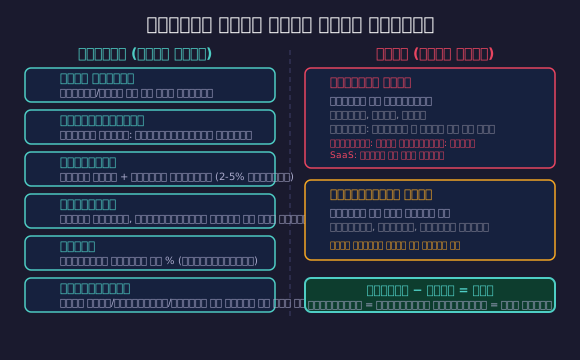
An MVP is the smallest version of your product that lets you test your core assumption. It is not a prototype. It is not version 1.0. It is the absolute minimum you need to learn whether customers will actually pay.
- Dropbox की MVP एक 3-मिनट की वीडियो थी जो दिखाती है कि उत्पाद कैसे काम करेगा। किसी भी कोड लिखने से पहले साइनअप बहुत बढ़ गए।
- Zappos (ऑनलाइन जूते की दुकान) स्थानीय दुकानों में जूते की तस्वीरें लेकर ऑनलाइन सूचीबद्ध करके शुरू किया। जब कोई ऑर्डर करता, तो संस्थापक स्टोर में जाता और जूते पूरी कीमत पर खरीदता। इसने प्रत्येक बिक्री पर पैसा खो दिया, लेकिन यह साबित किया कि लोग जूते ऑनलाइन खरीदेंगे।
- एक फूड ट्रक एक रेस्तरां अवधारणा के लिए एक MVP है।
पिवोट करना
जब आपका डेटा कहता है कि आपका मूल विचार गलत है, तो आप पिवोट करते हैं — दिशा बदलते हैं जबकि आपने जो सीखा है उसे रखते हैं। Slack एक वीडियो गेम कंपनी के रूप में शुरू हुई। Instagram एक स्थान चेक-इन ऐप Burbn के रूप में शुरू हुआ। YouTube एक वीडियो डेटिंग साइट के रूप में शुरू हुई। पिवोट करना विफलता नहीं है। पिवोट करने से इनकार करना जब सबूत कहता है कि आपको करना चाहिए — यह विफलता है।
सत्यापन अभ्यास
अपनी धारणाओं का परीक्षण करना
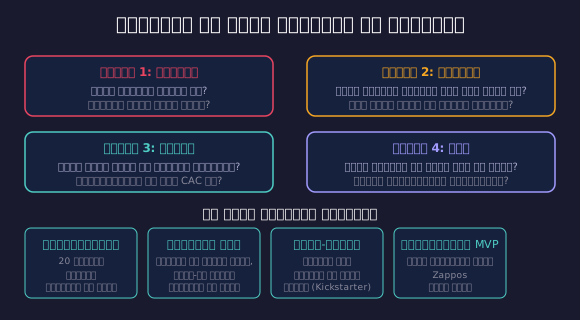
हर व्यावसायिक विचार धारणाओं पर टिकी होती है। सबसे खतरनाक वे हैं जिन्हें आप नहीं जानते कि आप बना रहे हैं।
एक भोजन-किट डिलीवरी सेवा के लिए, छिपी हुई धारणाएं हो सकती हैं:
- लोग भोजन योजना से इतने निराश हैं कि प्रीमियम के लिए भुगतान करेंगे
- वे वास्तव में भोजन बनाएंगे बजाय सामग्री को समाप्त होने दें
- डिलीवरी लॉजिस्टिक्स सभी लाभ मार्जिन को नहीं खाएगा
- ग्राहक फिर से ऑर्डर करेंगे, केवल एक बार नहीं कोशिश करेंगे
बूटस्ट्रैपिंग बनाम वित्तपोषण
पैसा कहाँ से आता है
एक व्यवसाय शुरू करने के लिए आपको पैसे की आवश्यकता है। कितना व्यवसाय के प्रकार पर निर्भर करता है, लेकिन उस पैसे का स्रोत सबकुछ को आकार देता है।
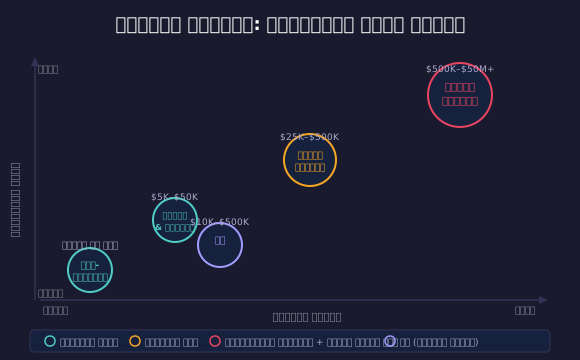
बूटस्ट्रैपिंग — अपनी बचत या राजस्व से खुद को वित्तपोषित करना
- आप 100% स्वामित्व और नियंत्रण रखते हैं
- आप उस गति पर बढ़ते हैं जो आपका राजस्व अनुमति देता है
- अधिकांश छोटे व्यवसायों को बूटस्ट्रैप किया जाता है
- जोखिम: यदि यह विफल हो जाता है, तो आप अपनी बचत खो देते हैं
दोस्त और परिवार — बाहरी वित्तपोषण का सबसे आम पहला दौर
- आमतौर पर $5,000 से $50,000
- शर्तें अक्सर अनौपचारिक होती हैं, जो बाद में समस्याओं का कारण बनती है
- जोखिम: विफल व्यवसाय संबंधों को नष्ट करते हैं
एंजल निवेशक — अमीर व्यक्ति जो $25,000 से $500,000 का निवेश करते हैं
- वे आमतौर पर इक्विटी (स्वामित्व प्रतिशत) प्राप्त करते हैं
- अक्सर मार्गदर्शन और कनेक्शन प्रदान करते हैं
- जोखिम: आप अपनी कंपनी का एक हिस्सा देते हैं
वेंचर कैपिटल (VC) — पेशेवर फर्में जो $500,000 से $50,000,000+ का निवेश करती हैं
- वे तेजी से विकास और एक बड़ी निकास की अपेक्षा करते हैं (अधिग्रहण या IPO)
- VC-वित्तपोषित कंपनियां सभी व्यवसायों का 1% से कम हैं लेकिन 99% मीडिया ध्यान प्राप्त करती हैं
- जोखिम: आप महत्वपूर्ण स्वामित्व और नियंत्रण देते हैं। बोर्ड आपको अपनी कंपनी से निकाल सकता है।
ऋण — बैंक, SBA ऋण, सूक्ष्मवित्त
- आप पूर्ण स्वामित्व रखते हैं लेकिन ऋण लेते हैं
- चाहे व्यवसाय सफल हो या नहीं, इसे चुकाया जाना चाहिए
- जोखिम: व्यक्तिगत देयता, विशेष रूप से व्यक्तिगत गारंटी के साथ
नकद प्रवाह और वित्तीय विवरण
नकद प्रवाह राजा है
लाभ और नकद प्रवाह एक ही चीज़ नहीं हैं। एक व्यवसाय कागज़ पर लाभदायक हो सकता है और फिर भी मर सकता है क्योंकि इसके पास नकदी खत्म हो गई।
उदाहरण: आप जनवरी में $10,000 मूल्य की परामर्श बेचते हैं। आपका ग्राहक 60 दिनों में भुगतान करता है। आपका किराया, वेतन और खर्च 30 दिनों में देय हैं। आप लाभदायक हैं लेकिन आपके पास अपने बिलों को भुगतान करने के लिए कोई नकदी नहीं है। इसे नकद प्रवाह अंतराल कहा जाता है, और यह हर दिन व्यवसायों को मारता है।
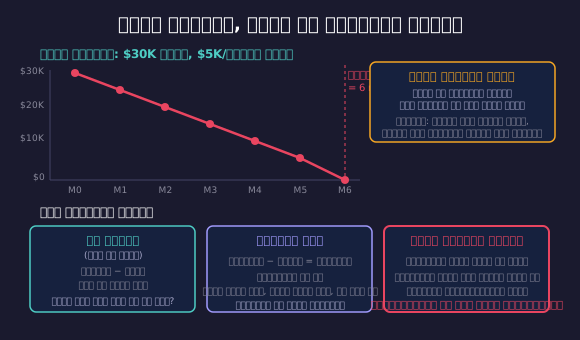
रनवे — आप पैसे खत्म होने से पहले कितने महीने संचालन कर सकते हैं। यदि आपके पास बैंक में $30,000 है और $5,000/माह बर्न करते हैं, तो आपका रनवे 6 महीने है। जब रनवे शून्य पर पहुंचता है, तो व्यवसाय मर जाता है। संस्थापकों को हमेशा अपना रनवे पता होना चाहिए।
तीन वित्तीय विवरण
हर व्यवसाय को तीन दस्तावेजों को समझने की जरूरत है:
- आय विवरण (P&L) — एक अवधि में राजस्व घटा व्यय। बताता है कि आप पैसा बना रहे हैं या खो रहे हैं।
- बैलेंस शीट — संपत्ति घटा देयता बराबर इक्विटी। आप क्या मालिक हैं, आप क्या देते हैं, और क्या बचा है इसका एक स्नैपशॉट।
- नकद प्रवाह विवरण — वास्तविक नकदी आने-जाने को ट्रैक करता है। स्टार्टअप के लिए सबसे महत्वपूर्ण है क्योंकि यह बताता है कि आप कब पैसे खत्म करेंगे।
मूल्य निर्धारण
अधिकांश नए उद्यमी अंडरप्राइस करते हैं। वे डरते हैं कि कोई भुगतान नहीं करेगा, तो वे बहुत कम चार्ज करते हैं। यह दो कारणों से खतरनाक है: (1) आप अपनी लागत को कवर नहीं कर सकते, और (2) कम कीमतें कम मूल्य का संकेत देती हैं। यदि एक सलाहकार $25/घंटा चार्ज करता है, तो आप मानते हैं कि वे अनुभवहीन हैं। यदि वे $250/घंटा चार्ज करते हैं, तो आप मानते हैं कि वे एक विशेषज्ञ हैं — भले ही वे एक ही व्यक्ति हैं।
आप ग्राहक को जो मूल्य प्रदान करते हैं उसके आधार पर मूल्य निर्धारित करें, न कि इसे आपको क्या खर्च होता है। यदि आपका सॉफ्टवेयर एक कंपनी को $100,000/वर्ष बचाता है, तो $10,000/वर्ष चार्ज करना उनके लिए एक सौदा है और आपके लिए बहुत अच्छा मार्जिन है।
व्यावसायिक संरचना और कानूनी बुनियादी
एकल संस्थापक बनाम सह-संस्थापक
सफल स्टार्टअप का लगभग 80% एक से अधिक संस्थापकों के पास है। सह-संस्थापक पूरक कौशल (एक बनाता है, एक बेचता है), साझा कार्यभार, और अनिवार्य कम बिंदुओं के माध्यम से भावनात्मक समर्थन लाते हैं। लेकिन सह-संस्थापक विवाद स्टार्टअप विफल होने के शीर्ष कारणों में से एक भी है।
यदि आप एक सह-संस्थापक लेते हैं, तो एक लिखित समझौता प्राप्त करें जो कवर करता है: इक्विटी विभाजन, निहित अनुसूची, भूमिकाएं, अगर कोई व्यक्ति चला जाता है तो क्या होता है, और निर्णय लेने का अधिकार। यह करें कि शुरुआत करने से पहले, मेज पर पैसे होने के बाद नहीं।
व्यावसायिक संरचनाएं
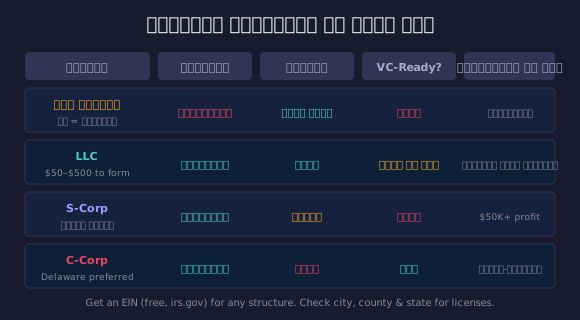
- एकमात्र स्वामित्व — सबसे सरल। आप और व्यवसाय कानूनी रूप से एक ही इकाई हैं। सेटअप करना आसान है, लेकिन आप व्यक्तिगत रूप से सबकुछ के लिए जिम्मेदार हैं। यदि व्यवसाय पर मुकदमा दायर किया जाता है, तो आपकी व्यक्तिगत संपत्ति जोखिम में है।
- LLC (सीमित देयता कंपनी) — आपकी व्यक्तिगत संपत्ति को व्यावसायिक देयताओं से अलग करता है। लचीला कर उपचार। छोटे व्यवसायों के लिए सबसे आम पसंद। राज्य के आधार पर $50-$500 में गठन की लागत।
- S-Corp — एक कर चुनाव (अलग संरचना नहीं) जो आत्म-रोजगार करों पर पैसा बचा सकता है एक बार जब आप लगभग $50,000-$60,000 लाभ में कमाते हैं। LLC से अधिक कागज़ी कार्य।
- C-Corp — वेंचर कैपिटल वित्तपोषण के लिए आवश्यक। दोहरा कराधान (कॉर्पोरेट कर और लाभांश पर व्यक्तिगत कर)। जटिल, लेकिन संस्थागत निवेश की मांग करने वाली कंपनियों के लिए आवश्यक।
लाइसेंस और परमिट
अधिकांश व्यवसायों को कुछ संयोजन की आवश्यकता है: एक व्यावसायिक लाइसेंस (शहर/काउंटी), एक राज्य कर आईडी, एक EIN (संघीय कर आईडी, IRS से मुफ्त), और उद्योग-विशिष्ट परमिट (खाद्य प्रबंधन, पेशेवर लाइसेंस, निर्माण परमिट)। आवश्यकताएं स्थान और उद्योग के अनुसार बहुत भिन्न होती हैं। लॉन्च करने से पहले अपने शहर, काउंटी और राज्य की वेबसाइट जांचें।
विफलता और सीखना
विफलता दर वास्तविक है
लगभग 50% व्यवसाय 5 वर्षों के भीतर विफल हो जाते हैं। यह गंभीर लगता है, लेकिन संदर्भ महत्वपूर्ण है:
- कई 'विफलताएं' ऐसे लोग हैं जिन्होंने कोशिश की, सीखा, और दूसरी बार एक बेहतर व्यवसाय शुरू किया
- अनुभवी उद्यमियों के लिए विफलता दर नाटकीय रूप से गिरती है — दूसरी बार संस्थापक अधिक बार सफल होते हैं
- विफलता की लागत बहुत अलग होती है। एक विफल साइड प्रोजेक्ट जिसकी लागत $2,000 और 6 महीने है, एक सस्ती शिक्षा है। एक विफल उद्यम जिसकी लागत $500,000 और आपका विवाह है एक आपदा है।
- सबसे बड़ा जोखिम कारक गलत विचार नहीं है — यह सही विचार खोजने से पहले नकदी खत्म करना है
विजेताओं को क्या अलग करता है
जो उद्यमी दीर्घकाल में सफल होते हैं वे कुछ विशेषताएं साझा करते हैं:
- वे निर्माण करने से पहले सत्यापित करते हैं
- वे अपनी नकदी को जुनूनी रूप से देखते हैं
- वे लगातार ग्राहकों से बात करते हैं
- वे पिवोट करते हैं जब डेटा कहता है
- वे अपनी निश्चित लागतें कम रखते हैं जब तक वे उत्पाद-बाजार फिट न पा लें
- वे असफलताओं को जानकारी के रूप में मानते हैं, निर्णय के रूप में नहीं