The Right First Instrument
A Cheap, Durable, Immediate On-Ramp
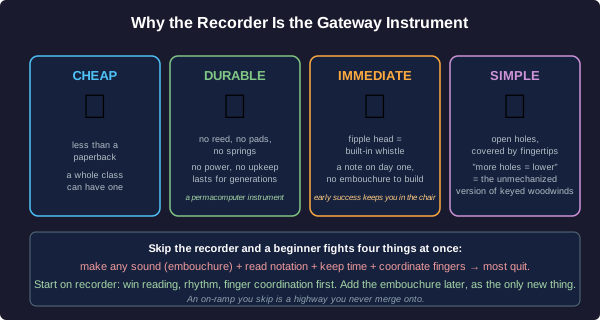
Most musicians do not start on a Stradivarius. They start on whatever instrument makes a sound on day one, costs almost nothing, survives a backpack, and teaches the fundamentals fast. For a century that instrument has been the recorder, and the reasons are practical:
- Cheap. A serviceable plastic soprano recorder costs less than a paperback book. A whole class can have one.
- Durable. No reed to crack, no pads to leak, no springs to bend. A plastic recorder shrugs off being dropped, sat on, and left in a car. A wooden one, cared for, outlasts the player. This is a permacomputer instrument: no electricity, no batteries, no firmware, no subscription. It works the day you buy it and the day your grandchild inherits it.
- Immediate. The recorder has a fipple head: a built-in whistle. You blow, and a note comes out, the very first second, with no embouchure to develop. A beginning clarinetist spends weeks just making a steady sound; a beginning recorder player is playing 'Hot Cross Buns' on day one. Early success keeps a beginner in the chair.
- Simple fingering. Open holes, covered by fingertips. No key mechanism between the player and the physics. The mental model ('more holes covered means a lower note') is the same model that the keyed woodwinds mechanize later.
What you would lose by skipping it. Hand a ten-year-old a saxophone instead, and they fight four things at once: making any sound (embouchure), reading notation, keeping time, and coordinating fingers. Most quit. Start them on recorder and they conquer reading, rhythm, and finger coordination on an instrument that already makes a sound, then add the embouchure later, alone, when it is the only new thing. The recorder is not a lesser instrument. It is the on-ramp, and an on-ramp that gets skipped is a highway you never merge onto.
Defend The Gateway
A school board member proposes cutting the grade-3 recorder unit: 'It is a toy. If we are serious about music, start the kids on real band instruments.'
Reading, Rhythm, Breath, Fingers, Embouchure
Most Of A Woodwind Player Is Already Built On The Recorder
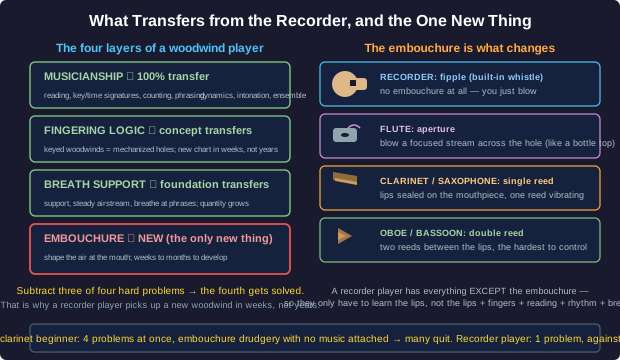
When a recorder player picks up a flute, clarinet, oboe, or saxophone, break what they carry over into four layers:
- Musicianship: 100% transfer. Reading notation, key signatures, time signatures, counting, phrasing, dynamics, articulation markings, intonation awareness, ensemble skills (following a conductor, counting rests, blending, tuning). None of this changes between instruments. A recorder player who reads fluently reads fluently on a saxophone.
- Fingering logic: the concept transfers, the patterns relearn. On a recorder, covering more holes lowers the pitch. The Boehm key systems on a modern flute, clarinet, oboe, and saxophone are exactly that idea mechanized: keys and pads are remote-controlled holes, so one finger can close a hole it cannot reach. The recorder player already has the mental model of 'fingerings as patterns' and the finger independence to execute them; the specific patterns are new, but learning a new fingering chart with that foundation is weeks, not years.
- Breath support: the foundation transfers, the quantity grows. A recorder uses gentle, steady, low-pressure air. A flute needs a lot of air; a clarinet and saxophone need firm, supported air against the resistance of a reed. But 'support from the diaphragm, a steady airstream, breathe at phrase points, do not let the tone sag' is identical. The recorder is in fact an excellent breath-training instrument precisely because it punishes overblowing instantly: blow too hard and it goes sharp or squeaks, so the recorder teaches air control by immediate feedback.
- Embouchure: this is the new thing, and it is the only new thing. The recorder has no embouchure: the fipple does the work. Every other woodwind makes you shape the air at the mouth: a flute asks you to blow a focused stream across an aperture (like blowing across a bottle top); a clarinet and a saxophone ask you to seal your lips around a mouthpiece and vibrate a single reed; an oboe and a bassoon ask you to control a double reed between your lips. This takes weeks to months to develop well.
Why this makes the switch fast. A child starting clarinet from zero learns embouchure plus fingerings plus reading plus rhythm plus breath, all at once, and the embouchure work is invisible drudgery with no music attached. A recorder player switching to clarinet learns embouchure and nothing else at first, with the reading, rhythm, breath, and finger model already in place: so the embouchure work happens against a backdrop of real playing, which is motivating, and it is the only thing standing between them and the new instrument. Subtract three of the four hard problems and the fourth gets solved.
Picking Up The Clarinet
A fluent soprano-recorder player, fifteen years old, wants to join the school band on clarinet.
The Recorder Family Mirrors The Woodwind Family
Soprano To Bass, On Both Sides
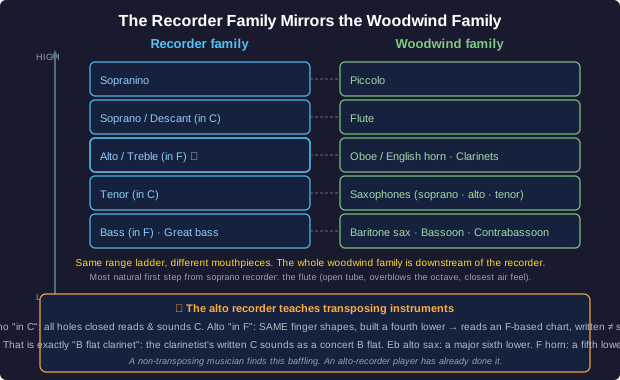
The recorder is not one instrument but a family, stacked by range like the voices in a choir: sopranino (highest), soprano / descant (in C), alto / treble (in F), tenor (in C), bass (in F), great bass (lowest). A recorder consort plays one instrument per part, the way a choir has soprano, alto, tenor, and bass singers.
The woodwind family of a band or orchestra has the same shape: piccolo (highest), flute, oboe and English horn, the clarinets (Eb, Bb, bass), the saxophones (soprano, alto, tenor, baritone), and the bassoon and contrabassoon (lowest). Same range ladder, different mouthpieces. A recorder player who has handled soprano, alto, and tenor recorders has already lived the experience of switching sizes within a family, which is exactly what moving from flute to clarinet to saxophone asks.
Transposing instruments. Here is where the alto recorder earns its keep. A soprano recorder is 'in C': all holes closed, it reads and sounds the note C. An alto recorder is 'in F': the player uses the same finger shapes, but the instrument is built a fourth lower, so it reads from an F-based fingering chart and the written note maps to a different concrete pitch. This is the transposing instrument concept, and it runs the entire wind section: a B flat clarinet sounds a whole step lower than written (the clarinetist's written C is a concert B flat); an E flat alto saxophone sounds a major sixth lower than written; an F horn sounds a fifth lower. Once you have internalized 'the alto recorder fingers like the soprano but sounds different and reads differently', every transposing instrument in the orchestra makes sense. A non-transposing musician finds this baffling; an alto-recorder player has already done it.
Why school bands do it this way. A typical program puts every child on recorder in grade 3 or 4, then lets them choose a band instrument in grade 5 or 6. By then the child reads music, keeps time, and coordinates fingers, and has heard the band instruments enough to choose with some idea of what they want. The recorder year is the foundation year and the audition year both at once. And the recorder consort, in a school that runs one, is the wind ensemble in miniature: a child who has played alto recorder in a four-part consort has rehearsed exactly the skills a clarinet section needs.
Mapping The Families
A grade-5 student plays soprano recorder fluently and is choosing a band instrument.
The Sequence, And Reading The Symptoms
How A Brand-New Group Gets Started
Teaching beginning recorder is how most music educators start a cohort of children, and the sequence is well-worn because it works:
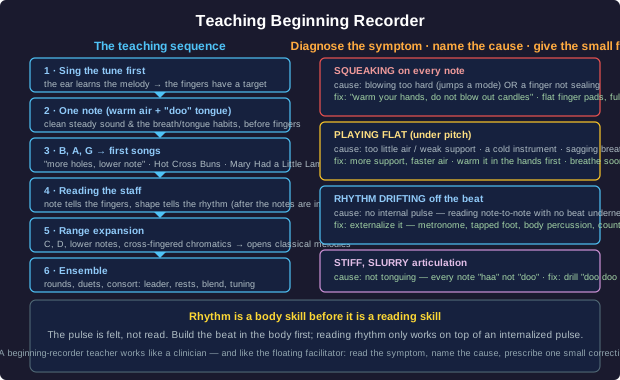
1. Sing the tune first. Before any recorder touches a lip, the group sings the song. The ear learns the melody, so the fingers have a target. A musician who cannot sing it cannot play it well.
2. One note, with the breath and the tongue. Everyone plays a single note (often B, just the left thumb and index finger): the lesson here is gentle warm air, not hard blowing, and starting each note with a whispered 'doo' or 'too' (tonguing) instead of a slide. Get a clean, steady single note before adding anything.
3. B, A, G: the first three notes, the first songs. Add A (left middle finger), then G (left ring finger): 'more holes covered, lower note.' Now 'Hot Cross Buns' and 'Mary Had a Little Lamb' are playable, both built from just these three.
4. Reading. Map the notes onto the staff; introduce note durations. The note tells the fingers; the note shape tells the rhythm.
5. Range expansion. Add C and D, then the lower notes that need the right hand, then chromatic notes by cross-fingering. The repertoire opens up: nursery tunes, folk songs, and classical melodies like Beethoven's 'Ode to Joy' and Grieg's 'In the Hall of the Mountain King.'
6. Ensemble. Rounds, duets, then a consort if the program supports it: following a leader, counting rests, blending, tuning.
Diagnose The Symptom, Name The Cause, Give The Small Fix
A beginning-recorder teacher works like a clinician (and like the floating facilitator in Geometry of Facilitation): read the symptom, identify the cause, prescribe one small correction. The common ones:
- Squeaking on every note. Either the student is blowing too hard (the recorder jumps to a higher mode: tell them 'warm your hands, do not blow out candles') or a finger is not sealing a hole (a tiny gap leaks air: check the finger pads are flat and fully covering).
- Playing flat (under pitch). Either not enough air (a sagging, breathy tone: more support, a faster airstream) or a cold instrument (a recorder is flat until it warms up: warm it in the hands first) or tired, sagging breath at the end of a phrase (plan the breath, breathe sooner).
- Rhythm drifting. Almost always no internal pulse: the student is reading note-to-note with no beat underneath. The fix is to externalize the beat: a metronome, a tapped foot, body percussion, count out loud, march it. Rhythm is a body skill before it is a reading skill.
- Stiff, slurry articulation. Not tonguing: every note is whispered 'haa' instead of 'doo,' so notes blur together. Drill the tongue: 'doo doo doo doo' on one note.
The First Lesson, And Three Beginners
You have a brand-new group of grade-3 students and their recorders. Also, three weeks in, you notice: Student A squeaks on almost every note; Student B plays consistently flat; Student C's rhythm drifts off the beat.
Recorder Is The First On-Ramp, Not The Only One
Parallel On-Ramps Into A Lifetime Of Music
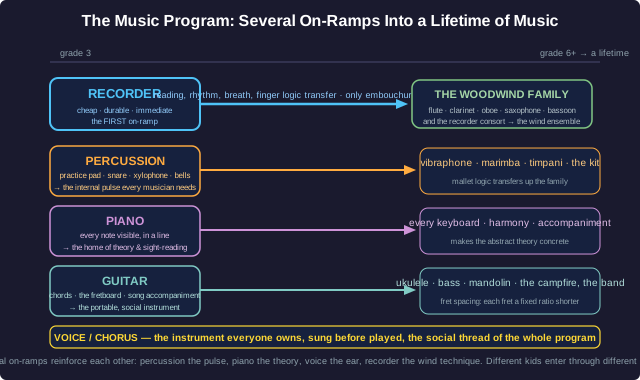
Recorder leads into the woodwind family. It is the on-ramp we build first because it is the cheapest, most durable, and most immediate. But a full music program has several on-ramps, each its own ladder, each leading somewhere wide:
- Percussion. Start on a practice pad and a snare for hands and rhythm, and a xylophone, glockenspiel, or bells for pitched-mallet playing. Reading and rhythm transfer to every instrument there is; the mallet logic transfers up the percussion family to vibraphone, marimba, timpani, and the full kit. Every musician benefits from a season of percussion, because nothing builds an internal pulse like having to keep it for everyone else.
- Piano. The universal instrument. Every note is visible and laid out in a line, so the piano is the natural home for theory, sight-reading, harmony, and accompaniment, and the keyboard skills transfer to every keyboard there is, from a church organ to a synthesizer. Many musicians who play a wind or string instrument keep piano as a second instrument for exactly this reason: it makes the abstract theory concrete.
- Guitar. Chords, the fretboard, and song accompaniment. The everyman's instrument: portable, social, and the fastest route to playing songs around a fire or in a band. The fretboard has its own geometry (each fret a fixed ratio shorter than the last), and the chord shapes transfer to ukulele, bass, and mandolin.
- Voice. The instrument everyone already owns. Singing underlies all of it: in this very ladder, every recorder song is sung before it is played. A voice or chorus ladder is the social thread of a music program: a circle of people making sound together, which is the thing a learner misses most when a program forces a choice between music and something else.
The shape of the program. A child enters on recorder in grade 3, because it is cheap and immediate. Along the way they spend time on percussion (for the pulse), maybe a year of piano (for the theory), maybe a guitar unit (for the songs), and they sing throughout. By grade 6 they pick a band instrument, and because the recorder did its job, the pick is informed and the transfer is fast. Some of them keep going: the recorder-and-flute doubler in a pit orchestra, the early-music professional in a Baroque ensemble or a recorder consort, the music teacher who now starts the next cohort on recorder, the adult who plays in a community band for forty years. A lot of those lives started on a plastic recorder in third grade. That is what an on-ramp is for.
Designing The Program
Someone says: 'The recorder is just a plastic toy. If we are building a serious music program, skip it and put the resources into real instruments.'
Recorder To The Woodwind Family: Summary
What You Have Learned
- Why the recorder is the gateway. Cheap, durable, immediate (a note on day one, no embouchure to develop), simple fingering. A permacomputer instrument: no power, no maintenance, lasts for generations. Skip it and a young beginner fights making a sound, reading, timing, and finger coordination all at once, and most quit.
- What transfers, and what is new. Musicianship (reading, rhythm, phrasing, dynamics, intonation, ensemble): 100% transfer. Fingering logic: the concept transfers, the patterns relearn fast (keyed woodwinds are mechanized holes). Breath support: the foundation transfers, the quantity grows. Embouchure: the new thing, and the only new thing: fipple, then aperture (flute), then single reed (clarinet, saxophone), then double reed (oboe, bassoon). Subtract three of the four hard problems and the fourth gets solved: that is why a recorder player picks up a new woodwind in weeks, not years.
- The family map. The recorder family (sopranino, soprano in C, alto in F, tenor in C, bass in F, great bass) lines up by range with the woodwind family (piccolo, flute, oboe, clarinets, saxophones, bassoon). The alto recorder ('in F') versus the soprano ('in C') is the transposing-instrument concept: the same idea as a 'B flat clarinet': so an alto-recorder player already understands the whole transposing wind section.
- Teaching beginning recorder. Sing first, one note before three, B-A-G, then reading, then range, then ensemble. Diagnose the symptom, name the cause, give the small fix: squeaking = overblowing or a leaky seal; flat = too little air or a cold instrument; rhythm drift = no internal pulse (externalize the beat). Rhythm is a body skill before a reading skill.
- The broader program. Recorder is the first on-ramp, not the only one: percussion (the pulse), piano (the theory), guitar (the songs), voice (the social thread) are parallel on-ramps, each its own ladder, each leading somewhere wide. Several on-ramps is a strength: different kids enter through different doors, and the on-ramps reinforce each other.
Hand a child a recorder in third grade and you have not handed them a toy. You have handed them the first key on a ring that opens the flute, the clarinet, the saxophone, the oboe, the whole wind section, and: through the parts that transfer everywhere: the piano, the percussion section, the guitar, and the choir too. The instrument is cheap. The door it opens is not.