The Continental Drift Expert Failure
Richard Hamming opens Chapter 26 with the continental drift story from the experts' perspective.
Biologists studying ancient distributions of life had already postulated a Pangaea — a single original continent — to explain why identical fossil species appeared on continents now separated by vast oceans. No land bridges were needed: the continents themselves had moved.
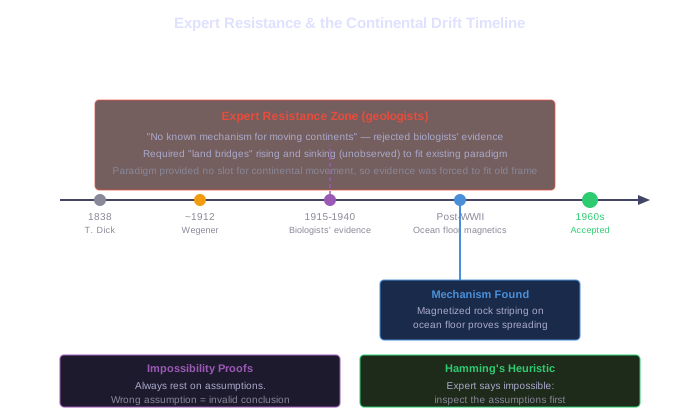
Geologists resisted. Their objection was specific: no one could propose a physical mechanism for how solid continents could move through solid oceanic crust. The biological evidence was real, but without a mechanism, it had no place in geology's conceptual framework.
Hamming's observation: geologists now claim they 'had always sort of believed in it' — but the textbooks they used told a different story. This is the typical pattern of a paradigm change: it is resisted, sometimes for decades, until a mechanism arrives. Then the experts retroactively claim they were never really opposed.
The mechanism came after World War II: oceanographers studying the ocean floor with magnetic instruments found symmetrical striping of magnetized rock on both sides of mid-ocean ridges. This proved the ocean floor spreads outward from the ridge — and provided the mechanism geologists required.
What Experts Filter
Hamming states: 'Experts in looking at something new always bring their expertise with them as well as their particular way of looking at things. Whatever does not fit into their frame of reference is dismissed, not seen, or forced to fit into their beliefs.'
He distinguishes three outcomes: dismissed (seen but rejected), not seen (invisible), or forced to fit (distorted to match existing beliefs).
Experts Can Fail in Both Directions
Hamming identifies two symmetric failure modes of expertise:
Failure Mode 1 — False Negative: the expert resists a valid new idea because it conflicts with the established paradigm. The geologist rejecting continental drift. The expert pronouncing heavier-than-air flight impossible days before the Wright brothers flew.
Failure Mode 2 — False Positive: the expert promotes an invalid idea because it fits the paradigm. A new result that slots neatly into existing theory gets less scrutiny. The paradigm provides cover for weak work.
Both failure modes have the same root cause: the paradigm filters perception. The first filters out too aggressively; the second not aggressively enough. The expert's framework is the constant; what varies is which direction the filtering goes.
Hamming also makes a statistical observation: most of the great innovations come from outside the field. Insiders are too deep in the current paradigm to see past it. Outsiders bring a different framework — or no framework at all — and sometimes that is the advantage.
The Outsider Advantage
Hamming cites radiocarbon dating as an example: the central archaeology problem of dating ancient remains was solved by a physicist (Willard Libby), not by an archaeologist. Archaeologists had elaborate stratigraphic dating methods. Libby brought nuclear physics and had no investment in stratigraphy.
All Impossibility Proofs Have Assumptions
Hamming's sharpest practical lesson in Chapter 26: an expert told him, early in his career, that a certain type of bounded continued fraction could not converge. Hamming doubted the claim, worked on it himself, and found the expert was wrong.
His principle, stated precisely: all impossibility proofs rest on assumptions. When one or more of those assumptions does not hold, the impossibility proof fails.
Experts rarely state the assumptions explicitly when pronouncing something impossible. They state the conclusion. But the conclusion is only as valid as the assumptions.
Historical cases Hamming cites: 'You cannot lift water more than 33 feet' (correct under one assumption — ordinary pump mechanics — but violated by standing wave methods). 'Heavier-than-air flight is impossible' (correct if you assume wings must generate lift the way kites do, perhaps not correct otherwise). 'Supersonic flight is impossible' (correct for the materials and geometries then known).
Hamming's heuristic: If an expert says something can be done, they are probably correct. If an expert says something is impossible, consider getting another opinion — and inspect the assumptions.
Find the Assumption
The '33 feet of water' example in detail: standard physics correctly derives that a suction pump can lift water at most 33 feet (approximately 10 meters), because atmospheric pressure is approximately 1 atmosphere, which supports a 10-meter water column. A patent examiner rejected a claim that exceeded this limit. The inventor demonstrated it by pumping water to the roof of a building far above 33 feet — using a standing wave technique that alternately admitted water at the bottom and expelled it at the top.
Working with Experts in Your Career
Hamming closes the chapter with advice for practitioners who will face expert resistance throughout their careers.
Four reasons he raises the topic:
1. You will deal with experts. Understanding their characteristics helps you navigate.
2. Many of you will become experts. Understanding the failure modes now may prevent you from becoming a roadblock later.
3. The rate of paradigm change is increasing. You will face more changes than previous generations.
4. Fewer of you need to be left behind by paradigm changes if you understand the pattern.