The Objection Pattern
Chapter 8 opens mid-argument. Hamming has been presenting examples of machine capability. Students & colleagues keep raising the same objections. He catalogs them & offers rebuttals.
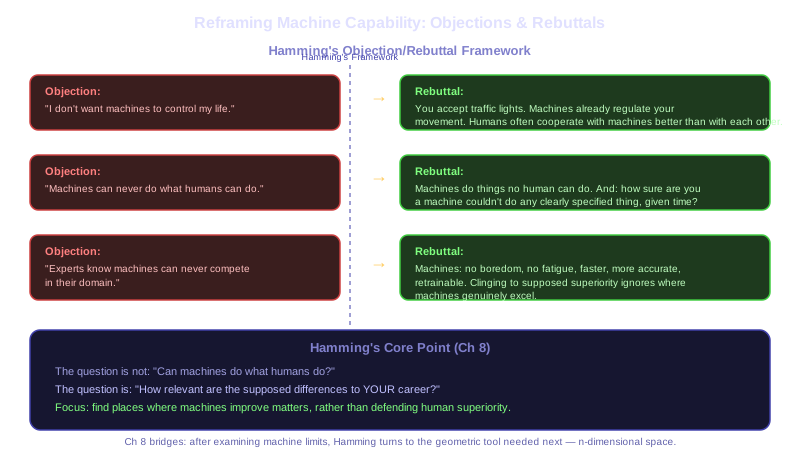
Objection 1: 'I don't want machines to control my life.'
Hamming's rebuttal: you already accept this. Traffic lights control your movement. Pacemakers govern your heartbeat. The objection proves too much: if it were valid, you would refuse every existing machine control. You don't. So the question is not whether machines control your life — they already do — but which machine controls are good & which are not.
Objection 2: 'Machines can never do what humans can do.'
Hamming's rebuttal: machines already do things no human can do. Millisecond-by-millisecond aircraft stability control, error-free petabyte-scale data storage, simultaneous language translation. The objection is demonstrably false in the strong form. In the weak form ('machines can't do everything humans can do'), it is trivially true but unhelpful.
Objection 3: Experts claim machines can never compete in their domain.
Hamming's observation: experts consistently defend human superiority in their domains while ignoring the full inventory of machine advantages. He lists: economics, speed, accuracy, reliability, rapid control, freedom from boredom, bandwidth, ease of retraining, hostile environments, no personnel problems. Experts dismiss the list without engaging it.
Analyzing the Objection Pattern
Hamming notices a structural pattern in how people resist machine capability arguments. They select one supposed human advantage & defend it, while declining to engage the comparative list of machine advantages.
His prescription: instead of defending human superiority, look for places where machines can improve matters. The combination of human & machine exceeds both.
What the Debate Actually Means for Your Work
Hamming closes the three-chapter machine reasoning sequence with a sharp pivot: 'In any case how relevant are these supposed differences to your career?'
This is the question most people avoid. The philosophical debate about whether machines 'really think' is entertaining but career-irrelevant for most practitioners. The practically important question is narrower & sharper: in your specific field, in the work you actually do, where does the human-machine boundary currently sit, & how fast is it moving?
Hamming's observation: people resist thinking clearly about this, in both directions. Those who believe machines cannot do their job fail to adopt tools that would multiply their effectiveness. Those who assume machines will take their job neglect to develop the non-routine judgment that makes their work irreplaceable.
His prescription is direct: 'Think more carefully on the awkward topics of machines thinking and their vision of their personal future.' Articulate your position, then examine it with counterarguments, back & forth, until you know what you believe & why.
Why n-Dimensional Space Comes Next
Hamming ends the machine-reasoning chapters & pivots to n-dimensional geometry. The connection is not arbitrary.
Design problems — & machine reasoning problems — take place in high-dimensional spaces. Every independent parameter adds a dimension. A bridge design might have dozens of parameters: material properties, cross-section dimensions, load assumptions, safety factors. The design space is 50-dimensional. The space of all possible machine learning models has far more dimensions.
Hamming's reflection: when he looked back on large engineering projects after 30 years, he noticed they all had common structure. 'The design problems all took place in a space of n-dimensions, where n is the number of independent parameters.' Understanding high-dimensional geometry is not optional; it is the prerequisite for clear thinking about any complex design.
The Surprise of High Dimensions
Low-dimensional intuitions break in high dimensions. Hamming's random walk observation: in three dimensions, a random walker almost never returns to the origin. In two dimensions, a random walker returns with probability 1. This difference has direct implications for how you encounter & re-encounter people, ideas, & problems — depending on the dimensionality of the space you operate in.