What This Course Is
Richard Hamming spent 30 years at Bell Telephone Laboratories, then taught at the U.S. Naval Postgraduate School in Monterey. His graduate course drew entirely from his own experience. He called it 'Hamming on Hamming.'
He opened every class with: 'There is really no technical content in this course.' Coding theory, digital filters, & simulation examples served only as window dressing. What he wanted to teach could not pass through words directly: a style of thinking.
In his preface, he compared teaching style to teaching painting:
> A great painter cannot be taught in words; one learns by trying many different approaches that seem to surround the subject. Art teachers let the advanced student paint, then make suggestions on how they would have done it, or what might also be tried.
He described his work as 'meta-education': not teaching content, but teaching how to look at & think about knowledge.
Education vs Training
> Education is what, when, and why to do things. Training is how to do it.
Most courses deliver training. This one attempts education. You already have training. What you need now: style.
Education vs Training
Hamming observed that most technical courses deliver training, leaving the 'what' and 'why' questions largely unaddressed.
A well-trained person executes known procedures reliably. An educated person figures out which problems deserve attention in the first place. Both matter. Neither alone suffices.
The Knowledge Explosion
Hamming made a simple, brutal observation: knowledge doubles roughly every 17 years. The half-life of technical knowledge runs about 15 years: half of what you know right now will become obsolete in 15 years.
He ran a back-of-envelope calculation to verify the two claims were consistent — they are — then asked: what does this mean for how you study?
His answer: concentrate on fundamentals, & develop the ability to learn new fields rapidly. A child born today will face, at the peak of their career, roughly four times the technical knowledge that exists now.
His test for whether something qualifies as fundamental:
> One test is they have lasted a long time. Another test is that from the fundamentals, all the rest of the field can be derived using the standard methods in the field.
The Drunken Sailor
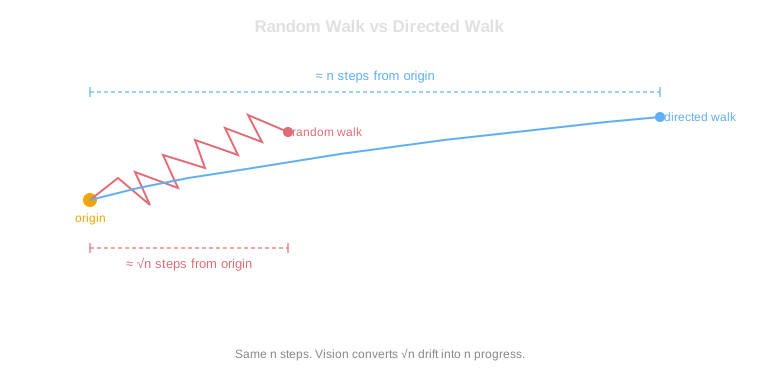
Hamming used a probability argument to make the case for having a vision:
> A drunken sailor who staggers left or right with n independent random steps will, on average, end up about √n steps from the origin. But if there is a pretty girl in one direction, his steps will tend to go in that direction and he will go a distance proportional to n.
In a lifetime of many small choices, a career with a vision produces distance proportional to n. Without vision: only √n. For large n, the difference is nearly everything.
He was careful about precision:
> The accuracy of the vision matters less than you might suppose — getting anywhere is better than drifting. There are potentially many paths to greatness for you, and just which path you go on, so long as it takes you to greatness, is none of my business.
He also distinguished three questions everyone in science & engineering must learn to ask separately:
1. What is possible? — Science
2. What is likely to happen? — Engineering
3. What is desirable? — Ethics
Most people ask only the first, occasionally the second, rarely the third.
Directed vs Drifting
Apply the random walk argument to a real career.
How Creativity Works
Hamming opened his creativity chapter by separating three things most people conflate:
- Creativity: making something of genuine value that did not exist before
- Originality: making something that has not been done before
- Novelty: making something different from what exists
You can achieve all three properties of novelty with zero creativity: multiply two random 10-digit numbers. The product probably never appeared before in human history. But no one cares.
Analogy as the primary tool
Hamming called analogy 'probably the most important tool in creativity.' When something resembles something else we already understood, we can transfer the solution framework.
His central example: Kekulé dreamed of a snake biting its own tail. He woke up and saw the benzene ring. The analogy needed only to suggest, not to be exact.
He described the creative process in five stages:
1. Recognition of the problem — often dim at first
2. A gestation period of intense thinking, followed by temporary abandonment
3. Emotional involvement: commitment to finding a solution
4. Moment of insight — usually from the subconscious
5. Logical cleanup and presentation to others
His method: saturate the subconscious with the problem, then give it space. 'Luck favors the prepared mind.' — Pasteur
The Analogy That Worked
Hamming also described a method for building richer analogical memory: when you learn something new, immediately ask what else it applies to. File the knowledge with many hooks, not just the one that got you there.
When to Drop a Problem
Hamming gave a warning that cut against most self-help advice:
> If you cannot drop a wrong problem then the first time you meet one you will be stuck with it for the rest of your career.
His example: Einstein. Tremendously creative in his early years. Once he began the search for a unified field theory in mid-career, he spent the rest of his life on it — and had almost nothing to show for the effort.
Hamming thought managing a creative career required actively deciding which problems to abandon, not just which to pursue. Previous successes can convince you that you can solve any problem. But some problems are not ready: continuing on them costs you the time you could spend on tractable ones.
The Expert Problem
Hamming drew heavily on Kuhn's The Structure of Scientific Revolutions. Under normal science, a field operates within a shared paradigm: accepted assumptions, accepted problems, accepted methods. Workers extend the paradigm; they seldom question it.
When the paradigm changes, the experts get left behind.
> What you did to become successful is likely to be counterproductive when applied at a later date.
He illustrated this with computing. His bosses at Bell Labs had built careers on analytical methods. They saw computers as inferior to proper mathematics. When digital methods became dominant, those bosses could not keep up. Most disappeared from the field.
His summary:
> An expert knows everything about nothing; a generalist knows nothing about everything.
On the asymmetry of expert claims:
> If an expert says something can be done, they are probably correct. If they say it is impossible, get another opinion.
Why innovations come from outside
Continental drift: proposed by Wegener (a meteorologist, not a geologist), accepted by oceanographers, before geologists came around. Carbon dating came from physics, not archaeology. The first automatic telephone came from an undertaker who thought operators cheated him.
Experts are not evil; they are economical. It makes sense to try old, successful approaches before looking for new ones. But this means genuinely new paradigms rarely emerge from insiders.
Why Expert Impossibility Claims Are Suspect
Hamming's sharpest statement on expert authority:
> All impossibility proofs must rest on a number of assumptions which may or may not apply in the particular situation.
When You Become the Expert
Hamming spent half of Chapter 26 warning about expert failure, then pivoted:
> The second point I want to make is many of you, in your turn, will become experts, and I am hoping to modify in you the worst aspects of the know-it-all expert.
He vowed, when he rose near the top at Bell Labs, not to participate in decisions about computer choices — he did not want to become the drag on the next generation that his bosses had been on him.
Data Lies More Than You Think
Hamming opened his unreliable data chapter with a blunt claim: data generally runs far less accurate than advertised.
He offered his rule:
> 90% of the time the next independent measurement will fall outside the previous 90% confidence limits.
He called this an exaggeration for memorability. The underlying truth: most published measurement accuracies fall nowhere near as good as claimed.
Why experiments produce biased accuracy claims
When you assemble equipment for an experiment, it does not work perfectly. You spend time fine-tuning until you get consistent, reproducible runs. You then hand this fine-tuned, low-variance data to a statistician who computes a confidence interval.
The problem: you fine-tuned specifically to reduce variance. The statistician sees low-variance data and concludes accuracy runs high. But you did not reduce the error; you adjusted specifically for low variance. The systematic bias from fine-tuning does not appear in the variance. You supply low-variance data; you get back high-claimed accuracy.
He cited the BIRGE 1929 vs CODATA 1973 comparison of fundamental physical constants. The average actual error ran 5.267 times larger than the estimated error. The world's leading experts were off by a factor of five on their own uncertainty estimates.
Two Sources of Claimed Accuracy
Hamming names two major causes of experimental measurements producing accuracy claims far too optimistic.
You Get What You Measure
Hamming closed Chapter 29 with a single sentence:
> You get what you measure.
He illustrated with two cases:
- Lines of code: measuring software productivity by lines of code creates incentive to write more code, not better code. Clean, compact, reliable code scores lower on the metric than bloated code.
- Navy readiness: ships inspected on a regular schedule receive special preparation for inspections. Day-to-day readiness is not what gets measured, so it does not get optimized.
The pattern: once you establish a metric, people optimize for the metric rather than the underlying goal. The metric becomes the target, displacing the thing it was meant to measure.
The Physics Table
Chapter 30 summarizes the entire book. Hamming called it 'You and Your Research,' though he noted he could equally have called it 'You and Your Career.'
Working on important problems
> If you do not work on important problems how can you expect to do important work?
He described eating for years at the Physics table at Bell Labs. Conversation revolved around fame, promotion, & being hired away. He moved to the Chemistry table, began asking: 'What are the most important problems in your field?' Most could not answer. Those who could answer were not working on them.
He later saw one of those chemists in a hallway: 'What you said caused me to think all summer about what the important problems are in my field.' That chemist became head of his group. Hamming never heard from the Physics table again.
Drive as compound interest
> Intellectual investment is like compound interest. The more you do the more you learn how to do, so the more you can do. One extra hour per day over a lifetime will more than double the total output.
The open door
He observed that people with closed office doors got more work done per year. But people with open doors worked on the right problems. The open door led to the open mind. He could not prove cause and effect — he could see only the correlation.
Ambiguity tolerance
> Great people can tolerate ambiguity: they can both believe and disbelieve at the same time. You must be able to believe your field is the best there is, but also that there is much room for improvement.
Friday afternoons
For years he devoted 10% of his time: Friday afternoons: to asking where computing was heading. Not answering questions — asking them. He credited this habit with keeping him directional in the face of rapidly changing technology.
The Important Problems Question
Hamming's question at the Chemistry table: 'What are the most important problems in your field, and why are you not working on them?'
Your Friday Afternoons
Hamming closed the book:
> The unexamined life is not worth living. — Socrates
His practical recommendation: set aside time on a regular basis to ask the big questions. Not to answer them — to ask them. Ask: What is the most important problem in my field? Where does my field go in 20 years? What would I work on if I had no constraints for three months?
The Friday afternoon habit was not research — it was navigation. It kept him from drifting.