The Feedback Structure
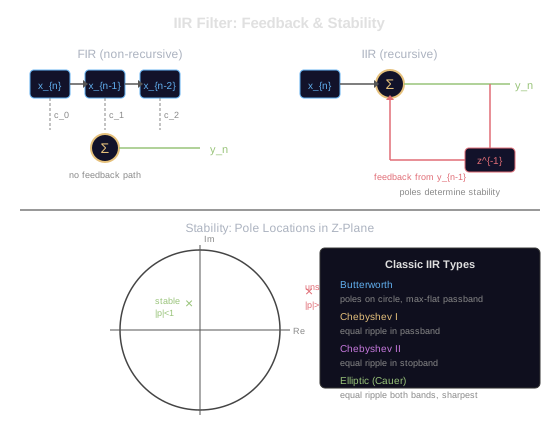
An FIR (finite impulse response) filter computes each output sample as a weighted sum of current & past inputs only. No feedback. The impulse response has finite duration.
An IIR (infinite impulse response) filter feeds previous outputs back into the computation:
y_n = Σ b_k · x_{n−k} − Σ a_k · y_{n−k}
The recursive term −Σ a_k · y_{n−k} creates feedback. A single impulse at the input will echo around the feedback loop indefinitely (decaying geometrically if stable).
Why Use Feedback?
An IIR filter can achieve sharp frequency selectivity with far fewer coefficients than an FIR filter. A 2-pole IIR can approximate what requires a 50-coefficient FIR for the same stopband attenuation.
The price: potential instability. The poles of H(z) determine stability. All poles must lie strictly inside the unit circle.
Hamming's Feedback Shower Story
Hamming used a vivid personal story to illustrate feedback instability.
He stayed in the same hotel room repeatedly because familiarity helped him orient himself when tired. The plumber had installed large-diameter hot-water pipes in the shower. These created a significant delay between adjusting the knob and feeling the change in water temperature.
Each morning, Hamming followed the same pattern: water too cold → turn up hot → still cold → turn up more → suddenly boiling → jump out → turn down → repeat.
The delay in the feedback path meant his corrections always overshot. He could not adapt to the delay, even after many repetitions.
The engineering lesson: instability arises either from excessive gain in the feedback path OR excessive delay in the feedback path. Both manifest as the same hunting behavior. In filter terms: poles at or outside the unit circle produce exactly this oscillatory or diverging response.
Characterizing the Instability
Hamming observed that the same shower instability could be analyzed two ways:
1. His response was too strong (excessive gain in the correction action).
2. His detection was too delayed (too hasty to enter the tub before the system settled).
Both descriptions produce the same mathematical result: the feedback loop's pole has moved outside the unit circle.
The Four Classic Families
Analog filter theory developed around four classical design families, each representing a different trade-off. These families transform to discrete time via the bilinear transform or impulse invariance.
Butterworth (Maximally Flat)
Passband response: |H(jω)|² = 1 / (1 + (ω/ω_c)^{2N}). Monotonically decreasing. No ripple in passband or stopband. Poles lie on a circle of radius ω_c in the s-plane (or transformed circle in the z-plane). The flattest possible passband for a given order N.
Chebyshev Type I
Equal ripple in the passband, monotone in the stopband. For a given order N and ripple level, achieves sharper cutoff than Butterworth. Poles lie on an ellipse (in the s-plane).
Chebyshev Type II
Equal ripple in the stopband, monotone in the passband. Mirror image of Type I in the frequency domain.
Elliptic (Cauer)
Equal ripple in BOTH passband and stopband. For a given order N and ripple levels, achieves the sharpest possible transition from passband to stopband. Uses elliptic functions to place poles & zeros optimally. Hamming: the name comes from the fact that elliptic functions are used in the derivation.
The Fundamental Trade-Off
All four families achieve the same basic trade-off differently: higher order N gives sharper transition. Allowing ripple (Chebyshev, elliptic) achieves sharper transition for the same N. Elliptic achieves the absolute sharpest transition for any given N and ripple specifications.
Choosing Among Filter Families
The choice among families depends on what the application tolerates.
Questioning the Expert Claim
Hamming recalled that certain experts had claimed all IIR (recursive) filters possessed a particular property. He asked himself whether this was really true — and found a counterexample.
His point: experts often carry claims they absorbed in school without ever re-examining them in the context of current problems. If you ask yourself whether what you are being told is really true, it is amazing how much you can find is, or borders on, being false, even in a well-developed field.
The counterexample was not the kind of filter you would normally design, but it proved the claim superficial. A single counterexample suffices to disprove a universal claim.
IIR Design in Practice
Hamming noted he had independently developed much of IIR filter theory while solving a different problem: deriving stable corrector formulas for numerical ordinary differential equations.
The corrector formula form: y_n = Σ a_k · y_{n−k} + Σ b_k · f(y_{n−k})
Feedback appears in both the y terms (linear feedback) and the f(y) terms (nonlinear feedback through the differential equation). Stability for IIR filters is a special case of the more general problem of stability for numerical ODE integrators.
Connecting Feedback Across Domains
The same mathematical structure — feedback, poles, stability boundary — appears in digital filters, numerical ODE solvers, control systems, biological rhythms, & economic models.
In each domain: a feedback loop computes a new state from previous states. Stability requires that the feedback not amplify perturbations indefinitely.
The unit circle stability boundary in the Z-plane corresponds to: the imaginary axis in the Laplace s-plane (continuous time), the spectral radius condition ρ(A) < 1 for linear iterations, & the Lyapunov exponent condition λ < 0 for nonlinear systems.