How Hamming Learned Digital Filters
Hamming came to digital filters as a mathematician, not an electrical engineer. When he asked engineers why they used sinusoids instead of polynomials or Bessel functions, no one gave a satisfying answer. So he went back to basics.
He identified three independent reasons why complex exponentials dominate digital signal processing. Each reason alone justifies the choice; together they make it nearly obligatory.
Reason 1: Time Invariance
Most signal processing systems carry no natural origin of time. A filter applied at noon should behave identically to the same filter applied at midnight. This constraint of time invariance forces the eigenfunctions to be complex exponentials.
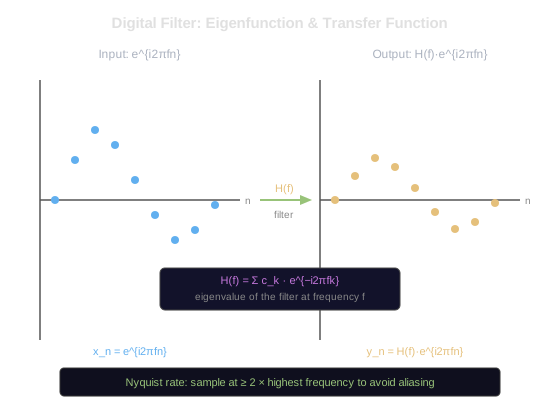
In mathematical terms: if a linear, time-invariant (LTI) system has input x(n) = e^{i2πfn}, the output must also oscillate at frequency f. Only complex exponentials satisfy this.
Reason 2: Linearity
Linear systems obey superposition. The eigenfunctions of any linear operator are the functions that emerge unchanged (except for scaling) when the operator acts on them. For the shift operator S: x(n) → x(n−1), the eigenfunctions are exactly e^{i2πfn}.
Reason 3: Nyquist Sampling
If a continuous signal contains no frequencies above f_max, sampling it at rate ≥ 2f_max captures all information. This Nyquist-Shannon sampling theorem connects continuous & discrete signal processing cleanly only for Fourier representations.
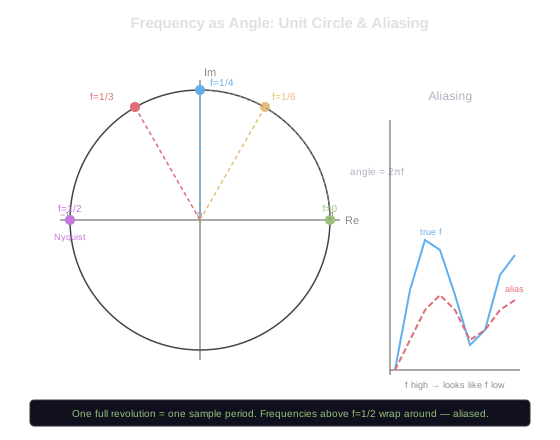
Under equal-spaced sampling, a single high frequency aliases to a single lower frequency. Under polynomial bases, a single high power of t aliases to many lower powers: a mess Fourier avoids entirely.
The Transfer Function as Eigenvalue
When e^{i2πfn} enters a linear, time-invariant filter, the output equals H(f) · e^{i2πfn} for some complex number H(f). The filter scales & shifts the oscillation but cannot change its frequency.
H(f) collects all the filter's behavior at frequency f into a single complex number. For a filter with coefficients c_k:
H(f) = Σ c_k · e^{−i2πfk}
This formula makes H(f) the Fourier transform of the coefficient sequence. Every frequency channel operates independently. The filter decomposes the input into frequency components, multiplies each by H(f), & reassembles them.
The Sampling Theorem
Hamming noted that the Nyquist sampling theorem was known before Nyquist, but Nyquist gets the credit. He quoted Pasteur: 'Luck favors the prepared mind.' The person who connects an existing idea to a practical need earns the fame.
The Theorem
If a continuous signal x(t) contains no frequency components above f_max, then sampling it at rate f_s ≥ 2·f_max captures all information. The original signal reconstructs exactly from the samples.
The threshold f_s / 2 = f_max carries Nyquist's name. Sampling at exactly the Nyquist rate (2·f_max) is sufficient in principle but dangerous in practice: any slight mismatch aliases the highest frequency.
Aliasing
When a signal contains frequencies above f_s/2, those frequencies fold back into the band [0, f_s/2]. A sinusoid at f = f_s/2 + δ appears indistinguishable from one at f_s/2 − δ. Tukey coined the term aliasing to name this impersonation.
The geometric picture: complex exponentials at frequencies f & f + f_s produce identical samples at integer times. They share an alias.
Choosing a Sampling Rate
A practical digital audio system must choose its sampling rate before designing filters. Humans hear up to roughly 20 kHz. The standard CD sampling rate of 44.1 kHz sets the Nyquist frequency at 22.05 kHz.
Before sampling, an anti-aliasing filter must remove all frequencies above the Nyquist frequency. If even a small 25 kHz component enters the sampler, it aliases to 44100 − 25000 = 19.1 kHz — audible.
The Three Limits of Hardware
Hamming taught a broader lesson alongside the mathematics. Digital filters exist because hardware has limits — & understanding those limits shapes good design.
He identified three laws of nature that bound hardware performance:
1. Molecular size: circuits cannot shrink indefinitely. Below a certain scale, quantum effects dominate.
2. Speed of light: signals travel at most 3×10⁸ m/s. Clock cycles faster than light-transit-time across the chip produce glitches.
3. Heat dissipation: switching consumes power, which becomes heat. Dense, fast chips overheat unless cooled.
His design philosophy followed directly: understand the limits, then design systems that operate comfortably within them, with room for variation & error.
Digital filters move computation from hardware (analog circuits) to software (arithmetic on samples). This shift trades hardware brittleness for numerical precision & programmability — a consequence of the sampling theorem, not a miracle.
Hamming's Design Philosophy
Hamming's framing: a digital filter implements in software what an analog filter does in hardware. The sampling theorem is the bridge. Once you know the bridge holds, you can design filters by specifying the desired transfer function H(f), then finding the coefficient sequence that realizes it.
The engineer's job becomes specification & arithmetic, not winding inductors & soldering capacitors.