Why Triangles Do Not Deform
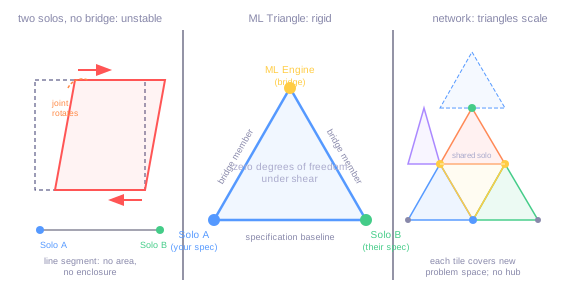
A square has four sides & four joints. Apply lateral force at one corner & the square shears into a parallelogram: the joints rotate freely, the shape changes. No combination of joint angles saves it. The square has one degree of freedom under shear.
A triangle has three sides & three joints. Apply force anywhere & the joints cannot rotate independently: each side constrains the other two. A triangle has zero degrees of freedom under shear. It cannot deform without breaking a member.
This property, rigidity without requiring fixed joints, makes the triangle the only polygon that holds its shape under load using only its edges. Every other polygon requires rigid joints or diagonal bracing to achieve the same result. That diagonal brace adds a triangle.
Two solos without a third element
Two solos agree to collaborate. They have direction: a shared intent, a line segment connecting their domains. But a line segment has no enclosed area: it cannot enclose a problem space, locate a solution, or distribute load. It can only point.
Under any lateral pressure, market change, disagreement on scope, a third-party offer to one of them, a two-node collaboration with no third element shears. The joint at each node rotates. The shape collapses into a different configuration.
Add a third element: a machine learning engine that bridges the two specifications. The three nodes form a triangle. The structure becomes rigid. Load distributes across all three members. No single member bears everything.
The ML engine does not need to be active at all times. Its presence as a structural member, a specification of how the two solos relate, is what provides rigidity. A structural truss member does not work harder when load increases; it distributes the load so no single member sees more than its share.
Rigidity in Practice
Consider two scenarios. In structural engineering: a construction crew installs diagonal triangular bracing inside wall frames before adding drywall. In collaboration architecture: two solos establish a machine learning bridge before taking their joint offer to market.
Two Known Points, One Unknown
Triangulation: a surveyor knows two reference points (A & B) with precise positions. She measures the angle to an unknown point C from both A & B. Two angle measurements, two known positions: enough information to locate C exactly, anywhere in the plane.
The law of sines makes this precise. For a triangle with vertices A, B, C, opposite sides a, b, c, & interior angles α, β, γ:
a / sin(α) = b / sin(β) = c / sin(γ)
Given side AB (the baseline, a known distance) & angles α & β (measured at A & B toward C), the surveyor computes γ = π − α − β, then: c = AB × sin(γ) / sin(α) & b = AB × sin(β) / sin(α). C resolves from two measurements.
Triangulating a collaboration gap
Solo A holds a specification: a precise description of their domain, capabilities, & interface requirements. That specification defines a position in the problem space: a known point.
Solo B holds a complementary specification: a different domain, a different set of capabilities, a known point at a different location.
The gap between them, the service, product, or bridge they need but neither can build alone, is an unknown point. Neither solo can locate it unilaterally (a single known point locates nothing). Together, their two specifications form a baseline. The machine learning engine measures from both known points & resolves the unknown point: the bridge.
The more precisely each solo's specification describes their position (capabilities, interface, constraints), the more accurately the ML engine can triangulate the gap's location. Vague specifications produce large angular uncertainty; the resolved point C can fall anywhere in a wide arc. Precise specifications narrow the angle measurements & shrink the error ellipse around C.
Third Known Point
Each Solo Owns Their Nearest Territory
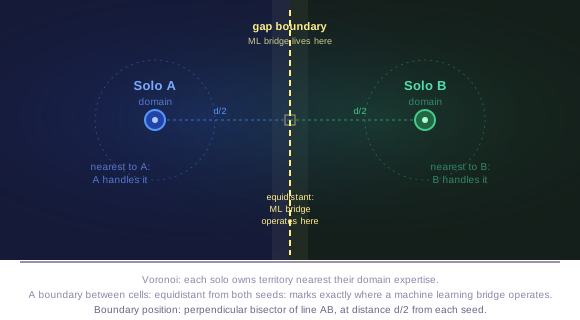
A Voronoi diagram partitions a plane into regions. Given a set of seed points, every location in the plane belongs to the nearest seed. The boundary between two Voronoi cells marks the set of points equidistant from the two nearest seeds.
The boundary has a precise geometric definition: it falls exactly halfway between two seeds, perpendicular to the line connecting them. For two seeds separated by distance d, the boundary line runs perpendicular to the axis at distance d/2 from each seed.
Domain ownership as a Voronoi partition
Solo A holds a domain: their expertise, their tools, their accumulated experiential capital. Every problem that maps to Solo A's capabilities falls in their Voronoi cell: they handle it more efficiently than any other actor in the space.
Solo B holds a different domain, positioned differently in the problem space. Their Voronoi cell covers problems closest to their capabilities.
The boundary between their cells marks a problem class that neither solo owns efficiently. A problem on the boundary requires capabilities from both domains roughly equally. That boundary is precisely where a bridge produces maximum value: not because neither solo can reach it, but because the boundary problem is equidistant from both: it needs both in equal measure.
The machine learning bridge operates at this boundary. It does not replace either solo's domain knowledge. It holds the boundary zone: translating between the two cells, mapping the interface, carrying load that belongs to neither cell alone.
Boundary properties
The Voronoi boundary moves when seeds move. If Solo A expands their domain (moves their seed toward Solo B), the boundary shifts toward B. If both solos expand toward each other, the boundary narrows. If both solos are identical (seeds coincide), the boundary disappears: there is no gap, no bridge needed, no unique value created.
A bridge that lives on a vanishing boundary loses its purpose. The ML Triangle requires genuine domain distance between the two solos. The more orthogonal the domain vectors, the more stable the boundary: & the more unique value the bridge can create.
When Seeds Move
Triangles Tile the Plane
Three regular polygons tile the Euclidean plane without gaps: equilateral triangles, squares, & regular hexagons. Of these, only equilateral triangles produce structurally rigid tilings: every shared edge is a structural member, every interior vertex resolves load to adjacent triangles.
A hexagonal tiling can be decomposed into six equilateral triangles meeting at a center point: the hexagon's rigidity derives entirely from its triangular sub-structure. Squares require diagonal bracing (adding triangles) to resist shear. The triangle is the primitive unit of planar tiling that carries its own structural integrity.
The ML Triangle as a tiling unit
Each ML Triangle, two solos plus one bridge, occupies a region of the problem space. When two ML Triangles share a solo (one solo participates in two collaborations), they share an edge. Two triangles sharing an edge form a parallelogram. Three sharing a vertex form a star. As more triangles tile the plane, the network covers more of the problem space.
This scaling mechanism works without hierarchy. No triangle controls another. No node becomes a hub that all others depend on. Each new triangle adds a tile & contributes structural rigidity to the tiles adjacent to it: a shared edge means shared load distribution.
Contrast this with hub-&-spoke scaling: one central node connects to N peripheral nodes. Removing the hub collapses the entire network. A tessellated triangle network has no hub to remove. Removing one triangle leaves the surrounding tiles intact; load redistributes across adjacent members.
Force distribution in a truss network
In a structural truss, load applied at any node distributes across all connected members. No single member bears the full load unless it is the only load path. In a tessellated collaboration network, work (intellectual capital, trust, coordination overhead) distributes across triangles. A solo embedded in three triangles shares their contribution across three bridges; they do not bear full load for any single project.
The practical limit: each solo has finite capacity. Adding too many triangles at one vertex over-concentrates load at that node: the structural equivalent of a truss with too many members meeting at one joint. Well-designed tessellations keep vertex degree (the number of triangles sharing a node) within the load-bearing capacity of each member.