Functions as Vectors
The Fourier series is not just a computational tool — it is a geometric operation: orthogonal projection of a function onto a basis.
Function Space
The set of square-integrable functions on [0,1] forms a vector space L²[0,1]. Addition & scalar multiplication work pointwise. The inner product of two functions f, g:
⟨f, g⟩ = ∫₀¹ f(t) · g*(t) dt
where g* is the complex conjugate of g. This satisfies all inner product axioms.
Orthogonality of Fourier Basis
The functions φ_k(t) = e^{i2πkt} form an orthonormal basis for L²[0,1]:
⟨φ_k, φ_m⟩ = ∫₀¹ e^{i2πkt} · e^{−i2πmt} dt = ∫₀¹ e^{i2π(k−m)t} dt = δ_{km}
(This equals 1 if k = m, 0 otherwise — by integrating a pure oscillation over a full period.)
Fourier Coefficient as Inner Product
The k-th Fourier coefficient of x(t):
c_k = ⟨x, φ_k⟩ = ∫₀¹ x(t) · e^{−i2πkt} dt
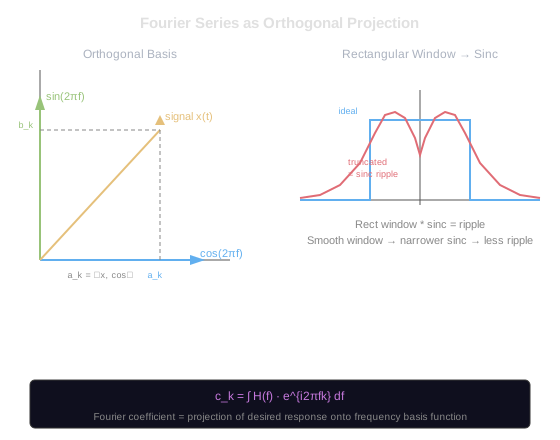
This is the projection of x onto the basis vector φ_k. The coefficient measures how much of φ_k is present in x.
Projection Onto a Subspace
Truncating a Fourier series to 2N+1 terms projects x onto the subspace spanned by {φ_{−N}, …, φ_N}. The truncated series is the orthogonal projection of x onto this finite-dimensional subspace.
By Bessel's inequality, the projection minimizes the L² error:
‖x − Σ_{k=−N}^{N} c_k φ_k‖² ≤ ‖x − Σ_{k=−N}^{N} a_k φ_k‖² for any choice of a_k
The Fourier truncation is the best approximation in L² from that subspace. It minimizes the mean squared error (the L² norm squared of the difference).
Rectangular Window → Sinc Kernel
The rectangular window in the time domain (keeping only coefficients for |k| ≤ N) corresponds to multiplication by a rect function in the coefficient index.
Multiplication in one domain corresponds to convolution in the other domain.
The Fourier transform of the rectangular window (in discrete coefficient space) is the Dirichlet kernel — a periodic sinc-like function:
D_N(f) = Σ_{k=−N}^{N} e^{i2πfk} = sin(π(2N+1)f) / sin(πf)
When we truncate the Fourier series, we convolve the ideal response H_ideal(f) with D_N(f).
Why Gibbs Occurs
The Dirichlet kernel has large sidelobes that decay slowly. Near a step discontinuity in H_ideal(f), these sidelobes ring — they add coherently on one side of the jump, producing the ≈9% overshoot.
The mathematical constant: ∫₀^π sin(t)/t dt = Si(π) ≈ 1.8519. The Gibbs overshoot height = (2/π)·Si(π) − 1 ≈ 0.0895 = 8.95%. This is independent of N.
Window Geometry
A smooth window (Hamming, Hann, Kaiser) has a Fourier transform with lower sidelobes. Convolving H_ideal(f) with a kernel that has smaller sidelobes produces less ringing. The trade-off: lower sidelobes always come with a wider main lobe, widening the transition band.
The Gibbs Constant
The Gibbs overshoot is a definite integral, not a function of N.
The first maximum of the N-term partial Fourier sum of a unit step occurs at f ≈ 1/(2N) from the discontinuity. As N → ∞, this maximum approaches 1/(2)·(2/π)·Si(π) ≈ 1.0895.
The overshoot: 0.0895 or approximately 8.95% of the jump height.
Windows as Frequency-Domain Kernels
Every window function has a Fourier transform that describes the kernel used to smooth the ideal frequency response.
The key geometric parameters of the kernel:
1. Main lobe width: determines the transition band width (wider main lobe → wider transition).
2. Peak sidelobe level: determines the passband & stopband ripple (lower sidelobes → less ripple).
These two parameters are not independent. For a given window length 2N+1, reducing sidelobe height requires widening the main lobe — always.
Kaiser's window gives the user one knob (α) to trade off sidelobe height vs main lobe width continuously, rather than jumping between fixed window types.
Design Insight
The transition band width ΔF ≈ main lobe width / N. The ripple δ ≈ sidelobe level. Both formulas are approximate; Kaiser's equations make them exact.