Zero-Sum Games & Their Cost
MAD Magazine's Spy vs Spy: two spies, one black, one white, perpetually destroying each other. No side wins. Both sides perpetually lose. Each optimizes to defeat the other rather than to achieve anything independently valuable.
This describes a large fraction of cold-war research: classified computing, military-funded network design, arms-race optimization. When both sides play, both sides burn resources on defeating each other — resources that could compound into shared infrastructure. The zero-sum frame does not just fail to produce positive sum outcomes; it actively destroys the capacity to produce them by treating sharing as strategic weakness.
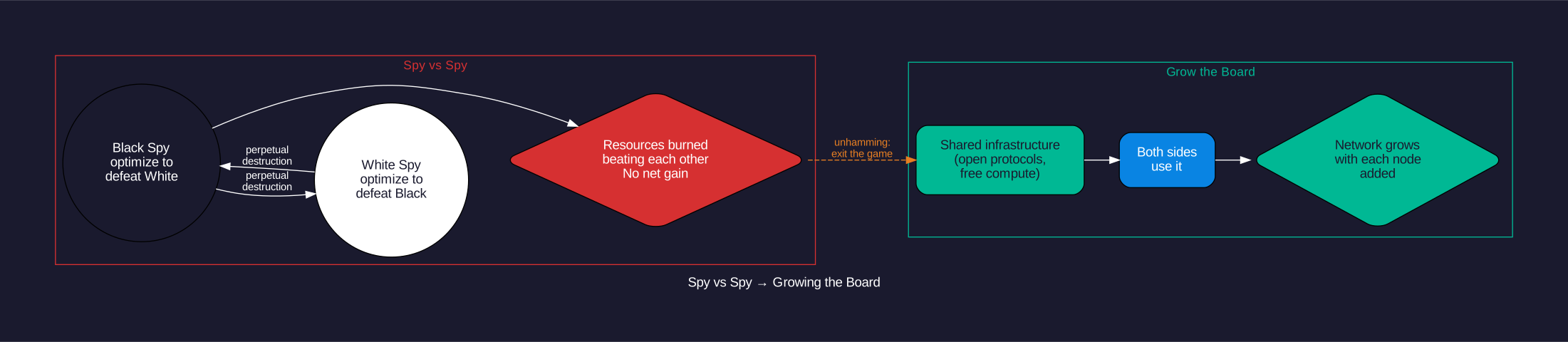
Hamming worked inside this game. Bell Labs held defense contracts. His digital filter work had military applications. He never questioned this frame publicly in 'You and Your Research' — it was the water he swam in. His advice on courage, important problems, and compound knowledge assumed an institutional player in a competitive landscape.
Unhamming does not assign blame for this. It asks: what can a researcher choose today that Hamming could not? One answer: the open-source move. Exit the zero-sum game. Build infrastructure both sides can use. Nobody wins by sabotage; both benefit from the shared substrate. The internet runs on TCP/IP regardless of who owns the hardware it traverses.
The capital-accounting question: what does staying in the zero-sum game actually cost? Not in the abstract — in each of the eight capital queues. Classified research consumes financial capital (black budgets), living capital (career hours, researcher health), social capital (secrecy prevents collaboration), intellectual capital (knowledge dies with clearance revocation or institutional collapse). Open infrastructure regenerates all four.
From Weapon to Commons
ARPANET started in 1969 as a US Department of Defense network. By 1995, the internet carried more civilian traffic than military. By 2010, it became the primary substrate for global civil society, science, commerce, & culture.
Platform Tax as O(N²) Friction
Spy vs Spy runs symmetric: both sides destroy each other at roughly equal rates. Predator/prey runs asymmetric: one side extracts, one side produces, and the extraction increases as the prey population grows.
In software platforms: the platform extracts a commission from every transaction. The independent developer produces value. The platform adds coordination but takes rent. This describes Uber, DoorDash, App Store, Google Play — platforms that charge 15-30% of every transaction, growing their extraction as the network scales while the cost of the coordination service does not scale proportionally. O(N²) friction in the exchange layer: every new participant pays the tax, creating a drag that grows faster than the value created.
Hamming did not analyze this because his work sat outside market dynamics. Bell Labs ran as a monopoly-funded research arm; it did not need to extract rent from its researchers to survive. His advice on doing important work implicitly assumed a context where the researcher's output did not get taxed at 30% before reaching the people who needed it.
Open-source reverses the extraction direction: the developer publishes freely, the community coordinates freely, no rent extraction occurs at the distribution layer. The package manager (pip, npm, cargo) delivers the work without a commission. The cost: no one pays the developer directly for the work. The benefit: the work reaches everyone who needs it without a platform toll accumulating between creator and user.
This matters for the eight-forms-of-capital ledger. Platform tax drains financial capital from developers (30% taken), social capital from users (lock-in to a specific platform), intellectual capital from the ecosystem (code stays proprietary to protect the platform's position), & living capital from workers (gig misclassification, income volatility). Open-source routes financial capital differently: no commission, but also no guaranteed income. Intellectual capital grows: every published package becomes a building block.
Applying the Capital Framework
A freelance developer earns income through a platform that takes 30% of every project. An open-source alternative exists: it has no escrow, no dispute resolution, & no built-in customer network. Both options involve real tradeoffs.
Infrastructure That Nobody Won
Yin-yang: every bit contains its flip. Black spy contains the seed of white. White spy contains the seed of black. Perpetual destruction is a choice, not a law.
The permacomputer move: build infrastructure that serves both sides simultaneously. An open DNS protocol, a public package registry, a free TTS service — these serve anyone regardless of which competitive game they participate in. They do not win by defeating an adversary. They grow by adding nodes. Each new node increases the value of the network for all existing nodes rather than splitting the pie into smaller slices.
Hamming's final lecture closed with: 'The most important single thing is to ask yourself the right question.' The right question in spy/spy: 'how do I beat the other side?' The unhamming question: 'how do I build something useful enough that both sides use it & the game becomes unnecessary?'
Examples of infrastructure that exited the zero-sum game: Linux (started as a competitor to commercial Unix; became the substrate both commercial and open deployments run on), TCP/IP (started military; became universal), SQLite (started as an embedded database; became the most deployed database in history, present in every smartphone regardless of manufacturer), git (started as Linus's tool for Linux; became the default VCS for the entire industry including the companies that tried to compete with Linux).
What these share: they solve a problem so universal that competitive exclusion became more expensive than adoption. No one wins by shipping a product that does not work with TCP/IP. No one gains advantage by using a VCS other than git when every open-source project uses git. The commons became load-bearing.
Why Load-Bearing Infrastructure Persists
Not all open-source projects become load-bearing infrastructure. Many stay small, fade, or get abandoned. The ones that persist share identifiable properties.