The Paradigm Landscape
Model a scientific field as a loss landscape: a function L(p) over paradigm space P, where L(p) = unexplained evidence under paradigm p. A paradigm that explains everything has L = 0 (perfect). A paradigm that leaves much unexplained has high L.
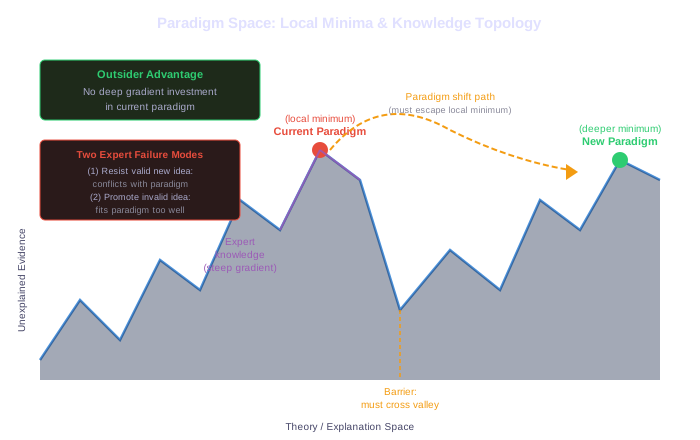
The current paradigm sits at a local minimum: it explains most known evidence, so small deviations from it increase L. This is why paradigms are stable — gradient descent keeps returning to them.
Expert knowledge deepens the gradient around the current minimum: decades of work filling in details, extending the paradigm's reach, and explaining anomalies all sharpen the walls of the local minimum. The gradient around the current paradigm becomes steeper.
This produces the expert paradox: the deeper the expertise, the harder it is to escape the current minimum. The very qualities that make someone a great expert — deep knowledge of the current paradigm — make them less likely to reach a different, possibly deeper minimum.
Paradigm shift = escaping a local minimum: the new paradigm may be a deeper minimum (better explanation) elsewhere in the space. But to reach it, you must first move uphill — increasing unexplained evidence temporarily — before descending to the new minimum. This is the period of 'crisis' in Kuhn's terminology.
Gradient Descent & Expert Investment
Consider a paradigm p that sits at a local minimum of L(p). A new anomalous observation produces evidence E that the current paradigm cannot explain, raising L(p) slightly.
Basins of Attraction in Paradigm Space
Every local minimum in L(p) has a basin of attraction: the region of paradigm space from which gradient descent leads to that minimum.
An expert in paradigm p has spent years inside the basin of p. They know the local topology in extraordinary detail. They can navigate the basin efficiently — this is their expertise.
An outsider arrives at a different point in paradigm space. They may be starting from a point outside the basin of p entirely — perhaps in the basin of a different paradigm, or on a saddle point, or in a flat region with small gradients. They have no strong gradient pulling them toward p.
This is the geometric explanation of the outsider advantage: they have not been gradient-descended into the current minimum. Their starting position in paradigm space is less constrained.
The two expert failure modes in landscape terms:
- False negative (resist valid new idea): the new idea corresponds to a different local minimum. The expert, deep in their basin, perceives the direction toward the new minimum as uphill (increasing L) and rejects it.
- False positive (promote invalid idea): the new idea patches a small anomaly, moving downhill within the current basin. The expert's gradient perception says 'yes, this reduces L' — but it may be moving to a shallower local minimum, not a deeper one.
Kuhn Cycles as Gradient Dynamics
Thomas Kuhn described the cycle: normal science (gradient descent in current basin) → accumulation of anomalies (L rises at p*) → crisis → paradigm shift (jump to new basin) → new normal science.
Impossibility as Boundary of the Feasible Region
An impossibility proof in mathematics or engineering can be modeled geometrically as a feasible region in some parameter space.
Example: the 33-feet water-lift result. The parameter is h = lifting height. The suction pump mechanism defines a constraint: h ≤ P_atm/ρg ≈ 10.3 m. This constraint defines a feasible region F = {h : h ≤ 10.3 m}. The impossibility proof says: for suction pumps operating via this mechanism, the feasible region does not include h > 10.3 m.
The standing wave pump operates in a different parameter space. It does not use suction; it uses dynamic pressure. The feasibility constraint is different; the feasible region is larger.
The hidden assumption of the impossibility proof is equivalent to assuming the problem lives in the first parameter space (suction mechanisms). When this assumption fails — when the solution is allowed to use a different mechanism — you are working in a different parameter space with a different feasible region.
Geometrically: the impossibility proof proves that h > 10.3 m lies outside the feasible region of suction pumps. It says nothing about h in the feasible region of standing wave devices.
Identify the Hidden Constraint
Consider the claim: 'You cannot communicate information at a rate above the bandwidth of the channel.' This was widely believed before Shannon's work.