The Central Argument
Richard Hamming opened Chapter 2 of his Naval Postgraduate School lectures with a question most engineers in 1993 took for granted: Why digital? Why discrete 0s & 1s rather than the smooth, continuous values of analog systems?
He gave nine reasons. Not a vague list — a structured argument. Each reason stands independently. Together they explain not just why digital won, but why the shift was nearly inevitable.
Reason 1: Reliability
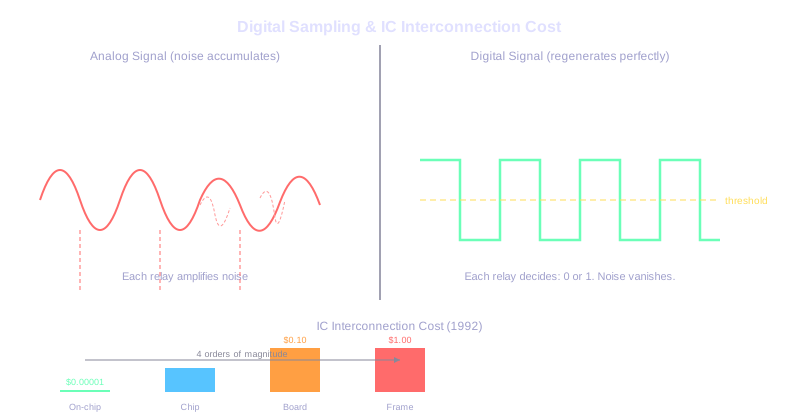
A continuous signal degrades with every transmission step. Noise accumulates. Small errors compound. A digital signal carries only two values: 0 or 1. At each relay point, the signal regenerates cleanly. Errors below a threshold disappear; only errors above the threshold matter, & those can trigger error-correcting codes.
The contrast matters in practice. An analog tape recording degrades with each copy. A digital file copied a million times remains bit-for-bit identical to the original. Reliability is not a marginal improvement — it changes the nature of what computation can do.
Reason 2: IC Interconnection Economics
In 1992, Hamming recorded interconnection costs across four levels:
| Level | Cost | |---|---| | On-chip | $0.00001 | | Chip-to-chip | $0.01 | | Board-to-board | $0.10 | | Frame-to-frame | $1.00 |
Four orders of magnitude across four levels. Integrated circuits collapsed the cost of on-chip connections to near zero. Before ICs, every connection cost money, space, & failure probability. After ICs, computation moved inside the chip where connections cost almost nothing. This economic fact drove miniaturization more than any single engineering decision.
Reliability as Regeneration
The reliability argument for digital rests on a precise claim: errors below a noise threshold get corrected at each relay. The system does not merely tolerate noise — it eliminates it at each stage.
Analog systems cannot do this. Every amplifier that boosts a signal also boosts its noise. Signal-to-noise ratio degrades monotonically through a chain of amplifiers.
From Material Goods to Information Services
Hamming's third & fourth reasons look beyond engineering to economics & demography.
Reason 3: The Material-to-Information Transition
At the American Revolution (1780), over 90% of workers farmed. By World War II, manufacturing dominated. By 1993, more Americans worked in government than in manufacturing. Hamming projected that by 2020, fewer than 25% of civilians would handle physical things; the rest would handle information.
He was not predicting a trend — he was observing one already underway. The shift from material goods to information services changes what counts as production, what skills become valuable, & what infrastructure enables commerce.
Reason 4: Robots & Manufacturing Automation
Computers make robots practical. Robots produce: (A) a better product under tighter control limits; (B) usually a cheaper product; (C) a different product.
Point C carries the most weight. Hamming emphasized: it is rarely practical to produce exactly the same product by machine as by hand. Automation does not mechanize existing processes — it forces redesign.
The move from hand fabrication to machine fabrication shifted construction methods from screws & bolts to rivets & welding. The product changed because the production method changed. This is not a side effect of automation; it is a central feature.
The Equivalent Product Insight
Hamming named a pattern he observed repeatedly across industries: successful mechanization produces an equivalent product, not the same product.
When accounting moved from hand ledgers to punch-card machines, the accounting system changed to fit the machine. When manufacturing moved from hand fabrication to machine fabrication, the product changed to use rivets & welds instead of screws & bolts.
He called this the lesson management consistently fails to learn. Managers commission automation expecting to produce the current product cheaper. They discover instead that the product must change to realize the efficiency.
The same pattern extends to computers: do not ask 'how can a computer do what we already do?' Ask: 'if we were designing this process for a computer from scratch, what would we build?'
Reason 6 & 7: Engineering Shifts & Micromanagement Risk
Reason 5: Computers Enable Redesign
Hamming's fifth reason restates the equivalent product insight at the engineering level. Computerization does not mechanize existing engineering practice — it shifts what engineering can do.
Reason 6: From 'What Can We Do?' to 'What Do We Want to Do?'
Traditional engineering asked: given our tools & materials, what is achievable? Computers invert the question. The constraint is no longer fabrication capability but imagination & formulation: what should we build?
This shift from constrained design to desired-outcome design was visible by 1993 in fields from circuit design (simulation before fabrication) to molecular biology (design before synthesis). Hamming projected it would extend further.
Reason 7: Micromanagement Risk
Information technology that enables managers to see everything also tempts them to control everything. Hamming noted this as a genuine risk of the information revolution: the same tool that provides situational awareness can drive micromanagement that destroys organizational effectiveness.
He did not resolve this tension — he pointed at it as a problem for his students' generation to navigate.
Reason 8 & 9: Military Information Dominance
Reason 8: Military Information Dominance
The Gulf War (1991) demonstrated information as a primary weapon. Hamming cited the failure to use accurate information about friendly-force positions as a cause of fratricide: information errors killed people. The war was won through information dominance, not materiel superiority alone.
His projection: battlefields would increasingly exclude human beings, replaced by machines making constant rapid decisions — machines with fewer of the cognitive & physical limitations that make information errors lethal for humans.
Reason 9: The Equivalent Product in Military Context
The same insight applies to military systems: automating the current tactics does not produce tactical advantage. Redesigning tactics around information-capable systems does.
Hamming closed the chapter with a challenge: if you will be at the peak of your career in 2020, you cannot rely on theories formed before the digital revolution. The world your training prepared you for will not exist.
Why Nine Reasons, Not One
Hamming gave nine reasons for the digital revolution's dominance. He could have stopped at reliability or economics. He did not.
Each reason operates at a different level: physical (reliability), economic (IC costs), demographic (society shift), industrial (robots & equivalent product), organizational (micromanagement), & military (information dominance). The argument is multi-level by design.
A single-level argument is fragile: one counterexample defeats it. A multi-level argument with independent supports requires defeating every level simultaneously. Hamming structured his argument to be robust.
His closing challenge: do not assume the theories you learned before the digital revolution will remain valid. Your career peak comes 25-30 years out. Build models that account for compound change.
Building the Argument
Of Hamming's nine reasons, some operate at the physical layer (reliability, IC economics), some at the social layer (information economy, robots), & some at the power layer (micromanagement risk, military dominance).