Welcome
Every restaurant meal you have ever eaten, every banquet served on time to three hundred guests, every plate that arrives at the pass looking exactly like the last one: all of it depends on cooks who mastered the fundamentals before they ever touched a sautee pan on the line.
Professional cooking is not home cooking scaled up. It is a discipline built on speed, consistency, organization, & technique. A home cook can improvise. A professional cook executes: the same dish, the same way, a hundred times in a single service.
The modern professional kitchen is organized around the brigade system, developed by Auguste Escoffier in the late 1800s. The brigade divides the kitchen into stations, each with a specific role: the saucier handles sauces & sauteed items, the garde manger handles cold preparations & salads, the poissonnier handles fish, the rotisseur handles roasted meats, the patissier handles pastry & desserts. The executive chef oversees the entire kitchen, the sous chef is second in command & runs the line, & the line cooks execute at their stations.
In this lesson, we will cover the core skills every professional cook needs: knife work, mise en place, cooking methods, flavor building, food safety, & the career paths available to someone who masters these fundamentals.
Warm-Up
Before we get into the kitchen, let's see where you start from.
Knives and Precision Cuts
The Tools & the Cuts
A professional cook's knife is the most important tool in the kitchen. Every cook needs to know the three essential knives & the standard cuts that appear on every prep list.
Chef's knife (8-10 inches): The workhorse. Used for chopping, slicing, dicing, & mincing. A cook uses this knife for 90 percent of all cutting tasks. The rocking motion of the curved blade allows rapid, controlled cuts.
Paring knife (3-4 inches): The detail knife. Used for peeling, trimming, tournee cuts, & any task that requires close control. Too small for heavy chopping, perfect for precision work.
Serrated knife (bread knife): The saw. Used for bread, tomatoes, & any item with a hard exterior & soft interior. The teeth grip the surface without crushing the item.
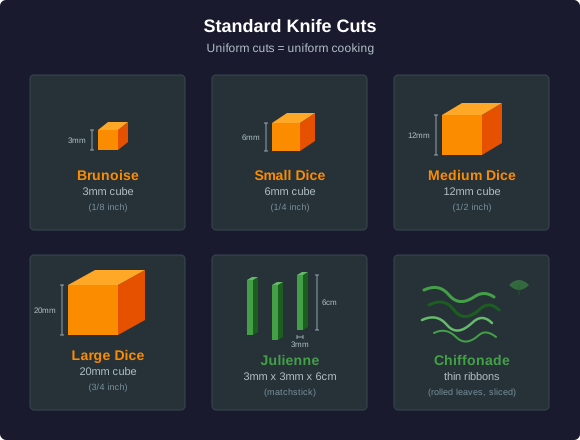
Standard cuts define size & shape for consistency. When a recipe calls for a brunoise, every cook in every kitchen produces the same size:
- Brunoise: 1/8 inch cubes. The finest standard dice.
- Small dice: 1/4 inch cubes.
- Medium dice: 1/2 inch cubes.
- Large dice: 3/4 inch cubes.
- Julienne: 1/8 inch by 1/8 inch by 2 inches. Matchstick strips.
- Chiffonade: Thin ribbons of leafy herbs or greens, cut by rolling leaves & slicing across.
- Mirepoix: A rough dice of onion, carrot, & celery (2:1:1 ratio by weight) used as the aromatic base for stocks, soups, & braises.
Why do cuts matter? Uniform size means uniform cooking. A pot of soup with uneven vegetable cuts will have some pieces overcooked & mushy while others are still raw in the center.
Mise en Place
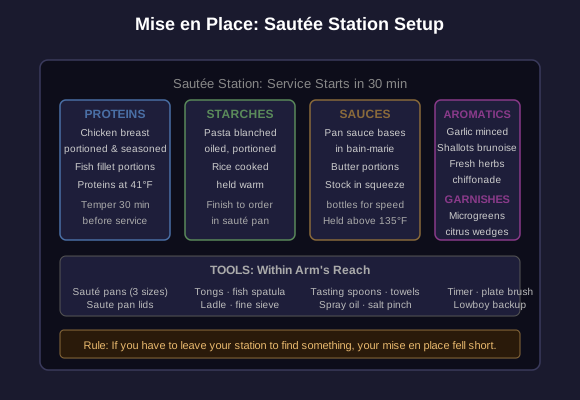
Mise en place is French for 'everything in its place.' It is the philosophy & practice of total preparation before cooking begins: every ingredient measured, cut, & organized in containers within reach. Sauces portioned, proteins tempered, garnishes ready. Nothing left to chance.
A line cook who starts service without complete mise en place will fall behind on the first rush & never recover. Mise en place is not just physical preparation: it is a mental discipline. When your station is set, your mind is set.
Imagine you are the sautee cook on a busy Friday night. Your station handles pasta dishes, chicken entrees, & pan sauces. Service starts in 30 minutes.
How Heat Cooks Food
Three Ways Heat Moves
Every cooking method transfers heat to food through one or more of three mechanisms.
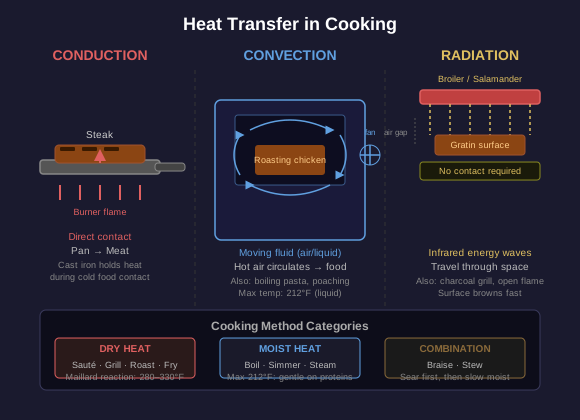
Conduction: Direct contact. A steak on a cast iron pan. Heat transfers from the hot metal surface into the meat through direct contact. Conduction is why a heavy pan sears better than a thin one, it holds more thermal energy & does not cool down when cold food hits it.
Convection: Moving fluid (air or liquid). A convection oven circulates hot air around food, cooking it faster & more evenly than a standard oven. Boiling water transfers heat to pasta through convection, the moving water carries thermal energy to the food surface.
Radiation: Energy waves. A broiler or salamander cooks food with infrared radiation from above. A charcoal grill radiates heat upward. Radiation does not require contact or a moving medium, it travels through space.
Cooking Method Categories
Dry-heat methods: No liquid. High temperatures. Browning occurs. Includes sauteing, pan-frying, deep-frying, grilling, broiling, & roasting. Dry heat triggers the Maillard reaction, the chemical reaction between amino acids & sugars that creates the brown crust, complex flavors, & aromas of seared meat, toasted bread, & roasted coffee. The Maillard reaction begins around 280-330 degrees Fahrenheit & requires a dry surface.
Moist-heat methods: Liquid-based. Temperature limited to 212 degrees Fahrenheit (boiling point of water). Includes boiling, simmering, poaching, steaming, & blanching. Moist heat is gentler & works well for delicate proteins like fish & eggs.
Combination methods: Dry heat first, then moist. Braising & stewing start with a sear (dry, Maillard reaction) & finish with slow cooking in liquid (moist, collagen breakdown). This is how tough, collagen-rich cuts like short ribs & pork shoulder become tender, the long, slow moist heat converts collagen to gelatin.
Choosing the Right Method
A cook gets three items to prepare: a filet mignon (beef tenderloin steak, very tender, lean), a beef short rib (tough, loaded with connective tissue), & a piece of fresh halibut (delicate, flaky white fish).
Salt, Fat, Acid, Heat
The Four Elements of Flavor
Every great dish balances four fundamental elements: salt, fat, acid, & heat. Understanding how they interact is what separates a cook who follows recipes from a cook who creates them.
Salt: Enhances & amplifies the natural flavors already present in food. Salt does not make food taste salty when used correctly, it makes food taste more like itself. Season throughout the cooking process, not just at the end. A soup seasoned only at the end tastes flat compared to one seasoned in layers.
Fat: Carries flavor. Many flavor compounds are fat-soluble, meaning they dissolve in fat but not in water. This explains why sauteing garlic in olive oil releases more aroma than boiling garlic in water. Fat also provides richness, mouthfeel, & helps achieve browning. Butter, olive oil, animal fats, & cream each contribute different flavor profiles.
Acid: Brightens & balances. A squeeze of lemon, a splash of vinegar, a spoonful of tomato. Acid cuts through richness, lifts flat flavors, & creates contrast. A dish that tastes heavy or dull almost always needs acid. This is the element most home cooks underuse.
Heat: Transforms. The Maillard reaction, caramelization, reduction, emulsification, heat drives the chemical changes that create cooked flavor. The amount & duration of heat determine texture & flavor development.
The Five Mother Sauces
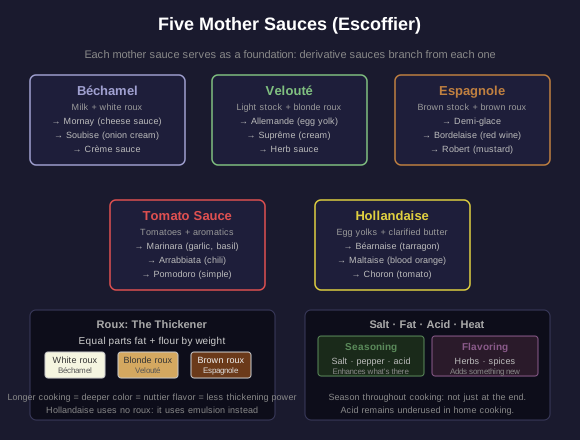
Escoffier codified five foundational sauces from which hundreds of derivative sauces are made:
- Bechamel: Milk thickened with a white roux (butter & flour). Base for cheese sauce, cream sauce, & gratins.
- Veloute: Light stock (chicken, fish, or veal) thickened with a blonde roux. Base for mushroom sauce, herb sauce, & Allemande.
- Espagnole: Brown stock thickened with a brown roux & tomato. Leads to demi-glace, the foundation of classic French brown sauces.
- Tomato sauce: Tomatoes cooked with aromatics, stock, & sometimes roux. Base for countless variations.
- Hollandaise: An emulsion of egg yolks, clarified butter, & lemon juice. Base for Bearnaise. The only mother sauce served warm without a roux.
Seasoning versus flavoring: seasoning (salt, pepper, acid) enhances what is already there. Flavoring (herbs, spices, aromatics) adds something new. A professional cook seasons constantly & flavors deliberately.
Diagnosing a Dish
You taste a chicken soup that a junior cook has been working on for two hours. The stock is homemade, the vegetables are well cooked, & the chicken is tender. But the soup tastes flat & one-dimensional. It is not bad: it just does not taste like much of anything. The cook says they added salt at the end.
Temperature, Storage, and Sanitation
The Non-Negotiables
Food safety is not optional in a professional kitchen. A single food safety failure can sicken hundreds of people, shut down a restaurant permanently, & end careers. Every professional cook must understand these principles cold.
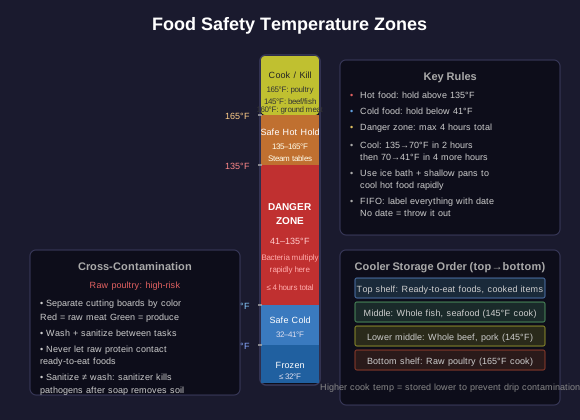
The Temperature Danger Zone: Bacteria multiply rapidly between 41 degrees Fahrenheit & 135 degrees Fahrenheit. Food must spend as little time as possible in this range. Hot food must be held above 135 F. Cold food must be held below 41 F. Food left in the danger zone for more than 4 hours total (cumulative, not continuous) must be discarded.
Cooling protocol: Hot food must be cooled from 135 F to 70 F within 2 hours, then from 70 F to 41 F within the next 4 hours. Use ice baths, shallow pans, & frequent stirring to cool food rapidly. Never put a large hot container directly into a walk-in cooler, it raises the temperature of everything around it.
FIFO, First In, First Out: Rotate stock so older product gets used before newer product. Label everything with the date it was received or prepared. Product without a date gets thrown out. No exceptions.
Cross-contamination: Raw proteins (especially poultry) must never contact ready-to-eat foods. Use separate cutting boards (color-coded in most kitchens), separate storage areas (raw proteins on the bottom shelf, ready-to-eat items on top), & wash hands between handling raw & cooked items. A cook who cuts raw chicken & then chops salad greens on the same board without sanitizing it has just created a potential outbreak.
HACCP (Hazard Analysis & Critical Control Points): A systematic approach to identifying & controlling food safety hazards. HACCP identifies critical control points in the food flow, receiving, storage, preparation, cooking, holding, serving: & sets measurable limits at each point. Professional kitchens & food manufacturers use HACCP plans to prevent contamination before it happens.
ServSafe: The National Restaurant Association's food safety certification program. Most jurisdictions require at least one ServSafe-certified manager on duty during food service. The certification covers food safety principles, personal hygiene, cleaning & sanitation, & pest control.
Safety Decisions
It is Sunday morning prep. You open the walk-in cooler & find a hotel pan of chicken stock that was made Friday night. There is no date label on it. Next to it, raw chicken thighs are stored on the shelf directly above a container of washed lettuce. On the prep table outside the cooler, a cambro of diced tomatoes has been sitting out since the overnight cook left six hours ago.
Where Culinary Arts Takes You
Kitchen Careers & Beyond
The culinary field is not one job: it is a network of career paths, each with its own skills, culture, & trajectory.
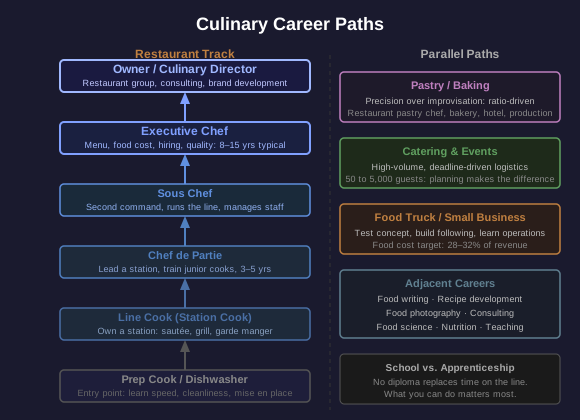
Line cook to sous chef to executive chef: The traditional restaurant path. A line cook masters individual stations (sautee, grill, garde manger). A strong line cook moves to sous chef, running the line & managing staff. An executive chef oversees the entire kitchen, menu development, food cost, hiring, & quality. This progression typically takes 5 to 15 years depending on the cook & the kitchen.
Pastry & baking: A distinct discipline. Pastry is precision, ratios, temperatures, & timing are less forgiving than savory cooking. Pastry chefs work in restaurants, bakeries, hotels, & production facilities. The best pastry positions require formal training or years of focused apprenticeship.
Catering & events: High-volume, deadline-driven cooking. Catering chefs plan, prep, transport, & execute meals for events ranging from 50 to 5,000 guests. The logistics & planning skills required go well beyond line cooking.
Food trucks & small business: Lower barrier to entry than a full restaurant. A food truck lets a cook test a concept, build a following, & learn the business side, permits, insurance, food cost, marketing: with less financial risk than a brick-&-mortar lease.
Culinary school versus apprenticeship: Culinary school (CIA, Johnson & Wales, community college programs) provides structured education in technique, food science, & management. An apprenticeship provides hands-on experience in a working kitchen from day one. Many successful chefs have taken each path. The best combination is often a short formal program followed by years of kitchen experience. No diploma replaces time on the line.
Adjacent careers: Food writing, recipe development, food photography, restaurant consulting, food science, nutrition, teaching, & sales all build on culinary fundamentals.
Planning Your Path
Connect the Kitchen to Your Future
You now know the fundamentals: knife skills, mise en place, cooking methods, flavor building, & food safety. These are the building blocks every culinary career is built on.