Mean, Variance, and Bias
Every measurement x_i of a true value μ can be written as: x_i = μ + β + ε_i, where β is the systematic error (bias, constant across measurements) and ε_i is the random error (different for each measurement, drawn from a distribution with mean 0).
Random error: E[ε_i] = 0, Var[ε_i] = σ². The sample mean x̄ = (1/n) Σ x_i has expected value μ + β and variance σ²/n. As n → ∞, x̄ → μ + β (not μ). The random error goes to zero; the bias does not.
Systematic error: β ≠ 0, constant. The mean of any number of measurements is μ + β. To remove bias, you need calibration (an independent measurement of β), not more repetitions.
Geometrically: imagine the distribution of measurements as a bell curve. Random error controls the width (variance). Systematic error controls the location of the center (the mean is shifted from the true value by β).
The stated uncertainty in a measurement is usually an estimate of σ (random error only). If β is large and undetected, the stated uncertainty is meaningless — it quantifies the noise in a biased instrument.
Bias vs Variance Calculation
A laboratory measures the gravitational constant g. Their instrument has a systematic calibration error of β = +0.05 m/s². Their random measurement error has standard deviation σ = 0.02 m/s². They take n = 100 measurements.
True value: g = 9.80 m/s².
How Errors Move Through Calculations
When you compute a quantity z = f(x, y) from measured quantities x and y, their measurement errors propagate into z.
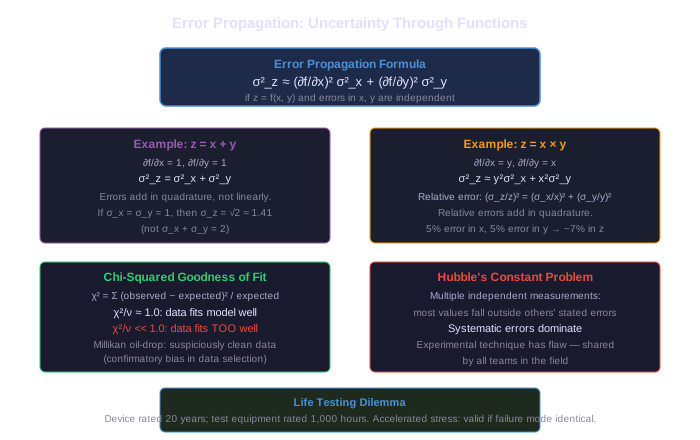
Error propagation formula (first-order Taylor expansion):
σ²_z ≈ (∂f/∂x)² σ²_x + (∂f/∂y)² σ²_y
(This assumes x and y errors are independent. If correlated, add 2 · (∂f/∂x)(∂f/∂y) · Cov(x,y).)
Key insight: the partial derivatives act as amplifiers. If ∂f/∂x is large, small errors in x produce large errors in z.
This means choosing a calculation method that minimizes the partial derivatives is a real engineering objective — not just algorithmic convenience. Hamming was acutely aware of this in his numerical analysis work.
Propagation Through a Product
You measure two lengths: L₁ = 10.0 m ± 0.1 m (σ₁ = 0.1) and L₂ = 5.0 m ± 0.2 m (σ₂ = 0.2). You compute area A = L₁ × L₂.
When Data Fits Too Well
Chi-squared goodness-of-fit test: given n observations O_i and model predictions E_i, compute:
χ² = Σ (O_i − E_i)² / E_i
If the model is correct and measurements have variance E_i, the expected value of χ² is approximately ν = (number of data points) − (number of fitted parameters), called the degrees of freedom.
The reduced chi-squared χ²/ν should be approximately 1.0 if the data fits the model with the expected amount of scatter.
- χ²/ν >> 1: data varies more than expected — model is wrong, or uncertainties are underestimated.
- χ²/ν << 1: data varies less than expected — suspiciously clean.
The suspicious case: if your measurements have σ = 0.1 but the data all fall within ±0.01 of the model curve, someone has selectively kept the 'good' measurements. This is confirmatory bias: discarding data that disagrees and retaining data that agrees.
Hamming cites Millikan's oil drop experiment: the Nobel Prize-winning measurement of the electron charge. Later analysis of Millikan's laboratory notebooks revealed he applied undocumented judgment to discard 'outlier' measurements — and the retained measurements fit suspiciously well.
Compute and Interpret Reduced Chi-Squared
A student fits a linear model y = ax + b to 10 data points, estimating 2 parameters (a and b). The stated measurement uncertainty for each point is σ = 0.5. The residuals (O_i − E_i) from the fit are: 0.08, −0.12, 0.05, −0.09, 0.11, −0.07, 0.04, −0.03, 0.10, −0.06.