Two Ways to Lead a Room
A Shepherd Walks Ahead. A Captain Stands at the Stern.
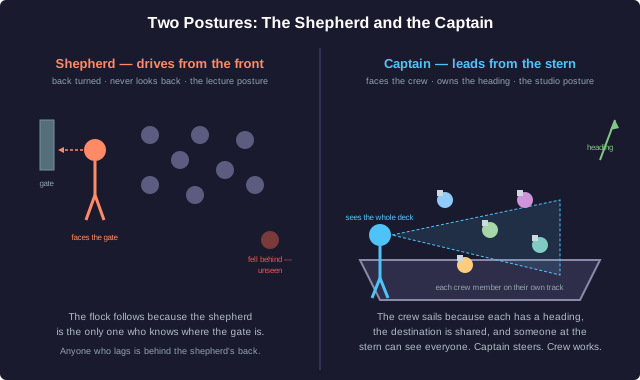
Picture a shepherd: out in front of the flock, back turned, driving the animals along by being ahead of them. The sheep follow because the shepherd is the only one who knows where the gate is. If a sheep falls behind, the shepherd does not see it: the shepherd is facing the wrong way.
Now picture a captain on a ship, leading from the back: standing at the stern, facing forward: which means facing the crew. The captain holds the destination, but the captain's eyes are on the people doing the work. The captain sees who is straining, who is idle, who has just figured something out. The captain steers; the crew sails.
A self-directed learning studio is a ship, not a flock. Students work self-paced: like a roomful of people at a co-working space, each on their own track: and the teacher floats, facing them. The teacher is not the source of every fact (the curriculum and the adaptive feedback handle the moment-to-moment loop). The teacher is the one who can see the whole deck.
Guide on the side, not sage on the stage. A lecture puts one voice at the front and thirty faces pointed at it: the shepherd's posture, scaled up. A studio inverts it: thirty people doing thirty things, one person circulating, watching, nudging. The 'sage on the stage' broadcasts. The 'guide on the side' listens, then places one well-aimed sentence.
What the captain is responsible for. Not abdication: a shepherd who never looks back has quit. The captain owns the heading: is each learner on a path that goes somewhere? Is anyone becalmed? Has anyone drifted off course? The crew owns the sailing: the actual reading, answering, building, practicing. Captain steers. Crew works. Neither does the other's job.
Sorting the Behaviors
Here are five things a teacher might do in a room of learners:
1. Stand at the front and deliver the day's content to everyone at once.
2. Circulate while students work, stopping where you see a need.
3. Set each learner's heading: checking that their track leads somewhere real: then let them sail it.
4. Keep your back to most of the room because you are focused on the one student in front of you.
5. Notice a learner who just had a breakthrough, name it, and ask them to show a neighbor.
A Co-Working Space for Learners
The Studio: Everyone Different, Everyone Together
A learning studio looks like a good co-working space. People at tables, headphones on or off, each deep in their own track: one on automotive diagnostics, one on a chorus part, one on fractions, one on a welding theory module: and a facilitator moving among them. Nobody is waiting for the slowest. Nobody is bored waiting for the rest of the class to catch up. The work is self-paced; the room is shared.
Why shared space, if the work is individual? Because learning is also social. A studio gives you: peers to ask before you ask the adult; a model of focus (the room concentrating is contagious); easy peer-teaching (the strongest evidence you understand something is being able to explain it to the person next to you); and a community: the thing the daughter in the story lost when chorus disappeared. Self-paced does not mean alone.
Why mixed ages and mixed subjects work. A nine-year-old and a sixteen-year-old in the same room is not a problem to be solved: it is the village restored. The older models for the younger; the younger keeps the older honest (you do not really understand it until you can explain it to a kid). And mixed subjects mean the room never has a single right answer being chased by everyone: it has thirty problems being worked, which makes asking a neighbor normal instead of cheating.
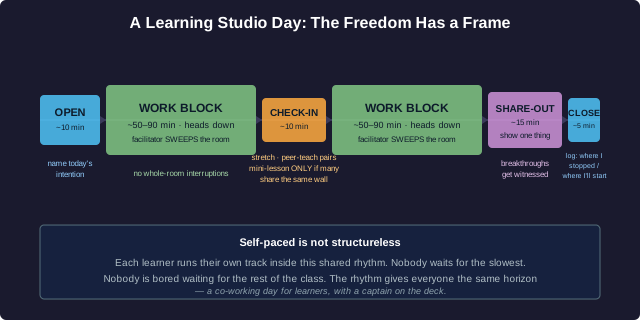
A daily rhythm gives the freedom a frame. Self-paced is not structureless. A workable rhythm:
- Open (10 min): everyone names today's intention out loud or on a board: what track, what they mean to reach. The facilitator now has the day's map.
- Work block (50-90 min): heads down. The facilitator sweeps (Section 3). No interruptions to the whole room.
- Check-in / stretch (10 min): stand up, regroup, quick peer-teaching pairs, a five-minute mini-lesson only if several people hit the same wall.
- Second work block (50-90 min): repeat.
- Share-out (15 min): a few learners show one thing they made or cracked today. This is where breakthroughs get witnessed.
- Close (5 min): each learner logs where they stopped and where they will start tomorrow. The voyage log (Section 4).
Designing the Room
A parent wants to run a small studio at home: their own two kids (ages 8 and 14) plus three neighbors (ages 7, 11, and 15). The kids will be on completely different tracks: early reading, fractions, a coding module, a welding-theory module, choral sight-singing.
Reading the Room: Who Needs You
The Sweep Is a Triage Loop
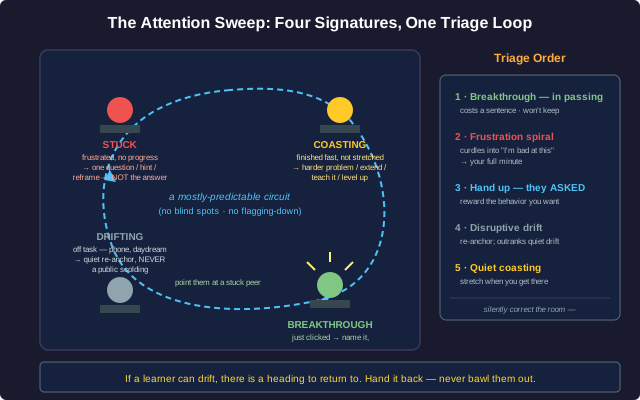
During a work block the facilitator circulates: a steady, mostly-predictable circuit: and at each pass reads the room and decides where one minute of attention should go. There are four signatures to learn to spot:
- The stuck learner. Real frustration, no forward motion: staring at the same step, the same blank line, for too long. They need a small unsticking: one question, one hint, one reframing: not the answer. Stuck for the right reasons (a genuinely hard idea) gets patience; stuck for the wrong reasons (a missing prerequisite, a confusing instruction) gets a quick fix and a note to fix the material.
- The coasting learner. Cruising through, finishing fast, not breaking a sweat. They are not being stretched. They need a harder problem, an extension, a 'now teach it to someone', or a jump to the next level: easy is its own kind of stuck.
- The drifting learner. Off task: phone, daydream, chatting, tab-switching. The captain's move here is not a scolding. You re-anchor, quietly: a hand on the back of the chair, 'where were you?', a soft restart of the task. Never a public correction, never a punishment for an honest lapse: you silently put the room back in order, the way a good interface silently corrects an invalid state instead of throwing an error. If you can type, there should be something to answer; if a learner is adrift, there should be a heading to return to. You hand it back, you do not bawl them out.
- The breakthrough learner. Something just clicked: you can see it. Catch it. Name it out loud ('you just did the thing'). Then, if they are willing, point them at a neighbor who is stuck on the same idea. A breakthrough witnessed and shared is worth ten that pass unnoticed.
Triage order. When two need you at once: a learner spiraling into frustration usually outranks a learner pleasantly coasting (frustration curdles into 'I'm bad at this'). A drifting learner who is disrupting others outranks one drifting quietly. A breakthrough is brief: catch it on the way past; it will not wait, but it also only costs a sentence. And a learner who has put their hand up has asked: they go near the front of the queue, because asking is exactly the behavior you want to reward.
The sweep is mostly predictable on purpose. A roughly fixed circuit means every learner knows you will reach them soon, so they keep working instead of flagging you down; and it means no corner of the room goes a long time unseen. Random wandering leaves blind spots and trains learners to interrupt. (The geometry of the circuit is its own lesson: see Geometry of Facilitation.)
Triage in Practice
It is the middle of a work block. On one pass of the room you see, all at the same time:
- A: a learner who has been staring at the same problem for fifteen minutes, getting visibly more frustrated, no progress.
- B: a learner who finished the whole module twenty minutes early and is now scrolling their phone, quietly, bothering no one.
- C: a learner who just lit up: you can see they cracked something: and is looking around like they want to tell someone.
- D: a learner with their hand up, waiting.
The Loop Gives Feedback. The Captain Logs the Voyage.
Two Different Jobs: Formative Feedback and the Record
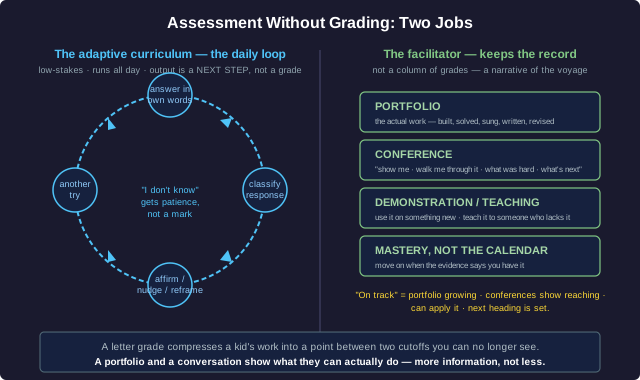
The adaptive curriculum carries the moment-to-moment loop. A learner answers a question in their own words; the system classifies the response and replies: affirming, nudging, reframing: and offers another try. That loop runs all day, on every learner, low-stakes, without a human in it. 'I don't know' gets patience, not a mark. A clarifying question does not count against them. The point of that loop is understanding, not ranking: so it does not produce a grade, it produces a next step.
The facilitator carries the record. Not a column of grades: a narrative of the voyage. The tools:
- Portfolio. The actual work: the thing built, the problem solved, the part sung, the weld diagrammed, the essay revised three times. Evidence you can hold, not a number that stands in for it.
- Conference. A short, regular sit-down: 'Show me. Walk me through it. What was hard? What's next?' The learner narrates their own progress; the facilitator listens and asks. This is where you find out what a portfolio piece cost and what it taught.
- Demonstration / teaching. The strongest evidence of mastery is use: solve a new problem with it, or teach it to someone who does not have it yet. A learner who can teach fractions to the seven-year-old has shown you more than any quiz could.
- Mastery, not the clock. Progress is 'can you do it yet', not 'is it October'. A learner moves on when the evidence says they have it: which means some move fast and some take the time they need, and neither is behind, because there is no shared front to be behind of.
'But how do I know my kid is on track without grades?' You know the way you know whether someone can drive: not from a letter on a transcript but from watching them do it. On track means: the portfolio is growing, the conferences show them reaching, they can use what they have learned on something new, and the next heading is set. A B+ tells you a kid scored between two cutoffs on things you can no longer see. A portfolio and a conversation tell you what they can actually do. The second is more information, not less.
Conflict and community. A studio is a small society, and the captain is also the one who keeps it a good one: a few clear norms (ask three peers before the adult; the room's focus is shared property; disagree with the idea, not the person), restorative repair when something goes wrong rather than punishment, and the steady modeling of how a crew treats each other. A room where it is safe to be stuck, safe to ask, and safe to not-yet-know is the precondition for everything else.
Answering the Worried Parent
A parent is interested in the studio but anxious: 'I get the appeal, but in a regular school I get a report card. Here there are no grades. How do I know my kid is actually learning and not just falling behind? How would you even tell?'
The Captain Faces the Crew: Summary
What You Have Learned
- Two postures. The shepherd drives from the front, back turned: the lecture posture. The captain leads from the stern, facing the crew: the studio posture. The captain owns the heading (each learner's path goes somewhere real); the crew owns the sailing (the actual work). Leading from the back is a vantage point, not a vacation.
- The room. Self-paced work in a shared space: a co-working studio for learners. Mixed ages and subjects are a feature: peers to ask, contagious focus, peer-teaching that proves understanding, community. A daily rhythm (open → work block → check-in → work block → share-out → close) gives the freedom a frame.
- The sweep. During work blocks the facilitator circulates a mostly-predictable circuit and triages attention: unstick the stuck (a question, not the answer), stretch the coasting (a harder problem, not a scold), quietly re-anchor the drifting (never a public correction), catch and share the breakthrough (it's cheap and it won't wait). Honor the hand that goes up.
- Assessment. The adaptive curriculum runs the moment-to-moment feedback loop: low-stakes, patient, output is a next step not a grade. The facilitator keeps the record: portfolio, conference, demonstration, teaching, mastery-not-calendar: which is more information than a letter grade, not less. In a self-paced room there is no shared front, so 'falling behind' is the wrong frame; 'is the portfolio growing and the next heading set' is the right one.
- Community. A studio is a small society. A few clear norms, restorative repair over punishment, and steady modeling make a room where it is safe to be stuck, safe to ask, and safe to not-yet-know: the precondition for everything else.
The shepherd's flock follows because the shepherd is the only one who knows where the gate is. The captain's crew sails because each of them has a heading, the destination is shared, and someone is standing at the stern who can see the whole deck. The studio is a ship. Face the crew.