How Light Stays Inside
Richard Hamming encountered fiber optics as a new technology proposal and immediately asked the physicist's question: why does the light stay inside a thin glass fiber?
Snell's Law
When light crosses from a medium with index of refraction n₁ into one with index n₂, the transmitted angle θ₂ satisfies:
n₁ sin θ₁ = n₂ sin θ₂
For glass (n₁ ≈ 1.5) to air (n₂ = 1.0), sin θ₂ = (n₁/n₂) sin θ₁ = 1.5 sin θ₁.
When sin θ₁ exceeds n₂/n₁ = 1/1.5 ≈ 0.667, no real solution for θ₂ exists. Light cannot exit the glass at all. Every photon reflects back inside. This threshold is the critical angle:
θ_c = arcsin(n₂/n₁)
For glass-to-air: θ_c = arcsin(1/1.5) ≈ 42°. Any ray striking the glass-air interface at an angle greater than 42° from the normal reflects entirely. Zero transmission. Zero loss at the boundary.
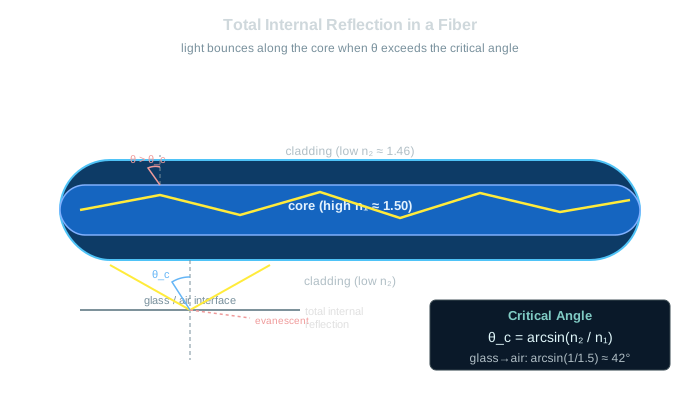
Computing the Critical Angle
The critical angle depends only on the ratio of refractive indices. A fiber design uses a high-index core (n₁) surrounded by a low-index cladding (n₂). Light guided within the core bounces between boundaries whenever its angle exceeds θ_c.
Why smaller diameter? Hamming noted this directly. A thicker fiber bends more gently over a given curve radius. A thinner fiber can follow a tighter curve while keeping the angle of incidence above θ_c. Smaller diameter also reduces signal distortion (modal dispersion) over long distances.
Bandwidth, Attenuation, & Immunity
Hamming enumerated the engineering advantages that made fiber optics inevitable:
Higher bandwidth. Optical frequencies (≈10¹⁴ Hz) far exceed microwave and radio frequencies. More cycles per second means more information per second. A single fiber strand carries more simultaneous channels than a copper cable bundle.
Lower attenuation. Modern silica fiber loses roughly 0.2 dB/km. Copper coaxial cable loses 10–100× more per kilometer. Fiber spans oceans with fewer repeaters.
Electromagnetic immunity. Fiber carries no electrical current. Lightning, nearby power lines, & atomic bomb detonations in the upper atmosphere generate electromagnetic pulses that destroy copper-based communications. Fiber ignores them. Hamming recognized this advantage through calculations he was doing with a chemistry group.
The graded-index solution. A sharp core-cladding boundary causes modal dispersion: different ray angles travel different path lengths, broadening pulses. Hamming recognized that smoothly grading the refractive index (same principle as strong focusing in cyclotrons) bends rays continuously back to center, eliminating sharp reflections & reducing dispersion.
Hamming's Security Insight
Hamming made an observation that was not initially obvious to the communications engineers working on fiber optics: the same property that makes fiber efficient also makes it secure.
> The fibers are so efficient, meaning they lose so few photons, 'tapping' a line will be a difficult feat. Not that it is impossible, only it will be difficult.
To tap a fiber, an attacker must bend it enough to cause some light to leak out at the bend point. But bending enough to leak light is detectable: the receiver notices a drop in signal strength. Unlike copper, where a passive tap draws negligible current, fiber provides physical evidence of interception.
This was a dual-use insight: Hamming noticed a security property while thinking about a physics problem. The lesson he drew: studying the physics of a technology often reveals properties engineers focused on the primary application will miss.
Hamming's Position on the Mode Debate
Hamming admitted he did not follow every argument in the single-mode vs multi-mode fiber debate. He ran simulations for both sides and ultimately backed single-mode on the same grounds he had backed binary signaling over multi-level signaling earlier in his career.
Multi-mode fiber allows multiple propagation angles (modes) simultaneously. Easier to manufacture, easier to couple light in, tolerates more connector imprecision. But modal dispersion broadens pulses over distance.
Single-mode fiber confines light to one propagation path. Requires a very small core diameter (≈8 µm for telecom). Much harder to splice & connect. But zero modal dispersion: pulses stay sharp over thousands of kilometers.
The long-run winner for high-capacity, long-distance transmission: single-mode. Hamming's preference for simplicity — fewer modes, one path, no modal dispersion — aligned with the eventual engineering outcome.