The Durable Edge
Why Skill Still Matters When Machines Do the First Pass
Automated systems now generate most first-pass production across the economy: draft contracts, draft code, draft financial models, draft designs, draft diagnoses. The output arrives fast and it usually looks competent.
This changes what a professional is worth. When anyone can summon a plausible draft, plausible drafts stop being scarce. What stays scarce is judgment: the skill to know when the draft is wrong, to fix what a tool cannot, and to perform the hard core of the craft unaided when it matters.
That skill does not maintain itself. It is built and kept through deliberate practice, and it decays quietly when you stop exercising it. This lesson is about keeping your edge sharp on purpose.
What Deliberate Practice Actually Is
Not Repetition. Targeted Strain.
Anders Ericsson spent decades studying experts: violinists, surgeons, chess masters, pilots. His finding: hours alone do not build expertise. A specific kind of practice does. He called it deliberate practice, and it has a precise shape.
1. At the edge of your ability. Deliberate practice targets what you cannot yet do reliably, not what you have already mastered. It feels effortful and slightly uncomfortable. Comfortable repetition of skills you already own is not deliberate practice; it is maintenance at best.
2. On a specific weakness. You isolate one failing sub-skill and attack it directly. A pianist does not replay the whole piece; they drill the four bars they keep fumbling. A litigator drills the cross-examination move that keeps collapsing, not the whole trial.
3. With immediate feedback. You find out quickly whether each rep was right or wrong, and you correct on the next rep. Feedback delayed by weeks barely teaches. Feedback in seconds compounds.
4. With focused repetition and refinement. You repeat the hard thing, adjusting each time, until the failing sub-skill becomes reliable. Then you move the edge.
The uncomfortable truth is the whole point. If practice feels easy and pleasant, you are almost certainly rehearsing what you already know instead of building what you do not.
Comfortable Repetition or Deliberate Practice?
A data analyst wants to get better at statistical modeling. Every week she rebuilds a linear-regression dashboard she already knows cold, adds a few charts, and reads one article about a technique she never tries. She has done this for a year and feels she is "practicing" but her modeling has not improved.
The Two Levers of Durable Memory
Making Skill Stick, Not Just Appear
Deliberate practice builds a skill. Two findings from memory science keep it from leaking away: retrieval practice and spacing. Both feel worse in the moment and work far better over time, which is exactly why most people skip them.
Retrieval practice. Recalling something from memory strengthens it far more than reviewing it. Re-reading your notes feels productive and teaches little; closing the notes and reconstructing the idea unaided is what builds durable command. For a professional this means: do the reasoning from a blank page before you look anything up. Derive the estimate, draft the argument, or reconstruct the procedure from memory first, then check.
The generation effect is the same lever: producing an answer yourself, even a wrong one, before seeing the solution makes the correct answer stick harder than reading it cold. The struggle is not wasted; it is what prepares the mind to encode the fix.
Spacing. Practice spread across days beats the same practice crammed into one sitting. Each time you let a skill get slightly rusty and then retrieve it again, you reinforce it more durably. Increasing intervals (a day, then a few days, then a week) fight the forgetting curve. Cramming produces a skill that performs on the day and evaporates by the next month.
Put together: retrieve the skill unaided, space those retrievals across expanding intervals, and the skill stops being something you can only do with your notes open.
Applying Retrieval and Spacing at Work
A newly promoted engineering manager wants durable command of the incident-response runbook so she can lead an outage without reading from a document. She currently re-reads the runbook once a month.
When Reviewing Feels Like Expertise
The Skill You No Longer Have but Think You Do
There is a specific trap in automated work. A tool produces the first pass; you review it, adjust a little, and approve it. This feels like expertise. You are, after all, the one signing off. But reviewing output is not the same act as producing it, and it does not exercise the same skill.
The illusion of competence is the gap between what you can recognize and what you can produce. Recognizing that a draft looks right is far easier than generating a correct one from nothing. Fluency with a tool's output can feel identical to fluency in the underlying craft, right up until the moment you must perform without the tool.
Atrophy is quiet. A skill you stop exercising fades gradually and without warning. Because you keep approving good-looking output, nothing signals the decline. The feedback that would reveal it, trying to do the task unaided, is exactly the feedback you have stopped collecting.
Fragile expertise is the result: competence that exists only while the tool is present. The day the tool is absent, wrong, or facing a case it handles badly, the fragile expert cannot step in, because the skill that would let them catch and fix the problem has quietly decayed. The expertise you can no longer exercise unaided is not really yours anymore.
The dangerous version is the subtle error: automated output that is 95% right and confidently wrong in one place. Only someone whose underlying skill is still sharp will catch it. The reviewer running on the illusion of competence will approve it.
The Error Only a Sharp Expert Catches
A senior tax accountant used to prepare complex returns by hand. For two years an automated system has drafted them; she reviews and signs. This quarter the tool produces a return that is flawless except for one subtly misapplied deduction rule that would trigger an audit. She skims it, it looks professional, and she signs.
Same Tool, Opposite Effect
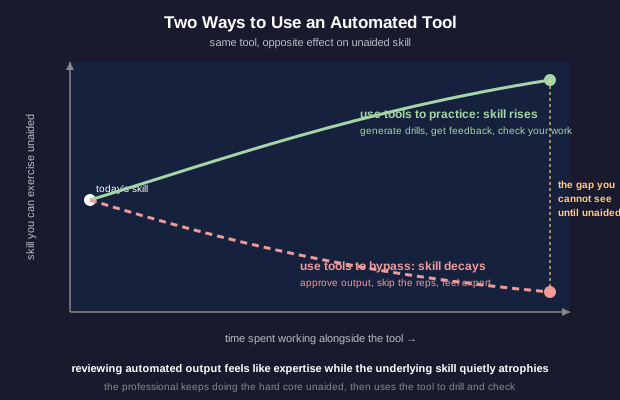
The Tool Is Not the Question. How You Use It Is.
The same automated tool can build your skill or hollow it out. The difference is not the tool; it is whether your use adds reps at your edge or removes them.
Build: use the tool to practice. Have it generate drills targeted at your weakness. Use it as an immediate-feedback partner that critiques the work you produced unaided. Use it to check your answer after you have committed to your own. Use it to explain the fix once you have struggled with the problem yourself. In every build use, you still do the hard core; the tool sharpens and corrects it.
Bypass: use the tool to skip the reps. Have it produce the work you were supposed to learn to produce, then approve it. Reach for it before you have attempted the thing yourself. Let it do the hard core while you do the reviewing. Every bypass use removes a rep at your edge, and it is those reps that were building the skill.
The professional''s rule is simple and demanding: deliberately keep doing the hard core yourself. Use tools to generate practice, to give feedback, and to check your work, never to replace the reps that build the skill you intend to keep. The curve you are on depends entirely on which side of that line your daily habits fall.
Sorting Your Own Habits
A junior software engineer wants to become genuinely strong at system design. In a typical week she: (a) asks a tool to produce a full design for each new feature and submits it after a quick read; (b) attempts a design herself first, then asks the tool to critique it; (c) has the tool generate practice design prompts she works through unaided; (d) copies the tool's code for any algorithm she finds tricky rather than writing it.
Turning the Discipline Into a Habit
From Principle to Practice
Everything so far becomes real only if it fits into a working week. A knowledge worker can hold a durable edge with a modest, repeatable routine that bundles the ideas from this lesson.
A workable weekly deliberate-practice routine has five moving parts:
- Pick one edge weakness. Choose a single sub-skill you cannot yet do reliably and that matters to your work. Rotate it as it becomes solid.
- Do unaided reps of the hard core. Produce the real thing from a blank page, tool switched off, so the reps land at your edge.
- Get immediate feedback. Check each attempt quickly against a known-good answer, a held-out case, a mentor, or a tool used as critic, and correct on the next rep.
- Space and retrieve. Return to the skill across expanding intervals, reconstructing it from memory rather than re-reading, so it stays durable.
- Keep a competence check. Periodically do a real task fully unaided to detect any quiet atrophy before production does.
It need not be large. Two or three focused hours a week, protected and deliberate, will outperform forty hours of comfortable production that never strains.
Design Your Own Routine
Choose a skill in your own field or one you know well: writing, coding, diagnosis, negotiation, forecasting, design, teaching, anything where automated tools now do a first pass.
What You Now Know
Keeping Your Edge on Purpose
Automated systems will keep producing more of the first pass. Your durable value is the skill you have deliberately kept sharp and can exercise unaided. You have covered:
- Deliberate practice: edge-of-ability work on a specific weakness, with immediate feedback, not comfortable repetition.
- Retrieval and spacing: recall the skill unaided and revisit it across expanding intervals so it stays durable.
- The illusion of competence: reviewing and approving output feels like expertise while the underlying skill quietly atrophies into fragile competence that fails the moment the tool is absent or subtly wrong.
- Build versus bypass: the same tool sharpens skill when it generates drills, gives feedback, and checks your work, and hollows it when it removes the reps; the professional deliberately keeps doing the hard core.
- A weekly routine: a small, protected, repeatable practice that reinserts the reps automation removes.
Two ideas matter most. The skill you cannot exercise unaided is not really yours. And use tools to add reps at your edge, never to remove them. Carry those two forward and your expertise stays genuinely your own.