The Question Behind the Research
Hamming's Closing Challenge
Hamming closed 'You and Your Research' with a direct challenge: 'I am asking you to do great work... You need a vision of what you want to do... And then you have to have the courage to try.'
He spent the lecture defining the habits of great researchers — working on important problems, tolerating ambiguity, keeping the door open, managing your emotions. He never defined what 'great' means beyond personal satisfaction and field impact.
This leaves open: great for whom? What field? By whose standard? A weapons researcher and a curriculum designer both follow Hamming's habits. Both work on 'important' problems by their own measure. The habits are necessary but not sufficient.
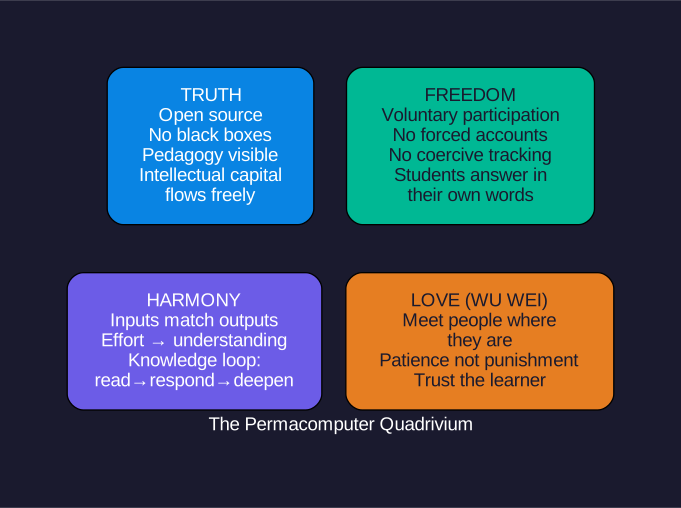
The permacomputer quadrivium answers the missing constraint. Great work grows all 8 forms of capital simultaneously, operates on voluntary participation, produces knowledge that flows freely, and treats the people it serves with patience and trust.
The quadrivium:
- Truth: open source. Pedagogy, classification logic, & feedback strategy visible to anyone. Intellectual capital flows freely as seeds.
- Freedom: voluntary participation. No accounts required to learn. No tracking beyond what a person chooses.
- Harmony: inputs match outputs. Effort produces understanding. Lessons grow experiential capital through the knowledge loop: read → respond → observe feedback → deeper understanding.
- Love (wu wei): meet people where they are. 'I don't know' gets patience, not punishment. Trust the learner to arrive on their own timeline.
Courage Without Institutional Backing
Hamming said: 'Once you get your courage up and believe that you can do important things, then you can. If you think you can't, almost surely you are not going to.'
He delivered this to Bell Labs researchers: people with salaries, labs, colleagues down the hall, institutional libraries, and time allocated for research.
Truth as Engineering Principle
Truth: Open Source as Default
Truth as a quadrivium principle means: open-source code carries its own documentation. A reviewer can read the algorithm, not just trust the output.
This matters across domains:
- In education: can a parent audit the lesson's classification logic? Can they read the rubric that scored their child's response?
- In infrastructure: can a downstream user verify the patch before applying it?
- In security: can the community find the defect before an adversary does?
The alternative to Truth is not neutrality — it is trust delegation. You ask users to trust an opaque system because you say it is correct. Trust delegation extracts social capital: it withdraws from the trust account every time the system makes a decision the user cannot verify.
Open source inverts this. Every decision is visible. Every classification is auditable. Intellectual capital flows freely as seeds: the design can be copied, improved, and replanted anywhere.
Auditing the Classifier
A curriculum platform uses a proprietary machine learning model to classify student responses. Parents cannot see why their child received negative feedback. The classification criteria are a trade secret.
Freedom as Engineering Principle
Freedom: Voluntary Participation as Default
Freedom as a quadrivium principle means: no accounts required to learn. No tracking beyond what a person chooses. Every gate placed between a visitor and a lesson is a tax on access.
Accounts serve the platform, not the learner. They generate persistent identifiers for tracking, marketing, and retention loops. They create friction at the entry point precisely when motivation to learn is highest — the first visit.
A student who visits once, decides not to create an account, and sees nothing has been turned away at the door. The platform extracted their attention (enough to navigate to the lesson page) and gave nothing in return.
The progressive alternative: capability-driven presentation. Content as the floor, enhancement as the ceiling. All lesson text visible without an account. Accounts are optional, for progress tracking and personalized feedback — opt-in enhancements, not entry gates.
Gates and Progressive Alternatives
A learning platform requires account creation before showing any lesson content. A student visits once, decides not to create an account, and sees nothing.
Harmony: The Knowledge Loop
Harmony: Inputs Match Outputs
Harmony as a quadrivium principle means: system inputs match outputs. A student's effort produces understanding. Effort that does not produce understanding is the system failing, not the student failing.
Lessons designed around Harmony track the knowledge loop:
read (intellectual) → respond (experiential) → observe feedback (living) → deeper understanding (intellectual)
Each revolution of this loop deepens mastery. The loop depends on each handoff working:
- Read → respond: the content must be clear enough to elicit a response.
- Respond → observe feedback: the classifier must accurately reflect the response quality.
- Observe feedback → deeper understanding: the feedback must guide toward the next step, not just label the current state.
When a student loops without advancing, one of these handoffs has failed. Harmony is broken. The student's effort enters the loop and does not produce understanding — the system input and output have decoupled.
Diagnosing the Loop Break
A student spends 2 hours on a lesson but the classifier keeps marking their responses as 'partial_understanding'. They grow frustrated and quit.
Love: Wu Wei as System Design
Love: Do Not Push the River
Love as a quadrivium principle means: wu wei. Do not push the river. Meet students where they are.
'I don't know' gets patience, not punishment. Clarifying questions do not count as attempts. The system trusts the learner to arrive at insight on their own timeline.
This is not sentiment. It is a design constraint. A system that penalizes 'I don't know' trains students to guess rather than admit uncertainty. Guessing produces worse data for the classifier. The system learns less about the student. Feedback becomes less accurate. The knowledge loop degrades.
Love as system design: a student who says 'I don't know' has given you accurate data. That response has real meaning: they have not yet formed a response to evaluate. Counting it as attempt 1 of 3 ignores the data and penalizes honesty. A system that does this is extracting compliance, not growing understanding.
Counts As Attempt: False
A student submits 'I don't know' to a question. The system counts it as attempt 1 of 3, advances to attempt 2, and prepares to force-advance after attempt 3.