Welcome
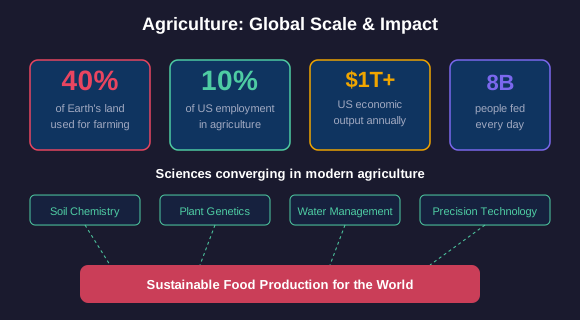
Every meal you have ever eaten started in a field, an orchard, a greenhouse, or a pasture. Agriculture is not just farming: it is the system that feeds eight billion people every single day.
Modern agriculture is an enormous industry. In the United States alone, farming & related sectors account for over $1 trillion in economic output & roughly 10 percent of all employment. Globally, agriculture uses about 40 percent of all land on Earth.
The scale is staggering, & the science behind it is deep. Soil chemistry, plant genetics, water management, pest ecology, animal nutrition, climate adaptation, & precision technology all converge in this field.
In this lesson, we will cover the foundational knowledge: soil science, crop management, livestock basics, agricultural technology, & the career paths that depend on all of it.
Warm-Up
Before we dig in, let's see what you already know about how food gets from the ground to your plate.
What Makes Up Soil
The Foundation of All Farming
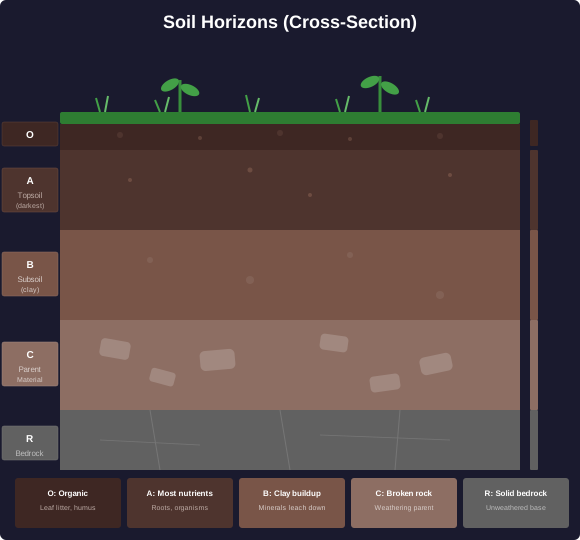
Soil is not just dirt. It is a living, complex system made up of four components: minerals, organic matter, water, & air. A healthy soil is roughly 45 percent mineral particles, 5 percent organic matter, 25 percent water, & 25 percent air by volume.
Mineral particles come in three sizes, sand (coarse, drains fast), silt (medium, holds moisture), & clay (fine, holds nutrients but drains poorly). The ratio of sand, silt, & clay determines the soil texture. Loam, a balanced mix of all three: counts as ideal for most crops.
Organic matter is decomposed plant & animal material. It feeds soil microorganisms, improves water retention, provides slow-release nutrients, & gives soil its dark color. Soils with less than 2 percent organic matter count as degraded.
Soil pH measures acidity or alkalinity on a 0-14 scale. Most crops prefer a pH between 6.0 & 7.0. If the soil is too acidic, farmers add lime (calcium carbonate). If too alkaline, they add sulfur or acidifying fertilizers. pH directly affects nutrient availability: some essential nutrients lock up & become unavailable to plants at the wrong pH.
NPK, Nitrogen, Phosphorus, Potassium, are the three primary macronutrients plants need. Nitrogen drives leaf & stem growth. Phosphorus supports root development & flowering. Potassium strengthens cell walls & disease resistance. Fertilizer bags show three numbers (like 10-10-10) representing the percentage of N, P, & K by weight.
Soil testing is how farmers know what they are working with. A lab test reveals pH, nutrient levels, organic matter content, & texture. Without a soil test, fertilizer application is guesswork: & guesswork wastes money & pollutes waterways.
Reading a Soil Test
A farmer sends a soil sample to a lab & gets these results: pH 5.2, nitrogen low, phosphorus adequate, potassium high, organic matter 1.8 percent. The farmer wants to plant corn, which prefers a pH of 6.0-6.8 & is a heavy nitrogen feeder.
Planting, Irrigation, and Crop Rotation
Growing Crops at Scale
Successful crop production starts with seed selection. Modern farmers choose varieties bred for their specific region: adapted to local climate, soil type, day length, & pest pressure. Seed catalogs list maturity dates, disease resistance, yield potential, & drought tolerance for every variety.
Planting depends on soil temperature, moisture, & the frost-free window. Planting too early in cold soil leads to poor germination. Planting too late shortens the growing season. Most row crops are planted with GPS-guided precision planters that place seeds at exact spacing & depth.
Irrigation supplements rainfall when natural precipitation is not enough. Drip irrigation delivers water directly to root zones with minimal waste. Center-pivot systems (the giant circular sprinklers visible from the air) are common for field crops. Flood irrigation is older & less efficient but still used in some regions. Over-irrigation wastes water, causes erosion, & can leach nutrients out of the root zone.
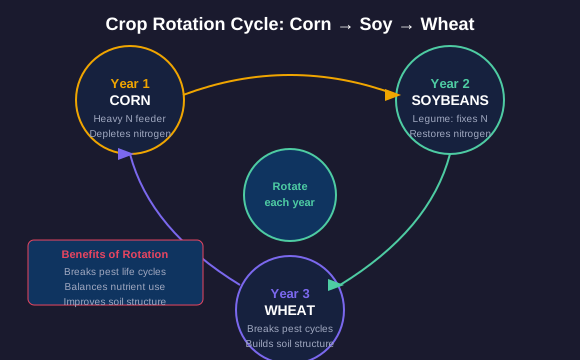
Crop rotation is the practice of growing different crops in sequence on the same field: for example, corn one year, soybeans the next, wheat the third. Rotation breaks pest & disease cycles, balances nutrient demands, & improves soil structure. Corn depletes nitrogen; soybeans (a legume) fix atmospheric nitrogen back into the soil through a symbiotic relationship with rhizobia bacteria in their root nodules.
Integrated Pest Management (IPM) combines multiple strategies to manage pests: crop rotation, beneficial insects (like ladybugs that eat aphids), resistant varieties, targeted pesticide use only when thresholds are exceeded, & monitoring. IPM reduces chemical inputs, lowers costs, & protects the environment compared to calendar-based spraying.
Designing a Rotation
A farmer has been growing corn on the same 200-acre field for five straight years. Yields have been dropping each year, the soil seems compacted, & rootworm damage is getting worse despite increasing pesticide applications. The farmer asks for your advice.
Animal Husbandry Fundamentals
Raising Animals for Food
Livestock production is the other half of agriculture. Cattle, poultry, swine, sheep, & goats convert plant material (grain, forage, & crop residues) into protein: meat, milk, & eggs.
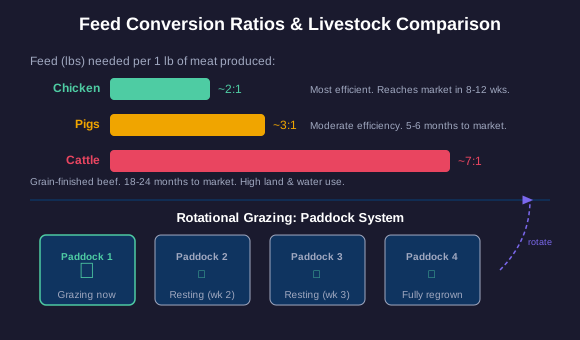
Feed conversion ratio (FCR) measures how efficiently an animal converts feed into body weight. Chickens are the most efficient at roughly 1.6 to 2.0 pounds of feed per pound of meat. Pigs are around 3 to 1. Cattle are 6 to 8 to 1 for grain-finished beef. These numbers drive the economics of the entire livestock industry.
Pasture management is critical for cattle, sheep, & goats. Rotational grazing, moving animals through a series of paddocks so each section rests & regrows, maintains grass health, prevents overgrazing, & builds soil organic matter through manure distribution. Continuous grazing on the same pasture degrades the land.
Animal welfare has become a major factor in modern agriculture. The five freedoms framework guides responsible animal husbandry: freedom from hunger & thirst, freedom from discomfort, freedom from pain & disease, freedom to express normal behavior, & freedom from fear & distress. Consumer demand for humanely raised products is reshaping how livestock operations are designed & managed.
Manure management is both an asset & a liability. Properly composted & applied manure is an excellent soil amendment: it returns nutrients & organic matter to cropland. Improperly managed manure contaminates waterways, produces greenhouse gases, & creates odor problems. Large operations must have nutrient management plans to handle waste responsibly.
Livestock Decisions
A beginning farmer has 50 acres of pasture & wants to raise livestock for meat production. They are deciding between a small cattle herd & a pastured poultry operation (chickens raised in mobile shelters moved across the pasture).
Precision Agriculture
Data-Driven Farming
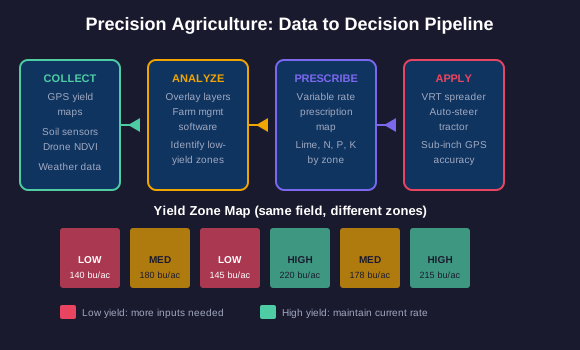
Precision agriculture uses technology to make farming decisions at a granular level: managing variability within a single field rather than treating the whole field the same.
GPS guidance allows tractors, planters, & sprayers to navigate fields with sub-inch accuracy. Auto-steer systems reduce overlap, save fuel & inputs, & let operators work in low-visibility conditions. GPS also enables yield mapping: the combine records yield data at every point in the field, producing a map that shows high-performing & low-performing zones.
Drones & aerial imaging give farmers a bird's-eye view of crop health. Multispectral cameras on drones detect stress, disease, & nutrient deficiency before they are visible to the naked eye. A drone can scout 500 acres in an hour: a task that would take days on foot.
Soil sensors measure moisture, temperature, & nutrient levels in real time. Some are permanently installed in fields & transmit data wirelessly. This information drives irrigation scheduling: watering only when & where the soil needs it instead of running the entire system on a timer.
Variable rate technology (VRT) adjusts fertilizer, seed, & chemical application rates on the fly based on prescription maps. If a soil test shows one corner of a field is low in phosphorus, the spreader applies more there & less where levels are adequate. VRT reduces input costs & environmental impact by putting the right amount of the right product in the right place.
Data platforms aggregate GPS, sensor, drone, yield, & weather data into farm management software. Farmers use these platforms to track inputs, plan rotations, compare hybrid performance, & make long-term decisions. Agriculture is becoming as data-intensive as any tech industry.
Applying Technology
A 1,000-acre corn & soybean farm has a problem: yields vary dramatically across each field. Some zones produce 220 bushels per acre of corn while others produce only 140. The farmer has been applying the same rate of fertilizer & seed everywhere.
Where Agriculture Takes You
Agricultural Careers & Education
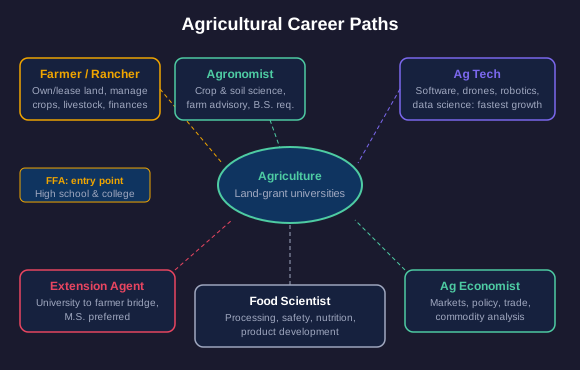
Agriculture is not one career: it is an entire economy. The range of opportunities spans from hands-in-the-soil farming to cutting-edge technology development.
Farmer or rancher: The core of the industry. Running a farm or ranch means managing land, crops, livestock, equipment, finances, employees, & weather risk simultaneously. Family operations, corporate farms, & beginning farmer programs all offer entry points. Many successful farmers also run direct-to-consumer businesses through farmers markets, CSA subscriptions, & online sales.
Agronomist: A crop & soil scientist who advises farmers on variety selection, fertility programs, pest management, & yield optimization. Agronomists work for seed companies, fertilizer companies, cooperatives, or as independent consultants. A bachelor's degree in agronomy, crop science, or soil science is typical.
Extension agent: The bridge between university research & working farmers. Extension agents work for land-grant universities & deliver education, technical assistance, & community programs in every county. They need strong science backgrounds & excellent communication skills. A master's degree is often preferred.
Agricultural technology (ag tech): The fastest-growing sector. Software engineers, data scientists, drone operators, & robotics specialists are building the tools that drive precision agriculture. Ag tech startups have attracted billions in venture capital. If you can code & understand farming, you are in high demand.
FFA (formerly Future Farmers of America) is a student organization that develops leadership, career skills, & agricultural knowledge through competitions, supervised agricultural experiences, & community service. FFA chapters operate in high schools & colleges across the country.
Land-grant universities: Institutions like Iowa State, UC Davis, Texas A&M, Cornell, & Purdue were established specifically to research & teach agriculture. They offer degrees in agronomy, animal science, agricultural engineering, food science, agricultural economics, & dozens of related fields. Many offer scholarships & paid research opportunities.
Planning Your Path
Connect Agriculture to Your Future
You now know the fundamentals of soil science, crop management, livestock production, & the technology transforming the industry.