3,000 Words
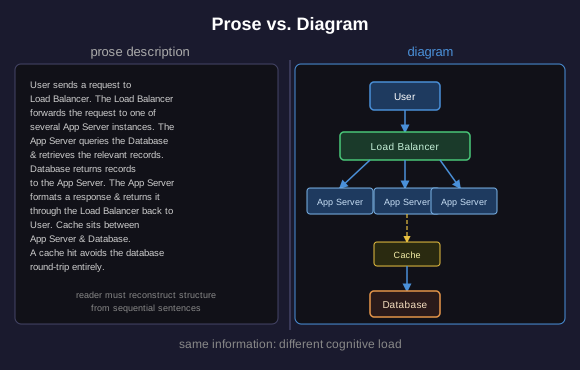
"A picture is worth a thousand words" is usually credited to an advertising executive in 1921. The number is wrong: it undersells.
A single well-designed diagram can communicate structure, relationship, sequence, scale, causality, & feedback loops simultaneously. Prose communicates these one sentence at a time. A reader must hold prior sentences in working memory to reconstruct the structure the diagram shows at a glance.
3,000 words is closer. For a complex system: a circuit, a supply chain, a control loop, a class hierarchy: the diagram is often the only way to communicate the whole thing without losing the reader in the middle.
This is not decoration. Diagrams are a primary communication medium in every technical profession. Engineers submit drawings, not paragraphs. Surgeons study anatomy plates, not text descriptions. Network architects draw topologies before writing a line of config. The diagram IS the specification.
Prose Limit
What prose cannot do
Prose is serial: one word after another, one sentence after another. A reader processes it sequentially. A diagram is parallel: the eye moves freely, zooming in on details, jumping between components, perceiving the whole & the part simultaneously.
A Map of Diagram Types
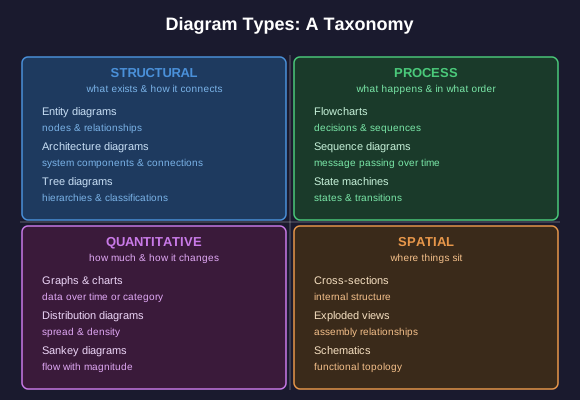
Every diagram type solves a different communication problem. Using the wrong type for your content creates confusion: not clarity. The first design decision is always: what kind of information am I communicating?
Structural diagrams show what exists & how it connects:
- Entity diagrams: nodes & relationships (database schemas, org charts, knowledge graphs) - Architecture diagrams: system components & their connections (network topologies, software systems) - Tree diagrams: hierarchies (classification trees, file systems, family trees)
Process diagrams show what happens & in what order:
- Flowcharts: decisions & sequences (algorithms, business processes, diagnostic logic) - Sequence diagrams: message passing over time (API calls, protocols, event handling) - State machines: states & transitions (UI flows, protocol states, control systems)
Quantitative diagrams show how much & how it changes:
- Graphs & charts: data over time or category (line, bar, scatter) - Distribution diagrams: spread & density (histograms, box plots) - Sankey diagrams: flow with magnitude (energy flows, budget allocations)
Spatial diagrams show where things are:
- Cross-sections: internal structure (geology, anatomy, engineering) - Exploded views: assembly relationships (mechanical parts, electronics) - Schematics: functional topology (electrical circuits, plumbing, HVAC)
Match Type to Problem
Type selection is the first design decision
The most common diagramming mistake is choosing a type by habit rather than by fit. A developer reaches for a flowchart because they always use flowcharts. A manager reaches for an org chart. The type should be chosen by what the diagram must communicate.
How to Read a Complex Diagram
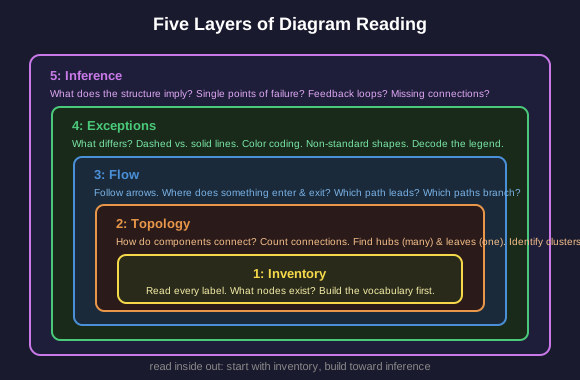
Complex diagrams have layers. A reader who tries to absorb everything at once gets overwhelmed. A reader who reads in layers extracts the structure efficiently.
Layer 1: Inventory. What nodes exist? What are the major components? Read every label. Do not follow connections yet. Build the vocabulary before building the grammar.
Layer 2: Topology. How are the components connected? What is connected to what? Count the connections. Identify hubs (many connections) and leaves (one connection). Notice clusters.
Layer 3: Flow. If arrows exist, follow them. Where does something enter the system? Where does it exit? What path does the main flow take? What are the branches?
Layer 4: Exceptions. What is different? Dashed lines vs. solid lines. Color coding. Shapes that differ from the majority. These encode meaning: find the legend and decode them.
Layer 5: Inference. What does this structure imply? A single hub with many dependencies is a single point of failure. A feedback loop implies oscillation risk. A missing connection implies a boundary. Read what is not drawn as carefully as what is.
Reading Practice
Apply the five-layer method
Think of a complex diagram you have encountered in your field: a circuit schematic, a network topology, an anatomy diagram, a system architecture, a plumbing isometric, a state machine.
Composition Principles
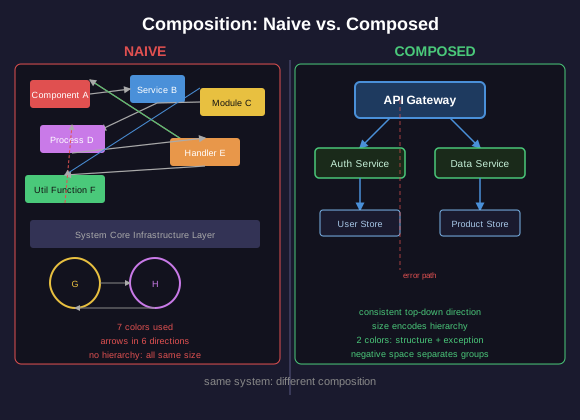
A diagram that is technically correct but poorly composed is still a failed diagram. The reader's eye must be guided to the right places in the right order.
Hierarchy through size & weight. The most important component should be the largest or the boldest. Secondary components are smaller. Labels are smaller than the things they label. The eye reads by prominence.
Flow through direction. Left-to-right or top-to-bottom implies time & sequence. Radial implies centrality. Vertical implies hierarchy. Choose a direction & maintain it. Mixed directions create confusion.
Grouping through proximity & enclosure. Components that belong together should be near each other or enclosed in a shared boundary. White space creates separation. Shared color or border creates association.
Contrast through color. Color encodes meaning: but only if used sparingly. Three to four distinct colors is a limit. More than that and the legend becomes a memory test. Use color to encode one dimension of the data: status, type, or ownership.
Reduction through elimination. Every element that does not add information subtracts from clarity. Remove decorative elements. Remove labels that the reader already knows. Remove lines that add no information. The best diagram is the one where you cannot remove anything else.
Design a Diagram
Apply the principles
Think of a process or system in your field that lacks a good diagram: or has one that could be improved.
Standard Diagram Language of Your Domain
Every professional domain has developed its own diagram language over decades. These are not arbitrary: they encode the exact distinctions that domain experts need to communicate.
Electrical: Schematics use standardized symbols (resistor, capacitor, transistor, ground, VCC). Every electrician worldwide reads the same symbol set. The schematic IS the specification: a wiring diagram is legally binding documentation.
Mechanical: Engineering drawings use orthographic projection, section views, & GD&T callouts. A dimension with a tolerance is a legal contract between designer & machinist. The drawing specifies the part completely.
Software: UML defines class diagrams, sequence diagrams, & state machine notation. Architecture diagrams use boxes-&-arrows with agreed conventions for services, databases, queues, & boundaries.
Medical: Anatomical cross-sections, pathology slides, radiology reads. A radiologist reads a CT scan as a diagram of internal structure: density-encoded spatial data. A pathologist reads a tissue slide as a population diagram of cell types.
Trades: Plumbing isometrics, HVAC duct layouts, structural framing plans. A plumber reading an isometric drawing sees pipe sizes, fittings, slopes, & fixture connections in three dimensions on a two-dimensional page.
Learning the standard diagram language of your domain is not optional for professionals. It is the shared vocabulary. Someone who cannot read a schematic cannot work as an electrician. Someone who cannot read a drawing cannot work as a machinist.
Final Synthesis
The Skill Behind the Diagram
A diagram is not a picture. It is a formal statement in a visual language. Like written language, it can be grammatically correct but meaningless, or grammatically sloppy but clear. The goal is both: correct use of the type's conventions AND a composition that guides the reader to the right conclusion.