A New Division of Labor
Your Field Now Runs a First Pass Without You
Automated systems now produce first-pass work across nearly every knowledge domain: pricing quotes, contract drafts, financial analysis, logistics routing, customer support replies, code, and clinical diagnosis suggestions. The draft arrives fast, fluent, and confident. That confidence is the trap. Fluent output is not verified output.
The professional question is no longer can a machine do this? Increasingly, it can produce something. The question is which parts should it do, and what must stay with me? Answering well is now a core professional skill in its own right, on par with the domain expertise it sits beside.
This lesson treats automated systems as one dominant class of tool. We will not explain how they work internally. We will build the judgment for working with them: a principled delegation split, verification workflows at professional stakes, ownership of the result, protection against skill atrophy, and the cases where automation is the wrong choice entirely.
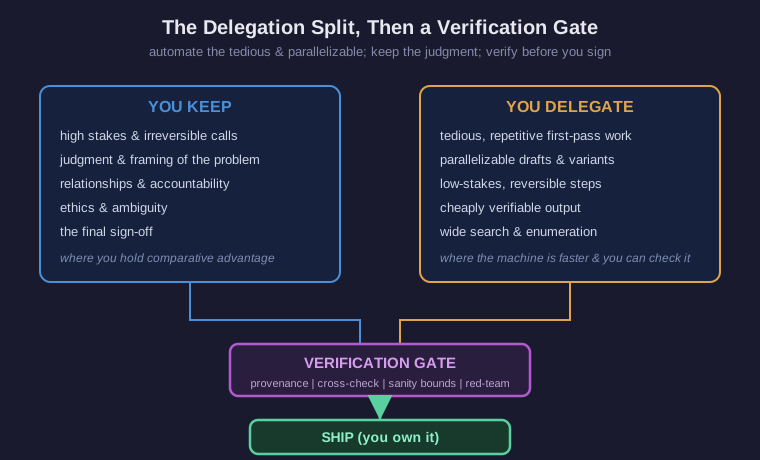
Four axes decide what to delegate:
- Stakes: what does a wrong answer cost? Low stakes tolerate automation; high stakes demand your hand on the wheel.
- Reversibility: can you undo a mistake cheaply? Reversible steps are safe to delegate; one-way doors are not.
- Verifiability: can you check the output faster than you could produce it? If yes, delegate and verify. If you cannot verify it, delegating it is just gambling.
- Comparative advantage: where are you genuinely better, and where is the machine? Keep judgment, framing, relationships, and accountability. Delegate the tedious, the parallelizable, the wide-search enumeration.
The rule of thumb: automate the tedious and parallelizable; keep the judgment, the relationships, and the accountability.
Splitting a Real Workload
You are a commercial insurance underwriter. A typical file involves: (a) extracting figures from 40 pages of broker submissions, (b) pulling comparable risks from a database, (c) drafting the standard policy-language boilerplate, (d) deciding whether to bind coverage on an unusual high-value account with an ambiguous loss history, and (e) the phone call where you explain a declined renewal to a long-standing client.
Trust Nothing You Cannot Check
Fluent Is Not Correct
Automated output reads as authoritative regardless of whether it is right. A confident wrong answer is more dangerous than an obviously broken one, because it invites you to skip the check. At professional stakes, the verification workflow is not optional polish; it is the work.
Four independent verification moves:
- Provenance: where did each claim, number, or citation come from? Trace it to a source you can inspect. An output that cites a case, a statute, a study, or a figure you cannot locate is a fabrication until proven otherwise.
- Independent cross-check: verify the result by a different path than the one that produced it. Recompute a total by hand, run the query yourself, ask a second system, or check against a known-good reference. Two methods agreeing is evidence; one method repeating itself is not.
- Sanity bounds: does the answer fall inside the range physical and business reality allows? An estimate, a dosage, a load figure, or a price that violates an order-of-magnitude expectation is wrong until explained, no matter how the calculation reads.
- Red-team the output: actively try to break it. Ask what a hostile reviewer, an auditor, or an opposing counsel would attack. Look for the failure mode the confident draft glosses over.
The cost of verification scales with stakes. A throwaway internal summary needs a glance. A number that goes in front of a regulator, a patient, or a court needs all four moves and a paper trail.
Verifying a High-Stakes Draft
You are a financial analyst. An automated system produces a valuation memo for an acquisition your firm will present to its investment committee tomorrow. The memo concludes the target is worth $612M, cites three comparable transactions, projects 22% revenue growth, and includes a discounted-cash-flow model. It reads flawlessly.
The Tool Cannot Be Blamed
Accountability Does Not Delegate
You can delegate the production of work. You cannot delegate responsibility for it. When output goes out under your name, the professional judgment that it was fit to send is yours, and so is the failure if it was not.
"The system generated it" is not a defense a client, a regulator, a licensing board, or a court will accept. The tool has no license to revoke, no reputation to lose, and no duty of care to your customer. You have all three. That asymmetry is the whole reason your sign-off has value: you are the accountable human in the loop.
This reframes verification from a chore into self-protection. Every check you skip is a liability you personally absorb. The professional who says "I ran it through the system and shipped it" has not saved effort; they have signed a document they did not read.
Ownership also means disclosure where it matters: knowing when a client, a colleague, or a record is entitled to know that automation produced a first pass, and never presenting unverified machine output as your own considered judgment.
When the Automated Output Is Wrong
You are a licensed structural engineer. An automated system sized a load-bearing beam for a drawing set you stamped and sealed last month. A junior engineer now flags that the system used the wrong load combination, and the beam is undersized. The drawings are already with the contractor.
Keep the Competence You Delegate
If You Cannot Do It, You Cannot Supervise It
There is a quiet trap in delegation: the skills you hand to a machine are the skills you stop practicing, and the skills you stop practicing decay. A pilot who never hand-flies loses the feel to recover when the autopilot quits. An analyst who never builds a model by hand loses the intuition to smell a wrong one. The danger is not that the machine fails; it is that it fails and you have lost the competence to catch it.
This is the supervision paradox. Delegating a task to automation demands more underlying skill from you, not less, because your remaining job is the hardest part: judging whether the output is right, and taking over when it is not. You cannot verify what you no longer understand.
Deliberate retention is the countermeasure. You keep the core competence alive on purpose, even though the machine could do it:
- Periodically do the task by hand and compare against the automated result. Divergence is a signal, in either direction.
- Keep doing the hard reps that build intuition; delegate the volume, not the skill.
- Maintain the mental model of how a correct answer is built, so you can spot when the output's reasoning is unsound and not merely its number.
The goal is to remain able to supervise, catch errors, and take the controls. Delegate to go faster, not to go blind.
A Retention Plan for Your Team
You lead a software team that has adopted an automated system to generate most first-draft code. Productivity is up. But you notice your mid-level engineers increasingly accept generated code they cannot fully explain, and your interns are learning to prompt the system before they can read a stack trace or reason about a data structure.
The Cases Automation Should Not Touch
Some Work Stays Human on Principle
Delegation has a hard edge. Some work should not be automated even when a system could produce a plausible draft, because the very conditions that make automation safe are absent. Recognizing these cases is as professional as knowing when to delegate.
Do not automate when:
- The decision is irreversible. A one-way door with high stakes (a medication order, a legal filing deadline, an irreversible financial commitment) removes your ability to undo a bad output. Reversibility is what makes delegation forgiving; without it, the whole safety net is gone.
- The situation is genuinely ambiguous. When the problem is not yet framed, when the right question is unclear, or when the context is novel and off-distribution, a confident draft papers over exactly the judgment the moment requires.
- The stakes are ethical. Decisions that allocate harm, weigh fairness, or carry moral weight require an accountable human who can be answerable for the values embedded in the choice.
- A relationship is the substance. Difficult conversations, trust, care, condolence, negotiation. The relationship is not a delivery channel for content; it is the work, and it needs a present human.
- You cannot verify the output. If you have no independent way to check whether the result is right, delegating it is not efficiency; it is unaccountable gambling with your name on it.
The Pre-Ship Checklist
Before I Ship Automated Output
A concrete gate to run every time output produced with automation goes out under your name. If any answer is unsatisfying, you are not ready to ship.
1. Provenance: can I trace every claim, number, and citation to a source I have inspected?
2. Independent check: have I verified the result by a path different from the one that produced it?
3. Sanity bounds: does the answer fall inside the range reality and my domain expectation allow?
4. Red-team: have I attacked this the way a hostile reviewer, auditor, or opposing party would?
5. Stakes and reversibility: if this is wrong, what does it cost, and can I undo it? Higher stakes and lower reversibility demand more checking, or demand I do it myself.
6. The no-automation triggers: is this irreversible, genuinely ambiguous, ethically weighted, relationship-bearing, or unverifiable? If so, why is a machine touching it at all?
7. Competence: do I still understand this well enough to catch an error and take over?
8. Ownership: am I ready to sign this and answer for it as my own professional judgment?
Run the gate. Then ship, and own it.
Drawing the Line
Consider four tasks that cross a professional's desk in one afternoon: (a) generating fifty variations of ad copy for A/B testing, (b) drafting the wording of a layoff notice for a specific employee, (c) triaging which of 200 inbound support tickets are urgent, and (d) deciding whether to disclose a newly found safety defect to a regulator.
The Playbook in One Page
What You Now Carry
Working well with automated systems is a professional discipline, not a reflex to accept or reject the tool. You have built the judgment for it:
- Delegation split: sort work by stakes, reversibility, verifiability, and comparative advantage. Automate the tedious and parallelizable; keep the judgment, the relationships, and the accountability.
- Verification: fluent is not correct. Trace provenance, cross-check by an independent path, test against sanity bounds, and red-team the output. Scale the effort to the stakes.
- Ownership: you sign the work, so the failure is yours, not the tool's. Every skipped check is a liability you personally absorb.
- Skill retention: keep the core competence you delegate, so you stay able to supervise, catch errors, and take the controls. Delegate to go faster, not to go blind.
- Boundaries: refuse to automate the irreversible, the genuinely ambiguous, the ethical, the relationship-bearing, and the unverifiable.
Two ideas carry the rest. Delegate the work, never the accountability. And run the pre-ship checklist before your name goes on anything. The professionals who thrive in an automated field are not the ones who resist the tools or the ones who trust them blindly; they are the ones who supervise them well.