Memory Decays on a Curve
Forgetting Has a Shape
In the 1880s Hermann Ebbinghaus memorized nonsense syllables, then tested himself at growing delays. His data traced a curve that keeps reappearing in modern memory research: retention starts high, drops fast, then levels off as it approaches zero.
That shape has a name: exponential decay. A clean model of it:
R = e^(−t/S)
where R is retention (fraction of the memory still recallable, from 1 down to 0), t is time since study, & S is stability: a number, measured in the same units as t, that sets how slowly the memory fades.
Read the geometry directly from the exponent t/S. Right after study, t = 0, so R = e^0 = 1 (100%). As t grows, the exponent grows negative & R slides toward 0 but never quite reaches it: the curve flattens into a long tail.
Stability S controls steepness. A small S (say 1 day) means t/S grows fast, so the curve plunges: you forget quickly. A large S (say 30 days) means t/S grows slowly, so the curve decays gently: the memory lingers. Larger S = flatter curve.
One landmark on every decay curve: retention hits 50% when t equals S multiplied by the natural log of 2 (S × ln2, & ln2 ≈ 0.693). Double the stability & you double the time to half-forgetting.
Reading Two Decay Curves
Two facts sit in your memory, both fresh at R = 100%.
Fact A has stability S = 2 days. Fact B has stability S = 20 days.
Every Review Flattens the Curve
Retrieval Raises Stability
Here is the discovery that turns forgetting into a tool. Each time you successfully retrieve a memory (recall it from a cue, not reread it) its stability S jumps UP. The memory you just pulled back from the edge of forgetting comes back sturdier than before.
Geometrically, a review does two things at once: it resets R to 100%, & it increases S so the NEXT decay is slower. Plot it over time & you get a sawtooth: retention drops, a review snaps it back to the top, it drops again but along a gentler slope, another review, gentler still. The teeth get wider & the overall trend flattens.
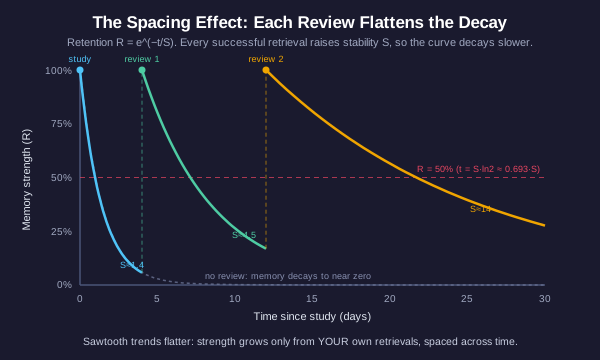
This is why spacing beats cramming. Cramming stacks many retrievals into one session while S is still small, so they barely move the curve, & by next week retention has collapsed. Spacing waits until R has dropped part way (retrieval feels effortful) then reviews, & that effortful pull-back raises S the most. Same total reviews, far higher long-term retention: purely a matter of WHEN you place them along the curve.
The ideal review lands just before you would forget: near the 50% mark, at t ≈ S × ln2. As S grows, that moment arrives later & later, so review intervals should stretch: 1 day, then 3, then a week, then a month. The curve tells you when.
Why the Sawtooth Flattens
You review a fact three times, spacing the reviews out as the diagram shows.
Solving for the Review Day
When Does Retention Hit 50%?
The best moment to review lands near where retention has fallen to about half. So a practical question: given a stability S, on what day t does R = e^(−t/S) equal 0.50?
Set R = 0.5 & solve. Take the natural log of both sides: ln(0.5) = −t/S. Since ln(0.5) = −ln2, this gives t = S × ln2, with ln2 ≈ 0.693.
This is exactly the half-life formula from radioactive decay: the same geometry governs a fading isotope & a fading memory. Both lose a fixed FRACTION per unit time, so both halve at a constant interval set by their stability.
Worked example: a fact with S = 5 days reaches 50% retention at t = 5 × 0.693 = 3.47 days. Round to review it on day 3 or 4.
Compute the Half-Life Day
A flashcard fact currently has stability S = 10 days, & it started at R = 100%.
Diminishing Returns & the Edge
The Other Curve
Forgetting is not the only curve in learning. Track a skill against practice time & you get the learning curve: fast gains at first, then slower gains as you climb, flattening toward a plateau. Psychologists call it the power law of practice: performance improves as roughly a power of the number of repetitions, which draws a curve that bends over & levels off.
Diminishing returns are geometric. Early on the curve is steep, so an hour of practice buys a big jump. Higher up the curve has flattened, so the SAME hour buys a smaller jump. You have not stopped improving; the slope where you now stand has simply gone shallow. The tenth hour adds less than the first because it lands on a flatter part of the same curve.
Deliberate practice moves the whole curve, not just your dot on it. Grinding easy, already-mastered material just slides you further along the flat top: motion, little gain. Practicing at the edge of your ability (harder problems, targeted weaknesses, immediate feedback) does something different: it lifts the entire curve upward, raising the plateau itself. You are not walking along the old curve; you are trading it for a higher one.
The two curves connect. Deliberate practice is effortful retrieval at the edge, & effortful retrieval is exactly what raises stability S in the forgetting model. Working at the edge flattens forgetting AND raises the learning plateau at the same time.
Slope & Shift
A pianist has practiced the same easy scales for a year & stopped improving.
Automation Flattens Effort, and Retention
The Retrieval Belongs to You
Every result so far turns on one move: YOUR own successful retrieval. That effortful pull-back from the edge of forgetting is what raises stability S, flattens the decay curve, & lifts the learning curve.
Automated study tools are seductive because they flatten EFFORT. A tool can summarize the chapter, reveal the answer the instant you hesitate, or solve the problem for you. The work feels lighter. But the geometry is unsentimental: if the TOOL does the retrieving, S never rises. You reset R to 100% by rereading, then the same steep curve drops you back to zero, because no effortful retrieval ever happened. The sawtooth stops flattening; it just repeats the same steep tooth.
This is the trap. A tool that flattens effort all the way to zero also flattens your retention to zero, because the two are driven by the same act. Convenience & durability pull in opposite directions here.
Used well, the same tools help: a spaced-repetition scheduler that PROMPTS you to retrieve (then checks you) rides the rising S instead of stealing it. The line is simple: a tool that makes you retrieve builds memory; a tool that retrieves FOR you rents you a copy that evaporates. The geometry says strength grows only from your own successful retrievals, spaced across time.
The Self-Defeating Shortcut
A study app auto-reveals every answer the instant a card opens, so you read rather than recall.
The Geometry of Learning, in One Picture
What You Have Learned
Learning & forgetting both have a shape, & the shapes are the lesson:
- The forgetting curve R = e^(−t/S) decays exponentially. Stability S sets the steepness: larger S, flatter curve. Retention halves at t = S × ln2 (ln2 ≈ 0.693).
- The spacing effect turns forgetting into a tool: each successful retrieval raises S, flattening the next decay. Plotted over time it is a sawtooth whose teeth widen, so review intervals can grow: 1 day, 3 days, a week, a month.
- The half-life calculation finds the review moment: for S = 10 days, retention hits 50% at t = 10 × 0.693 = 6.93 days. The same math governs radioactive decay.
- The learning curve bends over into diminishing returns because you climb onto a flatter slope. Deliberate practice at the edge of ability shifts the whole curve upward instead of sliding you along the flat top.
- The bottom line: every one of these gains is driven by YOUR own effortful, spaced retrieval. A tool that makes you retrieve builds memory; a tool that retrieves for you flattens your effort & your retention to zero together.
Learn the shapes, then place your effort where the curve rewards it: at the edge, just before you forget, doing the retrieving yourself.