A Question Is a Space
Every Question Draws a Space
A question does not just ask for one thing. It opens a space of possible answers, & every candidate answer is a point somewhere in that space.
"Pick a place to eat" opens an enormous space: every restaurant, cafe, food cart, & kitchen on Earth. "Pick a vegetarian place within walking distance, open now, under fifteen dollars" opens a tiny space: maybe three points.
Same intent, radically different geometry. The second question did real work: it shrank the space before anyone started searching.
This is the whole lesson in one sentence: a good question is one that shrinks the answer space to the region worth searching. A vague question leaves a vast space & forces a slow, wandering search. A sharp question hands you a small space you can scan at a glance.
We will make this precise with four pieces of geometry: partitioning a space, cutting it with constraints, & halving it with well-chosen yes/no questions.
Wide Versus Narrow
Consider two ways to ask for help debugging a program:
- Q1: "Why does not my code work?"
- Q2: "Why does this loop print 9 items when the list has 10, on Python 3.12?"
Splitting a Space Into Regions
Breaking a Big Question Into Regions
When a space is too big to search directly, you partition it: split it into non-overlapping regions that together cover the whole thing. Answering a sub-question means picking one region & ignoring the rest.
Say the question is "Why did revenue drop last quarter?" The answer space is huge. Partition it: (a) fewer customers, (b) same customers spending less, (c) a pricing or billing change, (d) a data error. These four regions cover the space & do not overlap. Each is a smaller question you can attack on its own.
A good partition has two properties borrowed straight from geometry: the regions cover the whole space (nothing is missed) & they are disjoint (nothing is double-counted). Miss part of the space & the real answer can hide in the gap. Overlap the regions & you waste effort searching the same ground twice.
Each sub-question narrows you to one region. Answer it, & you have thrown away everything outside that region: a large, cheap reduction of the search.
A Clean Partition
A city asks: "Why are emergency response times rising?"
An analyst proposes splitting it into: (a) calls take longer to reach a crew, (b) crews take longer to arrive once dispatched, & (c) crews take longer to finish & free up.
Each Requirement Cuts the Space
Constraints as Half-Planes
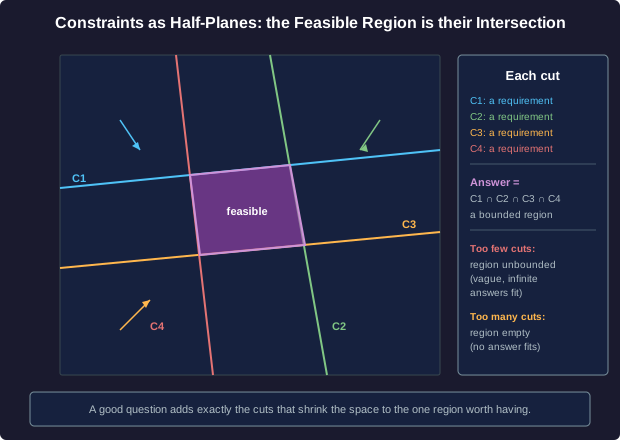
Picture the answer space as a flat plane, every point a candidate answer. A constraint is a requirement, & each requirement draws a line across the plane & keeps only one side. In geometry that kept side is a half-plane.
"Under fifteen dollars" is one line; keep the cheap side. "Within walking distance" is a second line; keep the near side. "Open now" is a third. Each requirement you add is another cut.
The answer that satisfies every requirement lives in the intersection of all the kept sides. Intersect enough half-planes & you get a small bounded region: a tidy area with the one right answer inside it.
Two Failure Modes
Under-constrained (too few cuts): the region stays unbounded. It runs off to infinity, so infinitely many vague answers all "fit". "Give me a good idea" is unbounded. You get noise because nothing was ruled out.
Over-constrained (too many, or contradictory, cuts): the region becomes empty. The half-planes have no common point, so no answer fits at all. "A number that is both even & odd" cuts the space down to nothing.
A well-posed question sits between these: enough constraints to bound the region, not so many that they contradict & empty it.
Bounded, Unbounded, Empty
A manager asks a designer for "a logo." Later they ask for "a logo that is a single letter, in one color, works at 16 pixels, & also uses at least four colors."
The Best Cut Splits the Space in Half
Binary Search: Every Yes/No Halves the Space
Some questions are yes/no. Geometrically, a yes/no question draws one line & tells you which side the answer is on: it throws away a whole region in a single stroke.
The best yes/no question is the one that cuts the space into two equal halves, because then whichever answer you get, you have discarded exactly half of what remained. Ask "is it in the top half?" over & over & the space collapses geometrically fast.
This is binary search. Start with N candidates. After one good question, N/2 remain. After two, N/4. After k questions, N / 2^k. You are done when one candidate is left, so you need the smallest k with 2^k at least N.
That smallest k is the ceiling of log2(N). For a thousand candidates: 2^9 = 512 (not enough) & 2^10 = 1024 (enough), so log2(1000) is about 9.97 & you need 10 questions. A billion candidates? log2 of a billion is about 30. Halving is so powerful that going from a thousand to a billion adds only about twenty questions.
The lesson for question-asking: a sharp yes/no question is worth the most when it splits the remaining space evenly. A lopsided question that rules out only a sliver wastes the turn.
Guaranteeing the Find
You are playing a guessing game. Someone picks a whole number from 1 to 1000. You may ask only yes/no questions, & you play optimally (each question splits the remaining candidates as evenly as possible).
When Answers Are Cheap, Cuts Are Precious
The Question Is the Work Now
Put the four pieces together. A question opens a space. Decomposition partitions it. Constraints cut it into a bounded feasible region. Good yes/no questions halve it. Every one of these is an act of shrinking the search before you look for an answer.
For most of history the answer was the expensive part. You paid an expert, ran the experiment, dug through the archive. So we prized people who could produce answers.
That balance has flipped. Automated systems now generate plausible answers by the thousand, almost for free. When answers are cheap & abundant, producing one more is no achievement. What stays scarce is knowing which answer is worth having: & that is a question-asking skill, not an answer-producing one.
In the geometry: a machine will happily hand you any point in the space. The value you add is drawing the constraints that cut the space down to the one region where a good answer must live. Under-constrain it & you drown in plausible noise (an unbounded region). Over-constrain it & you get nothing back (an empty region). Posing the cuts that bound the region to exactly the right size is the scarce, human skill.
So the leverage is not "get an answer". It is "pose the constraints that make the answer space small enough that any point in it is worth having".
Where the Value Moved
An analyst can now generate a hundred draft strategies in minutes at almost no cost.
Geometry of Questions: Summary
What You Have Learned
A question is not a request for one answer. It is a space of possible answers, & the craft of asking is the craft of shrinking that space:
- Search space: every question opens a set of candidate answers. A sharp question opens a small set; a vague one opens a vast set you must wander.
- Decomposition as partitioning: split a big space into regions that cover it with no overlap; each sub-question narrows you to one region.
- Constraints as boundaries: each requirement is a half-plane; the answer lives in their intersection. Too few cuts leave an unbounded region (infinite vague answers); contradictory cuts leave an empty region (nothing fits).
- Narrowing by halving: a well-chosen yes/no question splits the space in two. To pin a number in 1 to 1000 takes ceil(log2(1000)) = 10 questions; a billion takes only about 30.
And the payoff: when automated systems make answers cheap, the scarce skill is not producing answers but posing the constraints that cut the space to the one region worth having. Learn to draw those cuts, & you turn a vast, wandering search into a short one.