How an Intertangle Forms
Two subsystems start life as independent modules. Over time, each accumulates a field on a shared god-object: a global config struct, a singleton manager, a static class. Each addition: correct in isolation. The coupling: invisible in small-scale testing.
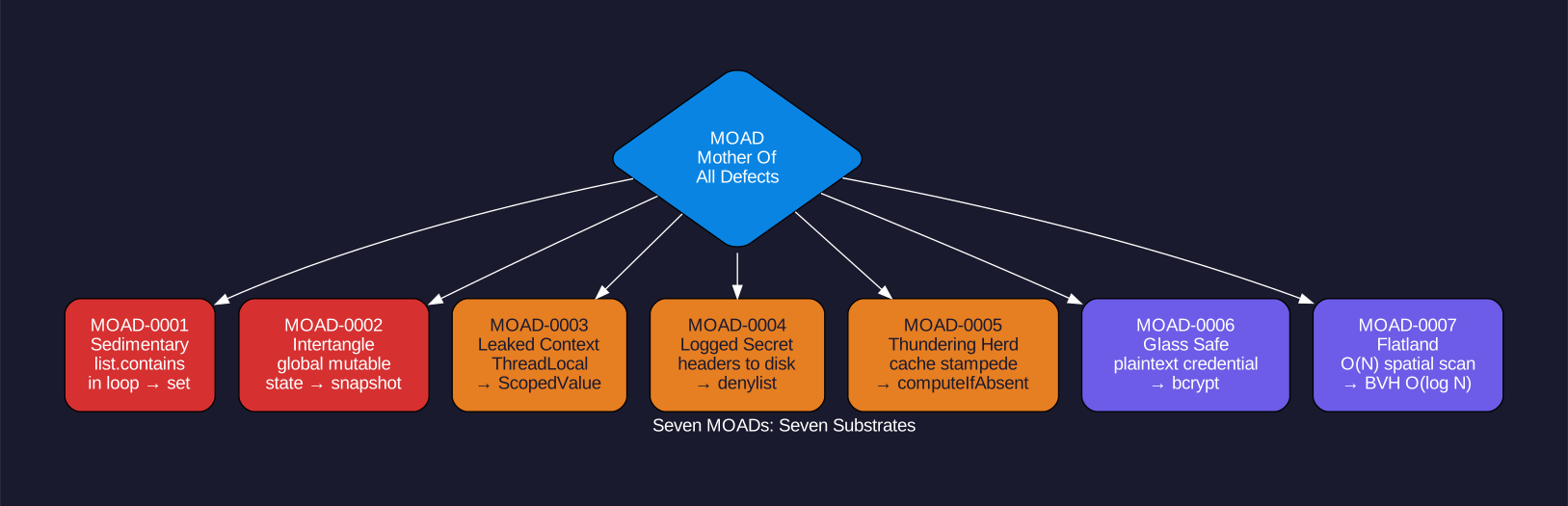
Three substrates where this calcified:
VLC media player. Audio, video, & playlist share a single lock guarding a global player state. A skip-to-timestamp request acquires the lock, modifies playback position, & flushes the audio buffer. The video subsystem, waiting for the same lock, stalls. The playlist subsystem, also waiting, cannot prefetch. Result: three independent subsystems serialized through a single state object. Performance cost: O(N) lock contention where N = number of subsystems, all proportional to operation latency.
Redis event loop. AOF fsync (disk write), replication (network write), & command execution (CPU) share the single-threaded event loop. Each: correct in isolation. A slow fsync stalls command execution. Replication lag compounds under write load. The coupling point: a single execution context shared by operations with different latency profiles.
LevelDB VersionSet. Write path (memtable flush) & background compaction share the VersionSet lock. A compaction job holds the lock for tens of milliseconds. Write path stalls. Both operations: necessary. The coupling: structural, not timing.
The Critical Distinction
An Intertangle has a structural coupling, not a timing problem. A race condition: two threads access shared state without synchronization. Fix: add a mutex.
An Intertangle: two subsystems share state by design. Adding a mutex does not fix the coupling; it serializes the access. The subsystems still share state. The bottleneck tightens.
Adding a mutex to a VLC Intertangle makes it worse: now audio, video, & playlist all wait for a single lock. The structural fix: give each subsystem its own state. Phase snapshot: freeze a snapshot of shared state at the phase boundary, let each subsystem read the snapshot independently, merge writes back at the end.
Structural vs Timing
The key diagnostic question for an Intertangle: would adding a mutex fix it, or would it make it worse?
A race condition: adding a mutex fixes it. Correct access ordering eliminates the corruption.
An Intertangle: adding a mutex serializes the access but preserves the structural coupling. The subsystems still share state. Under load, they still block each other. The bottleneck narrows.
How to Find an Intertangle
Three detection signals:
1. Shared mutable fields between subsystems. A god-object with fields read & written by more than one subsystem. If removing one subsystem's field access breaks another subsystem, they share state.
2. Single mutex guarding unrelated operations. One lock guarding audio flush AND video decode AND playlist fetch: three subsystems with different latency profiles, all waiting on each other. The smell: unrelated operations under the same lock name.
3. Performance regression when adding load. Latency for operation A increases when operation B runs concurrently, even though A & B appear independent. They are not independent: they share state.
The Phase-Snapshot Fix
Phase snapshot pattern:
# BEFORE: subsystems read and write shared state directly
class GameWorld:
    position = {}  # shared mutable
    velocity = {}  # shared mutable

def physics_tick(world):
    for entity in world.entities:
        world.position[entity] += world.velocity[entity]  # writes shared state mid-loop
# AFTER: snapshot frozen before phase; writes go to next_state buffer
def physics_tick(world):
snapshot = world.freeze() # immutable view
next_state = {}
for entity in snapshot.entities:
next_state[entity] = snapshot.position[entity] + snapshot.velocity[entity]
world.merge(next_state) # atomic merge at phase boundaryEvery subsystem reads the snapshot. No subsystem writes to it. Writes accumulate in a buffer & merge atomically at the phase boundary. Subsystems now execute independently: no lock contention, no ordering dependency, no hidden coupling.
Apply the Fix
A team reports a defect: their game engine's animation system & collision system both write to a shared entity transform object. When both run in the same tick, collision results depend on whether animation ran first. Adding a mutex fixed the ordering, but now animation stalls whenever collision runs a broad-phase sweep.