The Work Is Not the First Draft
Producing a Claim Is Cheap. Knowing It Is True Is the Job.
Any competent tool, colleague, or automated system can now produce a fluent first draft: a revenue figure, a market analysis, a legal summary, a price quote, a diagnosis, a block of code. Fluency is abundant & nearly free. What stays scarce is the judgment to ask a harder question: is this actually true, and how would I know?
A claim that sounds confident, reads cleanly, & arrives fast carries no guarantee of correctness. Confident wrong output looks exactly like confident right output until someone verifies it. That someone is the professional. Your durable value is not that you generated the draft; it is that you caught the error, understood why it happened, & owned the decision to act.
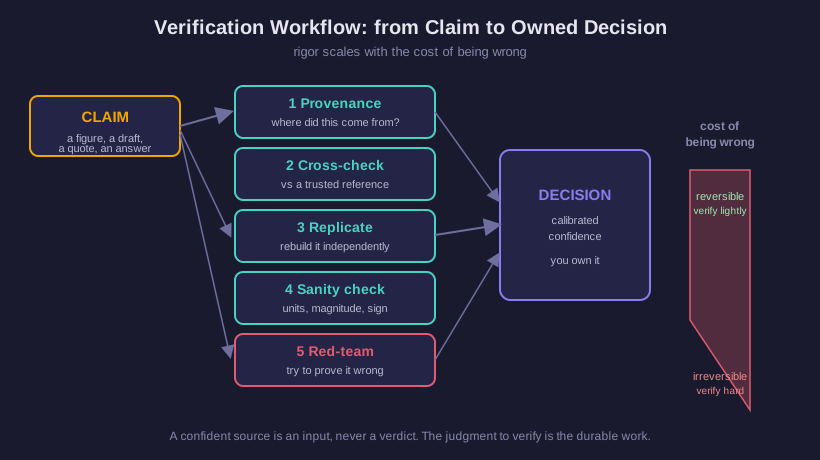
This lesson builds a working discipline of verification: where a claim came from, how to check it independently, how to match your confidence to your evidence, & how to spend your scrutiny in proportion to what a wrong answer would cost. Automated systems now mediate nearly all commerce & economic activity: pricing, credit, logistics, drafting, diagnosis, search. They earn a place in this lesson not as a special topic but as the loudest current source of confident claims that still need checking.
A Number That Shipped
A junior analyst hands you a slide for tomorrow's board meeting. One line reads: "Q3 churn improved to 2.1%, down from 3.4%." The analyst pulled the number from an automated dashboard, which pulled it from the data warehouse. The slide looks polished. The meeting is in fourteen hours. Acting on this number means the board will be told retention is turning around.
Provenance, Cross-check, Replicate, Sanity, Red-team
A Reusable Verification Toolkit
Five families of check cover almost every consequential claim. You rarely run all five; you choose which ones the stakes justify.
1. Provenance: where did this come from? Trace the claim to its origin. What is the source, the query, the definition, the date range, the sample, the assumptions? A number with no traceable origin is a rumor with a decimal point. Most bad figures are not miscalculated; they answer a slightly different question than the one you asked.
2. Cross-check against a trusted reference. Compare the claim to an independent source you already trust: a prior report, a second team's number, a published benchmark, a physical measurement. Agreement between two independent paths is strong evidence. Agreement between a claim & itself is none.
3. Independent replication. Rebuild the result yourself from the ground up, ideally by a different method or tool. If you reach the same answer by a path that shares no machinery with the original, confidence rises sharply. If you cannot reproduce it, you do not yet know it.
4. Unit & sanity checks. Before deep analysis, ask the cheap questions. Are the units consistent? Is the order of magnitude plausible? Is the sign right? Does it pass a back-of-envelope estimate? A surprising number of catastrophic errors announce themselves as a factor of 1000, a swapped numerator & denominator, or a positive where a negative belongs.
5. Red-team your own conclusion. Actively try to prove yourself wrong. Ask: if this were false, how would it still look true to me right now? What evidence would change my mind, & have I looked for it? Steelman the opposite conclusion. The goal is to find your own error before reality, a client, or a regulator finds it for you.
Confirmation feels like verification but is its opposite. Searching for reasons a claim is right will always succeed. Searching for the reason it is wrong is the check that has teeth.
The Quote That Came Back Instantly
You run margins for a manufacturer. An automated quoting system prices a large custom order at $18,400 & the customer wants to sign today. The system is fast, always available, & has priced thousands of orders. This order is unusual: bigger than typical, a non-standard material, & a compressed timeline. Signing commits you to deliver at that price.
Matching Confidence to Accuracy
Say How Sure You Are, and Be Right About It
Calibration is the match between how confident you feel & how often you turn out to be right. A perfectly calibrated professional who says "90% sure" is correct about nine times in ten. Most people, & most automated systems, are badly calibrated: confident far past their accuracy.
Three habits build calibration:
Know what you do not know. Separate three things explicitly: what you have verified, what you assume, & what you are guessing. Collapsing these into one confident voice is the root of most avoidable error. "The number is 2.1%" & "the dashboard reports 2.1%, which I have not yet traced" are different claims wearing the same words.
State uncertainty out loud. A range beats a point. "Between 40 and 60 units, most likely near 50" gives a decision-maker more than "50" because it exposes the risk. Hiding uncertainty does not make it disappear; it just moves the surprise downstream to whoever acts on your number.
Notice confident output is not calibrated output. Fluency, polish, & speed are properties of the delivery, not of the truth. Automated systems are engineered to sound sure; a confidently worded paragraph & a hedged one may have identical odds of being wrong. Treat tone as decoration, & judge the claim on its evidence.
Overconfidence & underconfidence both cost. Overconfidence ships errors; underconfidence wastes effort re-checking the settled & drowns real warnings in noise. Calibration is aiming your certainty, not maximizing it.
Rewriting an Overconfident Claim
A colleague sends you a line for a client report: "Our model shows the new campaign will increase signups by 23%." You know the estimate comes from one automated model, run once, on three months of noisy data, with no confidence interval & no holdout test.
Verify in Proportion to What Being Wrong Costs
Not Every Claim Deserves the Same Scrutiny
Verification costs time & attention, both finite. Spending equal rigor on every claim is itself an error: it starves the decisions that matter to feed the ones that do not. The governing question is not "how can I be certain?" but "how certain do I need to be, given what a wrong answer would cost?"
Two dimensions set the required rigor:
Reversibility. A decision you can cheaply undo tolerates less verification, because a mistake is recoverable: you try it, watch, & correct. A decision you cannot undo demands far more, because there is no second attempt. Jeff Bezos framed these as two-way doors (walk back through if it is wrong) & one-way doors (the door locks behind you). Treating a one-way door like a two-way door is how organizations sleepwalk into irreversible harm.
Magnitude of harm. A wrong claim that costs a rounding error deserves a glance. A wrong claim that costs a life, a lawsuit, a recall, or the company deserves independent replication & a red-team. Scale the check to the stakes.
Put together: rigor should rise with irreversibility multiplied by harm. A cheap, reversible, low-harm claim (which font renders on the internal wiki) needs almost no verification; ship it & fix it later if wrong. A costly, irreversible, high-harm claim (a dosage, a structural load, a public financial restatement, a mass email to every customer) demands your deepest checks, & often a second independent professional, before it moves.
The discipline cuts both ways. Under-verifying a one-way door is reckless. Over-verifying a two-way door is its own waste: it burns the scrutiny budget you will need when a real one-way door arrives.
Sorting Four Decisions
Four claims land on your desk the same morning, each from a fast, confident automated system:
- A. A suggested wording tweak to one line of internal documentation.
- B. A recommended price change to be pushed live to all customers in an automated email within the hour.
- C. A generated figure for a regulatory filing that will be submitted this week and cannot be amended without penalty.
- D. A proposed A/B test that will show a new button color to 1% of users for two days.
Fluent, Confident, and Often Wrong
The Dominant Source of Confident Claims
Automated systems now sit between you & nearly every economic act: they set prices, approve credit, route logistics, flag fraud, draft documents, rank search results, & propose diagnoses. This is not a niche; it is the substrate of modern commerce. So the single most common source of confident claims crossing your desk is now a machine, & the professional skill is knowing how these systems fail.
They share a dangerous property: fluent, confident output that is frequently wrong, stale, or biased. The failure is not random noise you can average out. It is structured:
- Confidently wrong. Output reads authoritative whether or not it is correct. A fabricated citation, a hallucinated figure, & a real one arrive in the same calm tone. Confidence is generated, not earned.
- Stale. The system reflects the world it was built or trained on, not today. Prices, regulations, inventory, & facts move; the model may not.
- Biased & distributional. It is reliable near the common cases it learned from & degrades at the edges: the unusual order, the rare patient, the underrepresented applicant. It fails exactly where cases are rare, which is often where they matter most.
- Silently out of scope. It answers questions outside its competence with the same fluency as ones inside it, giving no signal that it has left solid ground.
The professional response is not to reject these systems; they are extraordinary drafting & retrieval engines. It is to relocate your value. The first draft is now cheap & automated. The judgment to verify it, catch the error, & own the decision is the scarce, durable work. You are accountable for what ships, and "the system said so" has never been, & will never be, a defense. The point is not to produce the draft. The point is to be the one who can tell whether it is right.
The Report That Reads Perfectly
An automated system drafts a market analysis for a client. It is fluent, well-structured, & persuasive. It cites three studies, states a market size of $4.2B growing at 19% annually, & recommends entering the market now. Your name goes on it. The client will invest real money based on it.
Before You Act on Any Consequential Claim
A Checklist You Can Carry Into Any Field
This distills the whole lesson into a routine you can run against any consequential claim, whatever its source: a colleague, a spreadsheet, a vendor, or an automated system.
1. Provenance: where did this come from? Trace the claim to its origin. Identify the source, the definition, the date range, the assumptions. Reject claims with no traceable origin.
2. Independence: does a second, unrelated path agree? Cross-check against a trusted reference, or independently replicate the result by a different method. Agreement of a claim with itself is worthless.
3. Sanity: do the units, magnitude, & sign make sense? Run the cheap back-of-envelope check first. Catch the factor-of-1000 & the flipped ratio before deep analysis.
4. Red-team: how could this be confidently wrong? Actively argue the opposite. Ask what evidence would change your mind, & whether you have looked for it. Suspect the edges of the distribution, staleness, & bias.
5. Calibration: does my stated confidence match my evidence? Separate verified from assumed from guessed. State uncertainty as a range. Refuse to let a fluent tone stand in for proof.
6. Proportionality: is my effort matched to the stakes? Weigh reversibility times harm. Verify a one-way, high-harm decision to the hilt; do not squander scrutiny on a cheap, reversible one.
7. Ownership: am I willing to stand behind this? If your name goes on it, you verified it. "The system said so" is not a defense, & never will be. If you cannot own it, do not ship it.
Your Own Consequential Claim
Bring a claim from your own field: something you have acted on, or will act on, that came from a spreadsheet, a report, a vendor, a colleague, or an automated system.
What You Now Carry
The Durable Skill
Producing a confident claim has become cheap & abundant. Knowing whether it is true has become the rare & valuable work. You now have a portable discipline for that work:
- Five checks: provenance, cross-check, independent replication, unit & sanity checks, & red-teaming your own conclusion.
- Calibration: matching your stated confidence to your actual accuracy, separating verified from assumed from guessed, & stating uncertainty as a range.
- The asymmetry of error cost: verifying in proportion to reversibility multiplied by harm, spending your scrutiny where a wrong answer is permanent & costly.
- A stance toward automated systems: treat their fluent, confident output as a first draft to be checked, never a verdict to be trusted, because the failure modes hide behind exactly the polish that makes them persuasive.
- A seven-point checklist you can run against any consequential claim before you act on it.
Two ideas matter most. A confident source is an input, never a verdict. And you own what you ship. No system, however fluent, absorbs that responsibility for you. The professional's enduring value is not the first draft. It is the judgment to verify it, the discipline to catch the error, & the willingness to stand behind the decision.