Every Complexity Class Draws a Curve
Plot Cost Against Input Size
Put input size N on the x-axis. Put cost (operations, time) on the y-axis. Each complexity class produces a distinct curve. You can recognize an algorithm's growth rate from the shape of its performance curve.
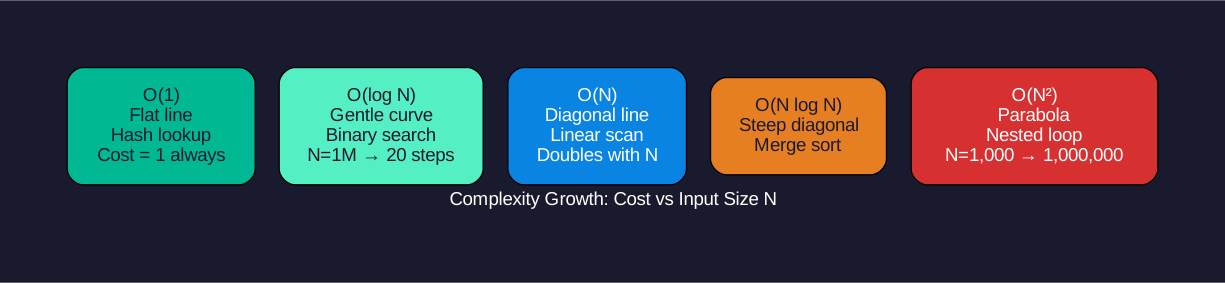
O(1) — flat horizontal line. The function f(N) = 1. No slope. Cost never changes regardless of N. Hash table lookup: whether the table holds 10 or 10,000,000 elements, one hash computation jumps to the right bucket.
O(log N) — gentle upward curve, slope decreasing. At N = 1,000,000: cost ≈ 20 operations. The curve rises steeply at small N, then flattens. Each doubling of N adds exactly one unit of cost.
O(N) — diagonal straight line. Slope = 1 (in the asymptotic sense). Cost grows at the same rate as N. If N triples, cost triples.
O(N log N) — steeper diagonal with slight upward curvature. Sits above O(N) but below O(N²). The log factor adds a slowly growing multiplier to the linear slope.
O(N²) — parabola opening upward. Slope increases as N grows. At N = 10: cost = 100. At N = 100: cost = 10,000. At N = 1,000: cost = 1,000,000.
The Growing Gap
The ratio O(N²) / O(N) = N. The gap between the parabola and the diagonal widens as N grows. At N = 10: 10× gap. At N = 100: 100× gap. At N = 1,000: 1,000× gap. At N = 50,000: 50,000× gap. The gap equals N — always.
Calculating the Scale Gap
A large dependency graph contains 50,000 packages (N = 50,000). One algorithm runs in O(N) time. A second runs in O(N²). At this N, the ratio O(N²)/O(N) = N = 50,000.
Bisecting a Line Segment
Binary Search as Repeated Bisection
A sorted array of N elements forms a line segment of length N. Binary search repeatedly bisects this segment:
1. Point to the midpoint of the remaining segment.
2. If target < midpoint: the right half disappears. Recurse on the left half.
3. If target > midpoint: the left half disappears. Recurse on the right half.
4. If target = midpoint: done.
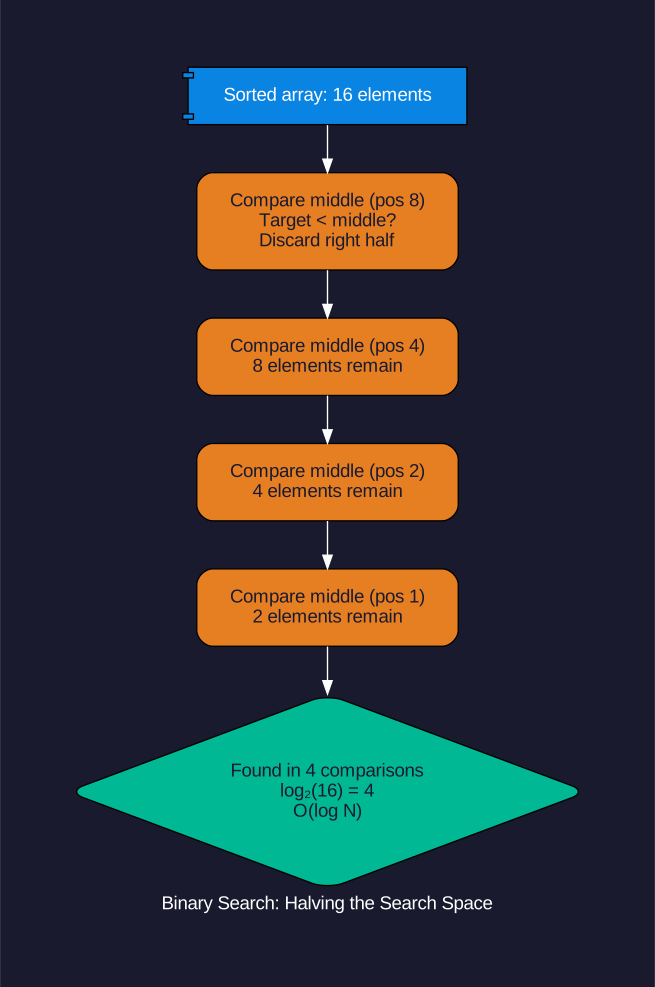
After k bisections, the remaining segment has length N / 2^k. The search ends when that length equals 1:
N / 2^k = 1 → 2^k = N → k = log₂N
So binary search on N elements requires at most log₂N comparisons.
Halving & Doubling: Two Sides of the Same Curve
Halving and doubling are geometric inverses. The exponential curve 2^k and the logarithmic curve log₂N are reflections of each other across the line y = x.
Consider paper folding: a sheet starts at 0.1 mm thick. Each fold doubles thickness. After 42 folds: 0.1 mm × 2^42 ≈ 439,804 km — past the moon (384,400 km). Binary search runs the inverse: start at N elements, each step halves the count, reach 1 element in log₂N steps.
The geometry: bisection is a self-similar operation. Each bisection produces two halves that look identical in structure to the whole. Recursion and logarithms share this self-similarity.
Comparisons & Doublings
A sorted array contains 1,048,576 elements. Note: 1,048,576 = 2^20.
A Hash Function as a Geometric Map
Hash Function as Function
A hash table maps a key to a bucket using a hash function:
bucket = hash(key) mod table_size
This is a function in the strict mathematical sense: it maps a domain (all possible keys) to a range (bucket indices 0 to table_size − 1). The geometric picture: keys occupy one space; buckets occupy another. The hash function projects keys onto bucket indices.
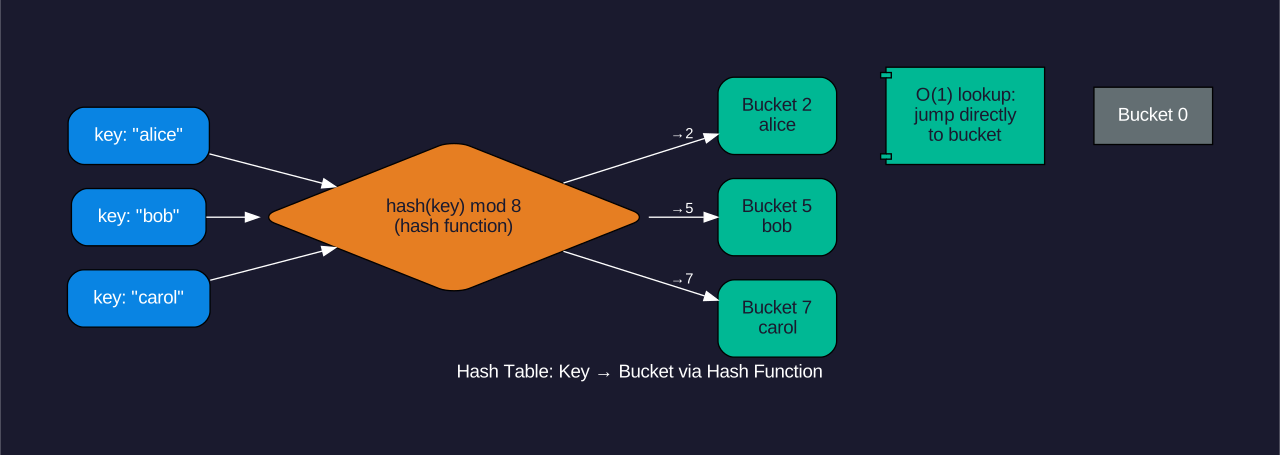
O(1) lookup — direct jump, no search. The hash function computes the bucket index in constant time. Jump directly to that bucket. No traversal, no comparison loop.
Load factor. At load factor 0.75, 75% of buckets contain at least one element. Above ~0.9, collisions increase: two keys hash to the same bucket, forming a chain of elements inside that bucket. Lookup in a long chain degrades to O(N) in the worst case.
Distribution Quality as Geometry
A well-distributed hash function spreads keys uniformly across all buckets. Geometrically: the function's range covers its codomain evenly. Every bucket receives approximately N / table_size keys.
A poor hash function clusters keys into a few buckets. Geometrically: the function's range collapses to a subset of the codomain — most keys map to the same few points. The remaining buckets sit empty.
Connection to MOAD-0001
Replacing a list with a set fixes MOAD-0001 because a set uses a hash table internally. O(N) list scan → O(1) hash table lookup. Geometrically: linear traversal along a sequence transforms into a direct projection via a function. The sequence disappears; the function replaces it.
Analyzing a Poorly Distributed Hash
A hash table has 1,000 buckets and 900 elements (load factor 0.9). A poor hash function sends 500 of those elements to the same bucket.