Derivation of the Logistic Equation
Hamming's S-curve has a precise mathematical derivation. Start with two observations about technology adoption:
1. Adoption rate accelerates with current adoption (word-of-mouth, network effects): dP/dt ∝ P
2. Adoption rate decelerates as the market saturates: dP/dt ∝ (1 − P)
Combine: dP/dt = r · P · (1 − P)
This is the logistic differential equation. It is separable: partial-fraction decomposition allows direct integration.
Derivation
Separate variables: dP / [P(1−P)] = r dt
Partial fractions: 1/[P(1−P)] = 1/P + 1/(1−P)
Integrate both sides: ln(P) − ln(1−P) = rt + C
ln[P/(1−P)] = rt + C
P/(1−P) = e^(rt+C) = e^C · e^(rt)
Let K = e^C. Solve for P: P = K·e^(rt) / (1 + K·e^(rt))
Equivalently: P(t) = 1 / (1 + e^(−r(t − t₀)))
where t₀ = (ln K)/r is the inflection point.
Inflection Point
At t = t₀: P = 0.5. Second derivative d²P/dt² = 0: growth rate is maximum. Before t₀: concave up (accelerating). After t₀: concave down (decelerating).
Fitting the Logistic to Data
Given two data points on a logistic curve, you can solve for both r and t₀.
Internet adoption: P(1995) = 0.01 (1% of US households), P(2005) = 0.70 (70%).
Network Value as a Geometric Count
Hamming noted that applications drove computing adoption more than hardware or software. Network-dependent applications follow a specific growth model: their value increases faster than their cost.
Metcalfe's Law
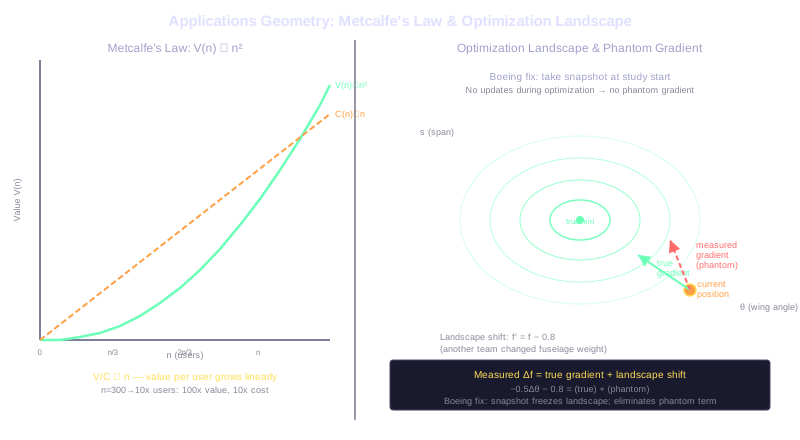
The value of a network with n users is proportional to the number of possible connections between users:
V(n) = k · n(n−1)/2 ≈ k · n²/2 (for large n)
where k is the value of one connection. Cost of a network: C(n) ∝ n (roughly linear in user count).
Value-to-cost ratio: V/C ∝ n²/n = n. As n grows, the ratio grows linearly. A network with 10x more users delivers roughly 100x more value at only 10x the cost.
Geometric Picture
With n nodes, the number of edges in a complete graph K_n is C(n,2) = n(n−1)/2. This is a combinatorial formula: choose 2 nodes from n. For n=10: C(10,2)=45. For n=100: C(100,2)=4950. For n=1000: C(1000,2)=499,500.
The S-curve and Metcalfe's Law interact: during Phase 2 rapid adoption, n grows rapidly, and V(n) grows as n². The value inflection occurs before the adoption inflection — value accelerates ahead of adoption, pulling more adoption in a positive feedback loop.
Network Value at Different Adoption Levels
Email adoption: in 1985 (n=100,000 users), k = $0.01 per connection-year. In 1995 (n=30,000,000 users).
Optimization as Geometry
Hamming's Boeing tape story describes an optimization failure with precise geometric meaning. Optimization of a function f(x) on a landscape requires:
1. A well-defined function f: the objective (drag, cost, time-to-market)
2. A fixed landscape: f evaluated at the same state each time
3. A gradient: the direction of steepest improvement
When the landscape changes between measurements, the gradient you estimate may point in a direction that no longer exists when you take the next step. You are computing gradient(f₁) but stepping in landscape f₂.
Gradient Descent
Standard gradient descent: x_{t+1} = x_t − α ∇f(x_t)
where α = step size (learning rate), ∇f = gradient vector (partial derivatives).
The Boeing failure: at time t, team measures f(x_t). At time t+1, team changes x to x_t + Δx. But the shared database also changed: f is now f' ≠ f. The observed change: f'(x_t + Δx) − f(x_t). This is NOT the gradient of f — it includes a term from the landscape shift.
The Phantom Gradient
Measured change = [f'(x+Δx) − f(x)] = [f(x+Δx) − f(x)] + [f'(x+Δx) − f(x+Δx)]
= true gradient × Δx + landscape shift
If the landscape shift dominates: the team moves toward a minimum in f' that is a maximum in f. They optimize the wrong thing — possibly making their design worse while measurements show improvement.
Quantifying Phantom Gradient Error
A team optimizes drag f(θ, s) where θ = wing angle, s = span. True gradient: ∂f/∂θ = −0.5 (drag decreases with θ), ∂f/∂s = +0.3 (drag increases with s).
Another team simultaneously reduces fuselage weight, which changes the drag function: f' = f − 0.8. (A lighter fuselage reduces drag by 0.8 units at all configurations.)
The first team measures: f'(θ+Δθ, s) − f(θ, s) = [f(θ+Δθ, s) − 0.8] − f(θ, s) = −0.5·Δθ − 0.8.