NM Cable Anatomy
NM-B: The Standard Residential Cable
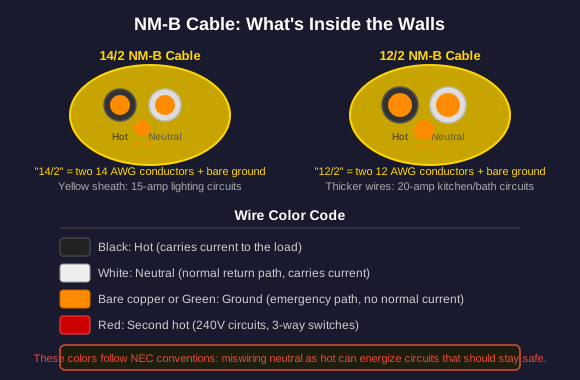
NM-B (commonly called Romex, a brand name) is the cable type used in nearly all residential wiring in the US. Inside the outer plastic jacket are insulated conductors & a bare copper ground.
Standard configurations:
- 14/2 NM-B: 14 AWG, two insulated conductors (black hot + white neutral) + bare ground. Use on 15A circuits.
- 12/2 NM-B: 12 AWG, two insulated conductors + bare ground. Use on 20A circuits.
- 14/3 NM-B: 14 AWG, three insulated conductors (black + white + red) + bare ground. Used for 3-way switch circuits and split receptacles.
Reading cable markings: The jacket is stamped with its specification: for example, 14-2 NM-B WITH GROUND 600V. Read the label before buying or installing. The first number is AWG, the second is the conductor count (not counting the ground).
Never substitute wire gauge. 14 AWG has a maximum ampacity of 15A. Installing it on a 20A circuit means the breaker will not trip until current well above 15A is flowing: and by then the wire is already overheating. The breaker protects the wire, not the device. Put the right wire on the right breaker.
Stripping and Termination
Making Clean, Code-Compliant Connections
Stripping the outer jacket: Use a cable ripper or a careful utility knife cut along the flat face of the cable: score only the jacket, do not nick the insulation on the conductors inside. Nicked insulation creates arc points.
Stripping individual conductors:
- Screw terminals: Strip 3/4 inch.
- Push-in (back-stab) connectors: Strip 1/2 inch. Avoid push-in connectors on 12 AWG: the spring contact is not rated for the larger wire. Use screw terminals instead.
Screw terminal technique: Hook the wire clockwise around the screw shank before tightening. Clockwise wrapping means the tightening action draws the wire in rather than pushing it off. A counter-clockwise hook will loosen as the screw tightens.
Pigtailing: When more than one wire must connect to a device (pass-through), do not run two wires through a single terminal. Use a wire nut to join all conductors of the same color, then run a short pigtail (6 inches) from the nut to the device terminal. One wire per terminal: always.
Torque compliance: NEC 110.14(D) requires that screw terminals be tightened to the manufacturer's torque specification. For most 15A/20A devices, that is 12-20 in-lb. Use a calibrated torque screwdriver on inspected work.
Aluminum wiring: If the house has aluminum branch circuit wiring (common in homes built 1965-1973), use only CO/ALR rated devices. Standard devices will corrode & arc at aluminum connections.
Outlet Anatomy and Box Fill
Reading an Outlet
A standard duplex receptacle has a face that tells you exactly what it is:
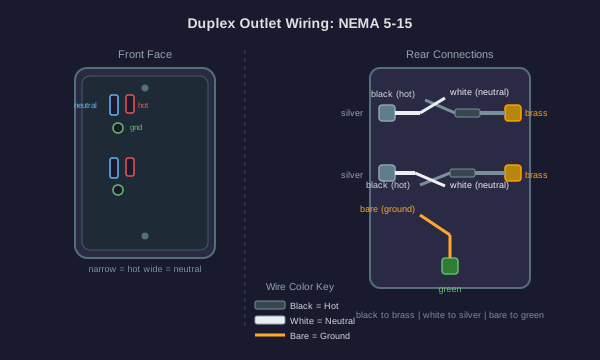
- Two short slots (hot side): narrow slot, connects to the brass-colored screw terminal
- Two long slots (neutral side): wide slot, connects to the silver-colored screw terminal
- U-shaped hole (ground): connects to the green screw terminal
NEMA ratings: NEMA 5-15 is a standard 15A/125V outlet. NEMA 5-20 has a T-shaped neutral slot and accepts both 15A and 20A plugs: required on kitchen countertop circuits.
Box Fill Calculation
NEC 314.16 requires that boxes not be overcrowded. Each conductor occupies a fixed volume:
- 14 AWG conductor: 2.0 cubic inches each
- 12 AWG conductor: 2.25 cubic inches each
Counting rules:
- Count every hot & neutral entering the box (each counts once)
- All ground wires together count as one conductor
- The device (outlet or switch) counts as two conductors worth of volume
- Cable clamps inside the box add one conductor's volume
A standard single-gang plastic box is typically 18 cu in. Deeper boxes (22 cu in, 25 cu in) are available when fill is tight.
Cable securing: NM-B must be stapled or clamped within 12 inches of a plastic box & within 8 inches of a metal box. Staple every 4.5 feet along the run.
Wiring the Outlet
Terminal Assignments
The color coding at an outlet is straightforward:
- Black (hot) → brass-colored screw (narrow slot side)
- White (neutral) → silver-colored screw (wide slot side)
- Bare copper (ground) → green screw (bottom)
Memory aid: black to brass, white to silver, bare to green.
End-of-Run vs. Pass-Through
End-of-run outlet: Only one cable arrives. Connect one wire to each terminal. Done.
Pass-through outlet: Two cables: power in, power out to the next outlet. Use wire nuts to join each color group (all blacks together, all whites together, all grounds together) and run a short pigtail to each device terminal. Never use both screws on the same side to continue a circuit: the internal tab can fail, losing power to the downstream outlet.
GFCI Outlets
A GFCI outlet has two sets of screw terminals: LINE (incoming power from panel) & LOAD (outgoing power to protect downstream outlets). The terminals are labeled & often covered with tape from the factory.
- LINE terminals: Connect the cable coming from the panel here.
- LOAD terminals: Connect cables going to downstream outlets here. All outlets on the LOAD side receive GFCI protection.
Never swap LINE & LOAD. The GFCI test function only works if LINE is the power source. A reversed connection will power the outlets but provide no ground fault protection.
Single-Pole Switch
What a Switch Actually Does
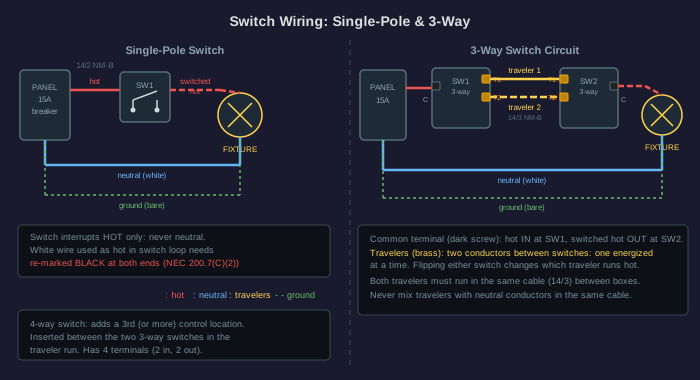
A single-pole switch controls a light (or other load) from one location. It interrupts the hot conductor only: never the neutral. Cutting the neutral while leaving the hot connected would de-energize the light but leave the fixture wiring energized and dangerous to touch.
Traditional Switch Loop
Before NEC 2011, switch loops used a two-wire cable run from the fixture to the switch:
1. Power arrives at the fixture box.
2. A 14/2 cable runs from the fixture box down to the switch box.
3. At the fixture, the black (hot) wire connects to the white conductor going down to the switch.
4. At the switch, the white conductor connects to one switch terminal.
5. The black conductor returns switched hot back up to the fixture.
The white wire in a switch loop carries hot: it is not neutral. NEC 200.7(C)(2) requires that it be re-identified with black tape, black paint, or black marker at both ends: at the switch box and at the fixture junction box.
Modern Method (NEC 2011+)
NEC 2011 requires a neutral conductor at the switch box to support smart switches, occupancy sensors, & dimmers that need a neutral to power their electronics. The modern approach runs 14/3 from panel to switch (hot, neutral, & switched hot) or routes the cable differently to ensure neutral is present.
3-Way Switches
Controlling One Light from Two Locations
3-way switches allow control of a single light from two locations: top and bottom of stairs, both ends of a long hallway. Each 3-way switch has three terminals:
- Common terminal (dark screw): The key terminal. Connects to either one traveler or the other depending on switch position. Hot connects to the common of the first switch. Switched hot leaves the common of the second switch toward the fixture.
- Traveler terminals (brass screws, ×2): The two travelers are conductors that run between the two switches. They carry hot alternately: when one traveler is energized, the other is not.
How the Circuit Works
Hot from panel → common of Switch 1 → one traveler energized → common of Switch 2 picks up that traveler → switched hot → fixture → neutral → panel.
Flip either switch: the common terminal shifts to the other traveler, breaking or making the circuit. Both travelers must travel in the same cable between switches: never mix travelers with neutral conductors.
4-Way Switches
A 4-way switch adds a third control location. It connects between the two 3-way switches and routes the travelers, allowing any of three (or more) switches to control the light. 4-way switches have four terminals: two traveler inputs, two traveler outputs.
Wiring Light Fixtures
Ceiling Box Ratings Matter
Not every ceiling box can hold every fixture. The box must be rated for the load:
- Standard outlet box: Not rated for ceiling fans. Rated for static weight only.
- Fan-rated box: Required for ceiling fans. Typically rated 35 lb with dynamic (vibration) load.
- Fan-&-light-rated box: Rated 70 lb with dynamic load for combined fan & light kits.
Octagon boxes (4-inch round) are the standard choice for light fixtures. Pancake boxes mount directly to a joist for heavy fixtures.
Making the Connections
Fixture wire is typically small-gauge stranded with thin thermoplastic insulation. Use wire nuts to join it to house wiring: never push-in connectors for stranded wire without ferrules. The strands will wiggle out of a back-stab contact over time.
- Black fixture wire → black house wire (switched hot from the switch)
- White fixture wire → white house wire (neutral)
- Ground → ground (metal fixture chassis must connect to ground; plastic fixtures do not require a ground at the fixture itself, but the box must still be grounded)
Recessed Lighting Requirements
- IC-rated (Insulation Contact): Required when batt or blown insulation will contact the fixture housing. A non-IC fixture buried in insulation overheats.
- AT-rated (Air-Tight): Required in insulated ceilings per energy codes. Prevents conditioned air from escaping into the attic through the fixture opening.
Always read the fixture label. Installing a non-IC fixture in an insulated ceiling is a fire hazard & a code violation.
Receptacle Placement Rules
NEC 210.52: Where Outlets Go
The National Electrical Code specifies minimum outlet placement for every room type. These are minimums: you can always add more.
General living spaces (NEC 210.52(A)):
No point along a wall should be more than 6 feet from an outlet. In practice: every 12 feet of continuous wall space needs an outlet. Wall segments 2 feet wide or wider require an outlet.
Kitchen countertops (NEC 210.52(C)):
An outlet every 4 feet of countertop length. Any countertop 12 inches wide or wider must have an outlet. All countertop circuits must be 20A GFCI-protected.
Bathrooms (NEC 210.52(D)):
At least one outlet within 3 feet of the basin edge. Must be GFCI-protected.
GFCI-required locations (NEC 210.8):
Garages, unfinished basements, outdoors, crawlspaces, boathouses, sinks in non-kitchen rooms. Any outlet within 6 feet of a sink.
Hallways (NEC 210.52(H)):
Hallways 10 feet or longer require at least one outlet.
Tamper-resistant receptacles (NEC 406.12):
Required in all new construction and renovation work (NEC 2008+). The shutters only open when both slots are pressed simultaneously: they resist insertion of single objects by children.
Putting It Together
The Complete Workflow
Residential electrical work follows a fixed sequence. Skipping steps does not save time: it creates rework, failed inspections, and liability.
1. Plan the circuit
Calculate load (watts), select wire gauge (14 AWG for 15A, 12 AWG for 20A), select breaker size, identify GFCI/AFCI requirements.
2. Pull a permit
Electrical permits are required in virtually every jurisdiction for new circuits & panel work. The permit triggers inspections.
3. Rough-in boxes
Set boxes at the correct heights: outlets 12 inches to center from floor (standard residential), switches 48 inches to center. Boxes must be flush with the finished wall surface.
4. Pull cable
Run NM-B through holes bored in studs (center of stud face, 1.25 inches minimum from edge). Staple every 4.5 feet along horizontal runs, within 12 inches of every plastic box, within 8 inches of every metal box.
5. Make up boxes
Strip jacket, strip conductors, pigtail where needed, connect devices. Black to brass, white to silver, bare to green. Torque to spec.
6. Rough-in inspection
Inspector verifies wire gauge, box fill, stapling, device connections, GFCI placement, & panel work before walls are closed.
7. Close walls
Drywall, plaster, or paneling goes up after rough-in passes inspection.
8. Trim-out
Install devices (outlets, switches) & cover plates. This is the visible finish work.
9. Final inspection
Inspector verifies all devices installed, cover plates on, GFCI test passes, panel labeled.
10. Energize & test
Breaker on. Test every outlet (plug tester), every switch, every GFCI. Document any failures before the homeowner takes occupancy.
Why Permits Matter
A house with unpermitted electrical work cannot be legally sold without disclosure of the unpermitted work. Homeowner's insurance may deny claims arising from unpermitted electrical modifications. The inspection process exists to protect the homeowner: the inspector is not the enemy, they are the second set of eyes that catches the mistakes everyone makes.