Three-Phase Power
Why Industrial Power Looks Different
Residential power uses a single-phase, center-tapped 240V transformer: two hot legs, one neutral, 120V each side. Industrial power operates on a completely different foundation: three-phase AC, where three conductors carry current at identical frequency but offset 120° apart in time.
That 120° offset is the key to everything. At any instant, the three phases sum to zero, which means the system never has a dead moment. A single-phase motor has two torque pulses per revolution (the power dips to zero twice per cycle). A three-phase motor has six torque pulses: overlapping continuously: so net torque is nearly constant. That is why three-phase motors run smoother, cooler, and more efficiently.
Wye & Delta Configurations
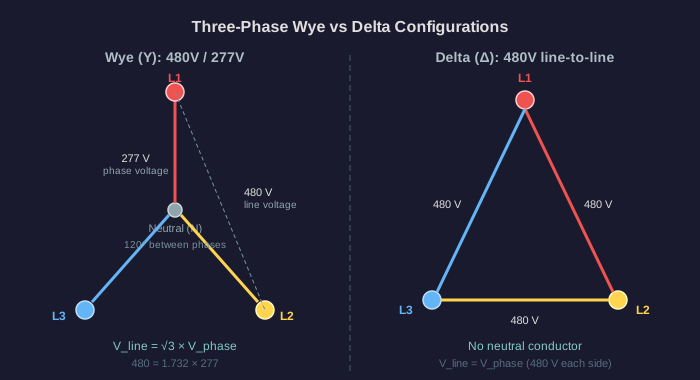
Three-phase systems use two wiring arrangements. In a wye (Y) configuration, one end of each winding connects to a common neutral point. This gives both a neutral conductor & two usable voltages: phase voltage (winding to neutral) & line voltage (winding to winding). The relationship is:
V_line = √3 × V_phase
In a 480V wye system, V_phase = 480 / 1.732 ≈ 277V. That 277V phase voltage powers fluorescent and LED fixtures throughout industrial facilities: a direct benefit of wye grounding.
In a delta (Δ) configuration, the windings form a closed triangle with no neutral. Line voltage equals phase voltage. Delta systems appear in medium-voltage feeders and some legacy industrial installations. Ungrounded delta systems have unusual ground-fault behavior: a single ground fault does not trip the system, but a second fault creates a short circuit: so ground fault detection is essential.
Power factor describes how much of the apparent power (VA) converts to real work (watts). A motor with 0.85 power factor draws more current than the watts alone would suggest. Utilities penalize industrial customers for low power factor: capacitor banks correct it.
Industrial Voltage Standards
Voltage Tiers in Commercial & Industrial Buildings
Not all three-phase systems run at the same voltage. The selection depends on load size, distance, & building type:
- 120/208V three-phase wye: office buildings, retail, light commercial. Phase voltage 120V (outlets). Line voltage 208V (small HVAC, small motors).
- 277/480V three-phase wye: industrial plants, warehouses, large commercial. Phase voltage 277V (fluorescent/LED fixtures wired line-to-neutral). Line voltage 480V (motors, HVAC chillers, welding equipment).
- 600V systems: heavy industrial, Canadian standards (CSA C22). Found in paper mills, mines, steel plants.
Why Voltage Level Matters
For the same power output, higher voltage means lower current (P = V × I, so I = P/V). A 50 horsepower motor on 208V draws about 131A. The same motor on 480V draws about 57A. Lower current means smaller wire, smaller conduit, less copper cost, less resistive heat loss in conductors.
Delta vs Wye Grounding Choices
Most modern industrial systems use grounded wye for safety: a ground fault trips a breaker immediately, equipment faults self-clear. Some older plants use ungrounded delta for process continuity: the first ground fault does not interrupt production, but it must be found & cleared before a second fault causes a phase-to-phase short. Ground fault detectors (GFDs) are mandatory on ungrounded delta systems.
Motor Control Centers (MCCs)
What Is a Motor Control Center?
A motor control center (MCC) is a factory-assembled lineup of metal enclosures: called buckets: mounted on a common structural frame. Each bucket is a self-contained unit housing a motor starter, circuit protection, and control wiring for one motor circuit.
A main horizontal bus bar runs the length of the MCC at rated voltage (typically 480V three-phase). Each bucket plugs onto the bus, drawing power & distributing it to its motor load. This arrangement keeps the plant's motor control wiring organized in one place rather than scattered through the facility.
Bucket Types
- Combination starter bucket: fused disconnect or breaker plus a magnetic motor starter (contactor + overload relay). The standard for fixed-speed motors.
- VFD bucket: houses a variable frequency drive plus input protection. For motors that need speed control (pumps, fans, conveyors).
- Soft-starter bucket: limits inrush current during motor start. Cheaper than VFD where speed control is not needed, just smooth starting.
Bus Capacity Planning
The main bus is rated for a maximum continuous current: typically 400A, 600A, or 800A. All buckets drawing current share that bus. Adding loads without verifying bus capacity can overload the bus bars, causing overheating, insulation failure, or fire.
NEMA vs IEC ratings: NEMA motor starters are rated for US applications, generally more conservative (larger, more robust). IEC starters are common in European-designed equipment and are more compact but require more precise sizing.
Variable Frequency Drives
How a VFD Works
A variable frequency drive (VFD) controls motor speed by varying the frequency & voltage of the AC power delivered to the motor. The process happens in three stages:
1. Rectifier: converts incoming AC to DC using a diode bridge.
2. DC bus: smooths and stores the DC energy in capacitors.
3. Inverter: uses IGBTs (insulated gate bipolar transistors) to synthesize a new AC waveform at the desired frequency and voltage.
Motor speed is directly proportional to frequency: RPM = (120 × f) / number of poles. A standard 4-pole motor at 60Hz runs at 1,800 RPM (synchronous). At 30Hz it runs at 900 RPM.
The VFD maintains a constant V/Hz ratio to preserve motor flux. If frequency drops by half, voltage drops by half too: otherwise the motor core would saturate and overheat.
Energy Savings on Centrifugal Loads
Pumps, fans, and compressors are centrifugal loads. Their power consumption follows the affinity laws: specifically the cube law:
Power ∝ (speed)³
Reducing motor speed to 80% of full speed reduces power to 0.8³ = 0.512: just 51% of full-speed power. This is why VFDs deliver dramatic energy savings on HVAC fans and water circulation pumps.
Contrast this with throttling: a mechanical valve on a pump reduces flow but wastes energy as pressure drop across the valve. The pump motor still works nearly as hard, just against the restriction. A VFD reduces the actual work done by the motor.
VFD Side Effects
VFDs generate harmonics: high-frequency current distortions that travel back upstream. Harmonics cause transformers to overheat, can damage other equipment, and cause excessive current on neutral conductors (3rd harmonic adds in neutrals rather than canceling). Line reactors (inductors in series with the VFD input) reduce harmonic injection. Large installations may require active harmonic filters.
Datacenter Power Path
From the Grid to the Server
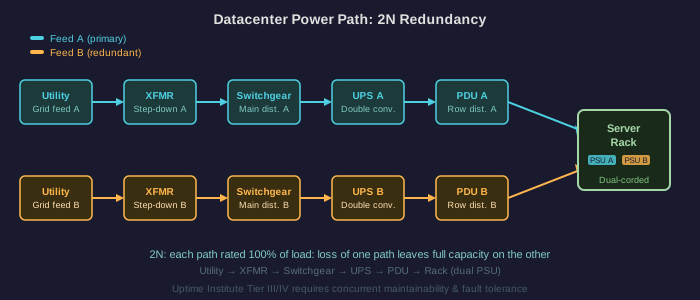
A datacenter's power system is a carefully engineered chain. Each link converts, conditions, or protects the power before passing it to the next stage:
Utility feed → medium-voltage power from the grid (typically 12kV: 35kV depending on utility)
Transformer → steps down to distribution voltage (typically 480V three-phase for medium datacenters, 13.8kV for large hyperscale)
Switchgear → main distribution, protective relaying, metering, transfer to generator on outage
UPS (Uninterruptible Power Supply) → conditions power & bridges the gap during utility outages. Batteries provide seconds to minutes of runtime while generators start.
PDU (Power Distribution Unit) → row-level or rack-level distribution. Steps voltage down to 208V or 120V for servers. May include metering at the circuit level.
Rack → dual-corded servers with two independent power supplies, one on each feed.
Redundancy Tiers
The Uptime Institute defines four tiers based on redundancy & fault tolerance:
- Tier I: single power path, no redundancy. 99.671% uptime (~28.8 hrs downtime/year).
- Tier II: adds redundant capacity components (N+1). 99.741% uptime.
- Tier III: multiple active power paths, only one active at a time. Concurrent maintainability. 99.982% uptime (~1.6 hrs/year).
- Tier IV: fully fault-tolerant, 2N or 2(N+1). 99.995% uptime (~26 min/year).
N means exactly what is needed. N+1 means one spare. 2N means two complete, independent systems each capable of carrying 100% of the load.
UPS and Cooling Integration
UPS Architectures
Three UPS topologies serve different needs:
- Offline/standby: inverter is off during normal operation. On utility failure, transfers to battery in ~8-20ms. Low cost, common for desktops and small office equipment. Not used in datacenters.
- Line-interactive: adds an automatic voltage regulator (AVR) to handle sags and surges without switching to battery. Transfer time ~4-8ms. Common for small server rooms.
- Online double-conversion: incoming AC converts to DC, then back to AC via inverter. The load always runs from the inverter. Zero transfer time on utility failure because the inverter never turns off. Industry standard for any critical datacenter load.
Battery technologies: traditional VRLA (valve-regulated lead-acid) batteries are heavy, bulky, and need replacement every 4-5 years. Lithium-ion batteries charge faster, last 8-10 years, weigh 40% less, and tolerate higher temperatures: reducing cooling cost. The capital cost premium is shrinking.
Power Usage Effectiveness (PUE)
PUE measures how efficiently a datacenter uses power:
PUE = Total Facility Power / IT Equipment Power
A perfect PUE of 1.0 means 100% of power drawn from the grid reaches the servers. In practice, power converts through transformers, UPS systems, PDUs, and chillers: all of which dissipate some energy as heat.
- PUE 1.1: hyperscale efficiency (Google, Microsoft). Very advanced cooling and power conversion.
- PUE 1.4–1.5: typical commercial datacenter.
- PUE 2.0+: older or poorly managed facilities. Half of all power is overhead.
Cooling is the largest non-IT power consumer: typically 30-40% of total facility power. CRAC (computer room air conditioning) units, chillers, cooling towers, and pumps all draw significant power. Strategies like hot aisle/cold aisle containment, economizer modes, and liquid cooling reduce the cooling fraction.
Arc Flash Hazards
The Energy in an Arc Flash
An arc flash is a sudden, violent release of electrical energy through an arc: a plasma channel of ionized air between conductors or between a conductor and ground. The temperatures in an arc flash can exceed 35,000°F: more than three times the surface temperature of the sun (~10,000°F). The blast includes intense radiant heat, intense light, pressure wave, and molten metal.
Arc flash is the leading cause of severe electrical burns and a significant cause of electrical fatalities. Most incidents happen during energized work: measuring voltage, racking in breakers, operating switches with covers open.
NFPA 70E Requirements
NFPA 70E (Standard for Electrical Safety in the Workplace) governs arc flash safety. Before any energized work, an arc flash hazard analysis must determine:
- Incident energy: the energy delivered to a surface at a specified working distance, measured in cal/cm² (calories per square centimeter).
- Arc flash boundary: the distance at which incident energy equals 1.2 cal/cm². At this distance a worker can receive a curable second-degree burn without PPE.
- Limited approach boundary: for qualified electricians only (unqualified persons cannot cross this without supervision).
- Restricted approach boundary: requires arc-rated PPE and additional precautions.
PPE Categories
NFPA 70E defines four PPE categories based on incident energy:
- Category 1: 4 cal/cm² minimum arc rating. Arc-rated shirt and pants, face shield, hard hat.
- Category 2: 8 cal/cm² minimum. Arc-rated clothing, arc-rated face shield or arc flash hood, arc-rated gloves.
- Category 3: 25 cal/cm² minimum. Arc flash suit, arc-rated face shield, arc-rated gloves.
- Category 4: 40 cal/cm² minimum. Full arc flash suit system.
Equipment labels specify the incident energy & required PPE category. The preferred approach is always de-energize & lock out before working. Energized work requires a written energized work permit.
Career Paths
Industrial vs Residential Electrical Work
Residential electricians wire houses. Industrial electricians wire factories, datacenters, water treatment plants, hospitals, & power generation facilities. The pay differential reflects the complexity: industrial electricians in the US earn $30-45/hr as journeymen; residential earns $22-35/hr in comparable markets.
Progression Path
Apprentice (years 1-4) → Journeyman (licensed, years 4-8) → Master Electrician (licensed, years 8+) → Foreman (leads a crew) → Superintendent (manages multiple crews) → Project Manager / Electrical Engineer
The IBEW (International Brotherhood of Electrical Workers) four-year apprenticeship combines classroom instruction with on-the-job training. IBEW contractors typically pay apprentice wages plus benefits from day one. Open-shop (non-union) apprenticeships exist through NECA & IEC.
Specializations Worth Knowing
- Instrumentation & Controls (I&C): sensors, transmitters, PLCs, SCADA systems, control panels. High demand in oil and gas, food processing, water treatment. Requires additional coursework in controls theory.
- Datacenter Specialist: critical power systems, UPS, PDU, cooling integration, structured cabling. Growing rapidly with cloud expansion. BICSI and RCDD certifications recognized.
- Power Systems Engineer: switchgear, protective relaying, short-circuit analysis, arc flash studies. Requires PE license in most states for stamping engineering documents.
- Commissioning Engineer (CxA): verifies that building systems install, operate, and perform as designed. Works for owners, not contractors. High pay, travel-heavy.
Certifications That Matter
- NFPA 70E: arc flash safety certification (required by many industrial employers)
- OSHA 30: construction or general industry safety (30-hour course)
- BICSI RCDD: registered communications distribution designer (datacenters)
- NABCEP: solar PV installer certification
- PE License: required for stamping engineering drawings in power systems roles