How Power Arrives
From the Utility to Your Panel
Power begins at a utility transformer: pole-mounted for overhead service, pad-mounted for underground. The transformer steps voltage down from distribution levels (typically 7,200V or higher) to 240V split-phase for residential service.
Service drop (overhead conductors) or service lateral (underground conductors) runs from the transformer to the meter base mounted on the building. The meter measures consumption. Behind the meter, service entrance conductors run to the main disconnect: almost always the main breaker inside the load center (breaker panel).
Critical safety point: Service entrance conductors are energized at all times. They run from the utility transformer through the meter and connect to the main breaker's line side (the top lugs). Turning off the main breaker disconnects everything downstream: but the conductors above the main breaker remain live. Only the utility company can de-energize them, by pulling the meter or switching the transformer.
The utility delivers two hot legs (L1 and L2) plus a neutral. Each hot leg carries 120V to neutral. The two legs are 180 degrees out of phase with each other, so L1 to L2 measures 240V: used for high-draw appliances like ranges, dryers, and A/C units.
Neutral-ground bond: In residential service, the neutral conductor and the grounding system are bonded together at exactly one point: the main service disconnect (the main panel). This bond is made with a main bonding jumper: often a green screw in the neutral bar. Sub-panels must never be bonded: more on this in the panel anatomy step.
Panel Anatomy
Inside the Load Center
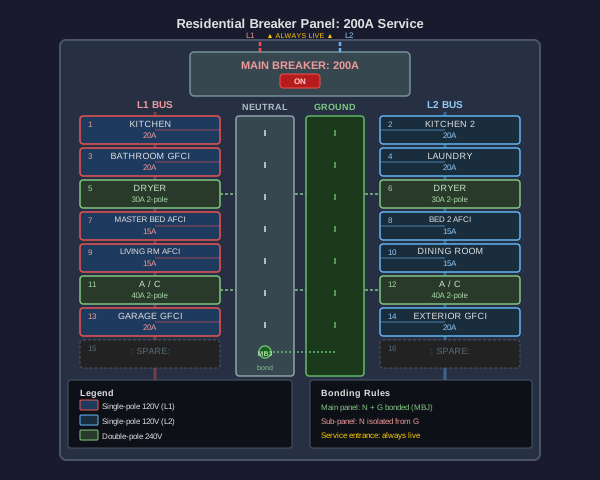
A standard residential load center contains these major components:
Main breaker: a double-pole breaker at the top, typically rated 100A, 150A, or 200A. It disconnects all branch circuits when tripped or switched off. As noted, it does not disconnect service entrance conductors above it.
Bus bars: two metal bars (B1 and B2) run vertically down the panel, one for each hot leg. Branch circuit breakers clip onto these bars. The slots alternate phase down each column: slot 1 is L1, slot 2 is L2, slot 3 is L1, and so on. This alternating pattern means a double-pole breaker spanning two adjacent slots connects to both L1 and L2, giving 240V.
Single-pole breakers occupy one slot, connect to one hot leg, & deliver 120V circuits.
Double-pole breakers span two adjacent slots, connect to both legs, & deliver 240V circuits (or 120/240V for multi-wire branch circuits).
Neutral bus bar: a silver bar where all neutral (white) conductors terminate. In the main service panel, this bar is bonded to the enclosure and to the grounding system via the main bonding jumper.
Ground bus bar: where all equipment grounding conductors (bare or green) terminate. In the main panel, ground and neutral bars are bonded together: this is the one permitted bonding point.
Bus bar rating must equal or exceed the main breaker rating. A 200A panel needs 200A-rated bus bars. Installing a 200A main breaker in a 100A-rated panel is a code violation.
Breaker Types
The Breaker Zoo
Not all breakers work the same way. Knowing the types is essential for code compliance & troubleshooting.
Standard thermal-magnetic breaker: the workhorse. Uses two trip mechanisms: a bimetallic strip that bends under sustained heat (overload protection) and an electromagnet coil that trips almost instantly under a short circuit or high fault current. The thermal element allows temporary overloads (motor startup surges). The magnetic element responds in milliseconds to faults.
AFCI (Arc Fault Circuit Interrupter): detects arc signatures in the electrical waveform. Arcing occurs when wires are damaged, connections are loose, or insulation is breached. An arc that does not draw enough current to trip a standard breaker can still ignite insulation. NEC 2020 requires AFCI protection in virtually all living spaces and bedrooms. AFCI breakers have a test button and a neutral pigtail that connects to the neutral bar.
GFCI breaker: detects a current imbalance of 5mA or more between the hot and neutral conductors. If current is leaving on the hot but not fully returning on the neutral, some is flowing through an unintended path: possibly through a person. The breaker trips in ~25 milliseconds. Protects the entire circuit, unlike a GFCI outlet which only protects downstream devices.
Tandem (duplex) breakers: two single-pole breakers sharing one slot. Useful when a panel is full. Not all panels accept tandems: check the panel's CTL (circuit total limitation) listing and the approved breaker list on the inside of the panel door. Installing an unapproved tandem is a code violation.
CAFCI (Combination AFCI): detects both parallel arcs (hot-to-neutral or hot-to-ground) and series arcs (a break in the hot or neutral conductor). NEC 2020 requires CAFCI in most residential locations. Standard AFCI only detected parallel arcs.
Breaker and Wire Sizing
Wire Gauge & Overcurrent Protection
The single most important rule in panel work: the breaker protects the wire, not the device. A breaker must be sized to the wire gauge it protects. Size it too large & the wire can overheat & start a fire before the breaker notices anything is wrong.
Standard ampacity pairings (NEC 310.15, copper, 60°C or 75°C terminations):
| Wire Gauge | Ampacity | Correct Breaker |
|---|---|---|
| 14 AWG | 15A | 15A max |
| 12 AWG | 20A | 20A max |
| 10 AWG | 30A | 30A max |
| 8 AWG | 40A | 40A max |
| 6 AWG | 55A | 60A max |
80% rule for continuous loads (NEC 210.20): Any circuit that will carry a load for 3 or more continuous hours must not be loaded above 80% of the breaker rating. A 20A breaker serving a continuous load (commercial lighting, EV charger) must not exceed 16A. For non-continuous loads in residential settings, the rule is less commonly enforced, but it applies to any circuit identified as continuous.
Aluminum wiring requires CO/ALR-rated devices & anti-oxidant compound at connections. Aluminum connections with copper-only devices have caused hundreds of fires. Never splice aluminum to copper without an approved connector (AlumiConn or equivalent).
Fuse Box Fundamentals
Before Breakers: Fuse Boxes
Homes built before roughly 1960 often have fuse boxes instead of circuit breaker panels. Fuses provide overcurrent protection through a fusible element: a thin metal strip that melts when current exceeds its rating, permanently opening the circuit. Unlike a breaker, a blown fuse cannot be reset: it must be replaced.
Edison-base screw-in fuses: the most common residential type. They screw into a socket like a light bulb. Available in 15A, 20A, 25A, and 30A ratings. The hazard: any amperage fuse fits any socket, enabling overfusing (putting a 30A fuse where a 15A fuse belongs: exactly the same problem as a breaker-wire mismatch). Type S (tamper-resistant) fuses use different socket adapters for each amperage rating, preventing overfusing. NEC 240.51-240.54 addresses fusestat/type-S requirements.
Cartridge fuses: cylindrical fuses used for larger loads. Ferrule-type cartridges handle 0-60A. Knife-blade cartridges handle 60A and above. Used in fused disconnects, air conditioning whips, and main fuse blocks.
Time-delay (slow-blow) fuses: allow brief current surges above rating for motor startup. A standard fuse would blow on the startup inrush of a refrigerator compressor or water pump. Time-delay fuses tolerate 5-10 second surges while still protecting against sustained overloads.
Hazardous Panel Brands
Federal Pacific Electric (FPE) Stab-Lok: manufactured from the 1950s through 1980s. Independent testing and CPSC investigations found that Stab-Lok circuit breakers have elevated failure rates: they may not trip on overload or short circuit. Documented fire hazard.
Zinsco (and rebranded versions: Sylvania, GTE-Sylvania): bus bar connection design allows breakers to arc and overheat at the bus connection rather than tripping normally.
Aluminum wiring (1965-1973): not a panel brand issue, but any panel in a home from this era with aluminum branch circuit wiring (not service entrance: that is fine) requires inspection of all device connections.
Panel Schedules and Load Calculations
Panel Schedules
A panel schedule is a document (or the directory on the panel door) listing every circuit: breaker number, breaker size, wire gauge, & the loads it serves. An accurate panel schedule is required for permit work & is invaluable for service calls. Always update the panel schedule after adding circuits.
Load Calculations (NEC Article 220)
Before adding service or a large circuit, a load calculation determines whether the existing service has capacity. The basic approach:
Step 1: Calculate general lighting and receptacle load: 3VA per square foot of living space (NEC 220.12).
Step 2: Add appliance branch circuits: 1,500VA per small appliance circuit (NEC 220.52).
Step 3: Add fixed appliances at nameplate rating: HVAC, water heater, dryer, range, etc.
Step 4: Apply demand factors (NEC Table 220.42): Not all loads run simultaneously. First 3,000VA at 100%. Remainder up to 120,000VA at 35%.
Step 5: Divide by 240V to get ampere demand. Compare to service rating.
200A service provides 200A × 240V = 48,000VA of capacity.
EV charger sizing: A 48A Level 2 EVSE draws 48A × 240V = 11,520W continuously. Because it is a continuous load, it requires a 60A circuit (48A = 80% of 60A). You must verify the panel has adequate remaining capacity before adding it.
Working on Panels Safely
Safety Protocols for Panel Work
Panel work carries real risk. The goal is to de-energize everything you can & verify before touching anything.
De-energize and verify: Turn off the main breaker. Then use a non-contact voltage tester (NCVT) to verify each conductor before touching it. Test every wire: hot, neutral, and ground. A lost neutral can energize conductors that appear to be safe. A miswired circuit can surprise you.
Lockout/tagout (LOTO): For commercial work or any time another person could re-energize the circuit, apply a padlock through the breaker handle & hang a tag. No padlock = someone can flip the breaker while you are working.
Service entrance conductors are always live (see Section 1). Even with the main breaker off, the lugs above it are energized. Treat the top of the panel as always-on unless you have personally confirmed the meter has been pulled.
One-hand rule: When working near energized parts, keep one hand in your pocket or behind your back. If you accidentally contact a live conductor with one hand, keeping the other hand away prevents a path through your chest and heart. Ventricular fibrillation requires only 100mA across the heart: well within what household current can deliver.
PPE for residential panels: Safety glasses minimum. For anything over 240V or in switchgear, arc-rated PPE is required per NFPA 70E. A residential 200A panel has a lower arc flash incident energy than 480V switchgear, but it is not zero. Know your PPE requirements before entering any electrical enclosure.
Call 811 before digging. Buried service laterals & feeder conduits are real. One shovel strike on an underground conductor is an electrocution risk & a major utility incident.