The Professional's Remaining Edge
The Work That Does Not Automate Away
Automated systems now generate recommendations and forecasts across the whole economy. They price insurance, flag transactions, rank candidates, predict demand, and suggest a next action on almost every screen a professional touches.
What they do not do is own the decision. A recommendation is a number; a decision is a commitment under uncertainty, made by someone accountable for how it turns out. That commitment is where your edge lives.
This lesson trains five skills that stay yours no matter how good the machinery gets:
1. Expected value and decision trees, and knowing when expected value is the wrong criterion.
2. Calibration and forecasting: making explicit probability estimates, tracking them, improving.
3. Asymmetric risk and optionality: capping downside, telling one-way doors from two-way doors.
4. Debiasing: pre-mortems, base rates, red-teaming, deciding in advance.
5. A decision protocol you can run before a consequential, mostly irreversible professional choice.
The professional supplies calibrated judgment, weighs asymmetric risk, and owns the irreversible calls. A forecast informs that work. It does not replace it.
A Decision You Own
Before we build the toolkit, locate the problem in your own work.
Trees, Averages, and Ruin
Expected Value: The Default, Not The Answer
Expected value (EV) weights each outcome by its probability and sums: EV = sum of (probability times payoff). A decision tree draws the branches so you can compute EV at each node and fold the tree back to the choice at the root.
Worked example. You can take a deal: 70% chance you gain 100, 30% chance you lose 50.
- EV = 0.70 times 100 plus 0.30 times (minus 50) = 70 minus 15 = +55. Positive, so over many repetitions this deal pays.
When EV Is The Wrong Criterion
EV is an average over many trials. It quietly assumes you get to repeat the bet and that no single loss removes you from the game. Two situations break that assumption.
- Ruin risk: if a losing branch ends you (bankruptcy, a death, a lost license, a destroyed reputation), the average is meaningless. You never collect the long-run payoff because a single bad draw takes you off the board. Never risk what you cannot afford to lose, however good the EV.
- Non-repeated bets: for a one-time decision, the average outcome may be an outcome you never actually experience. A bet that is +EV but 90% likely to lose can still be wrong for a choice you make exactly once.
This is why a lottery of small, repeated, survivable bets is played on EV, while a single bet that risks ruin is played on survival first, EV second. An automated system will happily report a positive EV; it is your job to ask whether the losing branch is survivable.
Fold Back the Tree
A subscription company weighs shipping a risky feature now. If it works (60% chance) retention rises, worth 2 million dollars. If it fails (40% chance) a defect triggers refunds and churn costing 500 thousand dollars. There is a wrinkle: the founder personally guaranteed the runway, so a 500 thousand dollar loss this quarter forces insolvency. A third option exists: run a 4-week beta first, costing 150 thousand dollars, which reveals whether the feature works before any full launch.
Are Your 90s Really 90s?
A Probability You Can Be Graded On
A calibrated forecaster is one whose stated probabilities match reality. When you say '90% confident' across many predictions, close to 90% of them should come true. Calibration is not about being right more often; it is about your confidence meaning what it says.
Track, Then Improve
The only way to know your calibration is to write predictions down with an explicit probability, then score them against outcomes. The Brier score makes this concrete: for each forecast, take the probability you assigned to what actually happened, and measure squared error against the outcome coded as 1 (happened) or 0 (did not).
- Predict 0.90, event happens (outcome 1): error is (0.90 minus 1) squared = 0.01. Small: good.
- Predict 0.90, event does not happen (outcome 0): error is (0.90 minus 0) squared = 0.81. Large: you were confidently wrong.
Average these across many forecasts. Lower Brier is better. The score punishes confident mistakes hardest, which is exactly the habit that hurts professionals most.
The discipline: state a number, log it, check it, adjust. Systematically over the line means you are overconfident and should widen your estimates; systematically under means you are underconfident and can commit harder. Automated forecasts can be scored the same way, which is how you learn when to trust them and when to override.
Grade the Forecaster
An analyst repeatedly tells the team 'I am 90% sure this will land on time.' Over a quarter she made 40 such predictions at that stated 90% confidence. 26 of them came true.
One-Way Doors and Two-Way Doors
Not All Mistakes Cost The Same
A decision has asymmetric risk when the downside and the upside are not mirror images. Capping the downside while keeping the upside open is the whole game. A capped-loss, uncapped-gain position can be wrong most of the time and still win overall.
Optionality is the right, without the obligation, to act later once you know more. The 4-week beta two sections back was optionality: a small, known cost that keeps the big, irreversible commitment open until the uncertainty resolves.
Reversible-Fast, Irreversible-Slow
A useful frame separates decisions by how hard they are to undo:
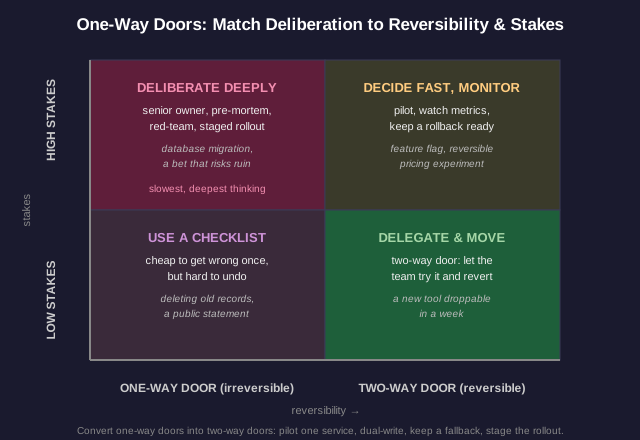
- Two-way doors are reversible. Walk through, and if you dislike what you find, walk back out at low cost. Decide these fast and delegate them. Deliberating for weeks over a choice you can reverse in an afternoon is its own kind of waste.
- One-way doors are irreversible or expensive to undo. These deserve deep deliberation, senior ownership, and safeguards.
The quadrant above crosses reversibility with stakes. Match deliberation depth to the square you are in. The costliest professional errors come from treating a one-way door like a two-way door, rushing an irreversible call.
The strongest move is often to convert a one-way door into a two-way door: pilot on one service, dual-write to old and new systems, keep the old path as a fallback, stage the rollout. You buy back reversibility so a wrong call stays survivable.
Classify and Convert
An engineering director faces two choices this quarter. Choice 1: migrate the primary database to a new engine, a months-long project touching every service and painful to reverse once live. Choice 2: adopt a new internal code-review tool the team could drop within a week if it disappoints.
Tools Against Your Own Mind
The Room Is Often Wrong Together
Individually and in groups, professionals share predictable biases: optimism about timelines, overweighting the vivid story in front of them, and a drift toward whatever the group already favors. Debiasing techniques are cheap procedures that counter these before they cost you.
- Pre-mortem: imagine it is later and the decision failed. Working backward, list every reason it went wrong. This surfaces risks that enthusiasm hides and counters the planning fallacy and groupthink.
- Base rates and the outside view: instead of reasoning only from the inside of this case, ask how similar efforts actually turned out. If most comparable projects ran 50% over schedule, your project probably will too, whatever the inside story says. Counters inside-view optimism.
- Red-teaming: assign someone to argue the opposite case in earnest and to attack the plan. Counters confirmation bias and the comfort of agreement.
- Deciding in advance: set the rule and the kill criteria before you are emotionally committed and before the sunk costs pile up. 'If by month 3 we have not hit X, we stop.' Counters escalation of commitment.
Each technique is a small ritual with an outsized payoff, precisely because it fights a bias you cannot feel from the inside.
Debias a Live Decision
Your team is about to greenlight a 9-month platform rebuild. The room is unanimous and excited, and leadership wants to commit today.
Run the Whole Toolkit
One Protocol, Every Consequential Call
You now hold the full kit. A protocol strings the pieces into a repeatable order you can run before any consequential, mostly irreversible professional choice:
1. State an explicit probability you own. Not the machine's number, yours: what do you believe the odds are, and why?
2. Sketch expected value, then check for ruin. Weight the outcomes, but before you act, ask whether the losing branch is survivable and whether this is a one-shot bet.
3. Classify reversibility. One-way door or two-way door? Match the depth of your deliberation to the answer, and try to convert one-way doors into two-way doors.
4. Debias. Run at least one pre-mortem, base-rate, or red-team pass against your own enthusiasm.
5. Pre-commit a decision rule and kill criteria. Decide now what evidence would make you stop or reverse, before sunk costs capture you.
Where an automated system supplies a recommendation or forecast, it feeds step 1 and step 2. You still own steps 3 through 5, and you own the override.
Write Your Protocol
Pick a concrete, consequential, mostly irreversible choice a professional in your field faces: accepting a role, signing a multi-year vendor, launching a product, taking a large financial position. Assume an automated system has handed you a recommendation and a forecast for it.
What You Carry Forward
The Skills That Stay Yours
You built a toolkit for deciding under uncertainty:
- Expected value and decision trees, and the discipline to override EV when a losing branch risks ruin or the bet happens only once.
- Calibration: stating explicit probabilities, scoring them (Brier, lower is better), and training your confidence to mean what it says.
- Asymmetric risk and optionality: capping downside, telling one-way doors from two-way doors, and converting the irreversible into the staged.
- Debiasing: pre-mortems, base rates, red-teaming, and deciding in advance.
- A protocol that runs all of it before a consequential call.
Automated systems will keep getting better at recommendations and forecasts. None of that removes the need for someone to supply calibrated judgment, weigh asymmetric risk, and own the irreversible decision. That someone is the professional. Now you have the toolkit that makes the ownership real.